
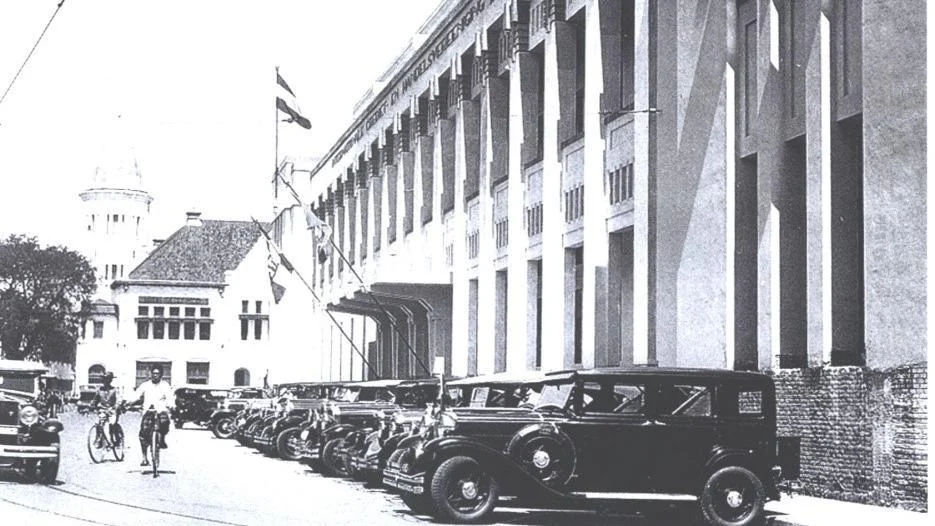
Standing proudly near the historic Red Bridge (Jembatan Merah) in Surabaya, Gedung Internatio—officially known in the colonial era as Internationale Crediten Handelvereeniging—remains one of the most poignant architectural and historical landmarks in Indonesia’s City of Heroes. While modern travelers often view it simply as a relic of a bygone era nestled within Surabaya’s revitalized Old Town district, the building holds a profound place in the collective memory of the Indonesian national revolution. It was here, within the imposing walls of this former trading house, that a volatile convergence of colonial commerce, post-World War II geopolitics, and fierce local resistance culminated in an event that permanently altered the trajectory of Indonesia’s fight for independence: the dramatic death of British Brigadier General Aubertin Walter Sothern Mallaby on October 30, 1945.
To fully understand the weight of the events that unfolded at Gedung Internatio, one must look beyond its revolutionary significance and examine its origins. Long before it became a battleground for Indonesian nationalists and British occupation forces, the structure served as a vital nerve center for the colonial economy of the Dutch East Indies. Constructed between 1927 and 1931, the building was designed by the renowned Dutch architect Frans Johan Louwrens Ghijsels, a prominent figure associated with the Algemeen Ingenieurs en Architecten Bureau (AIA). Ghijsels left an indelible mark on the architectural landscape of the archipelago, having also designed iconic structures such as the Onder de Bogen Hospital—now known as Panti Rapih Hospital—in Yogyakarta, and the grand Jakarta Kota Railway Station.
Commissioned during a period of intense commercial expansion, Gedung Internatio was strategically positioned at the intersection of Heerenstraat and Willemsplein within the bustling trade district surrounding Jembatan Merah. Surabaya, serving as the premier port city and economic powerhouse of East Java, attracted numerous European enterprises seeking to capitalize on the region’s rich agricultural and trading commodities. The Internatio firm itself was a major player in the colonial financial ecosystem, dealing in investment management, import-export operations, and the facilitation of goods that fueled the Dutch mercantile machine. The imposing facade and robust construction of the building reflected the confidence and permanence of colonial authority in the region. However, the sweeping winds of the Second World War and the subsequent declaration of Indonesian independence on August 17, 1945, would swiftly upend this commercial stability, transforming corporate boardrooms into tactical military outposts.
The Chronology of Escalation: From Allied Arrival to Fatal Standoff
The historical trajectory of Gedung Internatio shifted dramatically on October 25, 1945, when British forces—operating under the umbrella of the Allied Forces Netherlands East Indies (AFNEI)—landed in Surabaya. Initially mandated to disarm Japanese troops, repatriate Allied prisoners of war, and maintain public order, the British quickly found themselves thrust into a complex and hostile political landscape. Armed Indonesian youths, known as pemuda, along with newly formed local militias and security bodies, viewed the arrival of foreign troops with deep suspicion, fearing an imminent return of Dutch colonial rule under the guise of Allied liberation.
Upon securing their initial positions in the city, the British military command, led locally by Major V. Gopal, occupied Gedung Internatio. The choice of the building was tactical; its sturdy structure, strategic location near the port and primary river crossings, and expansive layout made it an ideal command post. However, placing a foreign military garrison in the heart of Surabaya’s most politically charged commercial district proved to be a severe miscalculation. The presence of British troops inside Gedung Internatio quickly became an intolerable provocation to the local populace.
By late October, tensions reached a boiling point. Armed Indonesian nationalists surrounded Gedung Internatio, trapping the British garrison inside. The standoff threatened to ignite an all-out war prematurely, prompting the highest levels of the newly formed Indonesian government to intervene. On October 29 and 30, 1945, President Sukarno, Vice President Mohammad Hatta, and Minister Amir Sjarifuddin flew to Surabaya from the capital to defuse the escalating crisis. Accompanied by local leaders, including Doel Arnowo—who had been elected Chairman of the Indonesian National Committee (KNI) for the Surabaya Residency on August 28, 1945—the national leadership engaged in high-stakes negotiations with the British commanders.
A Contact Bureau was established to facilitate communication between the opposing sides, and local figures like Doel Arnowo played a pivotal role in bridging the gap between the revolutionary masses and the British military. Arnowo worked tirelessly to disseminate news of a newly brokered ceasefire agreement, coordinate with regional leaders such as East Java Governor R.M.T.A. Soerjo, and manage the chaotic flow of information surrounding the besieged Gedung Internatio. Despite these frantic diplomatic efforts, confusion on the ground remained pervasive. Miscommunications between scattered Indonesian fighters and British patrols near the building prevented the ceasefire from taking immediate effect.
Amidst the swirling chaos, gunfire erupted around Gedung Internatio on the afternoon of October 30, 1945. It was in the midst of this firefight that Brigadier General Mallaby, the commander of the 49th Infantry Brigade, met his end. While inspecting the situation and attempting to enforce the tenuous ceasefire near the building, Mallaby was killed. Accounts regarding the exact sequence of events and the identity of the shooter remain a subject of historical debate, but the immediate impact of his death was unambiguous and catastrophic for diplomatic relations. The killing of a senior British officer dealt a severe blow to any remaining hopes of a peaceful resolution, hardening British resolve and directly precipitating the catastrophic Battle of Surabaya on November 10, 1945—a defining moment of resistance that cemented the city’s status as the City of Heroes.
The Diplomatic Effort and the Role of Local Leadership
While the physical confrontation at Gedung Internatio is often remembered primarily for its violence, historians emphasize that the episode equally highlights the complex interplay between armed struggle and civilian diplomacy during the Indonesian National Revolution. The events surrounding the building demonstrated that the defense of the nascent republic was not waged exclusively by fighters on the front lines, but also by administrators, negotiators, and civic leaders who sought to navigate the treacherous waters of international diplomacy.
Figures like Doel Arnowo exemplified this dual front of resistance. As the head of the KNI in Surabaya, Arnowo was tasked with organizing local administrative bodies, mobilizing public support, and managing the severe socio-economic fallout of the war. When the British forces occupied Gedung Internatio, Arnowo utilized his administrative network and channels within the Contact Bureau to engage directly with the occupier. His consultations with President Sukarno ensured that local resistance efforts remained aligned with the broader strategic goals of the central government in Jakarta, even as communication lines were frequently severed by ongoing skirmishes.
Furthermore, Arnowo assisted Governor R.M.T.A. Soerjo in broadcasting crucial appeals for calm to the panicked citizenry of Surabaya, striving to prevent panic while upholding national dignity. This diplomatic engagement underscored a fundamental reality of the revolution: Indonesian leaders were acutely aware of the global political optics. They understood that demonstrating a willingness to negotiate, even while fiercely defending territorial sovereignty, was essential for gaining international sympathy and eventual diplomatic recognition from Western powers and the United Nations.
Post-Revolutionary Transformation and Urban Evolution
In the decades following the tumultuous events of 1945, Surabaya underwent profound urban and socio-economic transformations, and the area surrounding Gedung Internatio evolved in tandem with the city’s modern needs. For years following the conflict, the space directly in front of the historic building served various civic purposes, including functioning as a bustling terminal for city buses and public transportation routes that connected the older districts with the expanding metropolitan areas.
As part of Surabaya’s urban renewal initiatives in the late 20th and early 21st centuries, municipal authorities sought to reclaim and revitalize the historic core of the city, commonly designated as the Old Town (Kota Lama) district. The bustling transport terminals were relocated, and the cleared land was transformed into landscaped public open spaces designed to honor the city’s rich heritage. Today, the area immediately surrounding the site is integrated into Taman Jayengrono, a vibrant public park that connects seamlessly with nearby historical markers such as the Red Bridge Monument and the Surabaya History Park. This urban redesign allows contemporary residents and visitors to walk through spaces that once echoed with the marching boots of colonial traders and revolutionary fighters alike.
Despite the surrounding infrastructural changes, Gedung Internatio itself has maintained its architectural integrity while adapting to modern commercial realities. Management of the historic property was eventually assigned to state-owned enterprises, specifically PT Tjipta Niaga (later operating under PT Aneka Niaga). Over the years, parts of the building have been utilized for various commercial and industrial purposes, including operating as printing facilities. While it does not function as an open museum in the traditional sense, its imposing facade continues to command attention, serving as an unyielding physical link to the past.
Broader Implications and the Historiography of the Indonesian Revolution
The enduring significance of Gedung Internatio extends far beyond its local footprint in East Java; it serves as a critical case study in the historiography of decolonization. The events that transpired at the building in October 1945 illustrate the inherent instability of the transitional period between the surrender of Japanese forces and the re-establishment of Allied control. It exposed the immense difficulty of managing armed populations who viewed any foreign military presence as an existential threat to their hard-won sovereignty.
From a strategic perspective, the death of General Mallaby inside the orbit of Gedung Internatio fundamentally altered British policy in Indonesia. Prior to the incident, British commanders had entertained hopes of maintaining a relatively neutral or mediating posture between the returning Dutch authorities and the Indonesian republicans. Mallaby’s death, perceived by the British military establishment as an unacceptable breach of military honor and protocol, provoked a powerful institutional reaction. The subsequent military buildup culminated in the issuance of an ultimatum by Major General Eric Mansergh on November 9, demanding the unconditional surrender of all Indonesian armed personnel in Surabaya—a challenge that the city’s defenders famously rejected, leading directly to the immense bloodshed of November 10.
Analyses by military historians suggest that the standoff at Gedung Internatio also highlighted the tactical vulnerabilities of conventional military forces operating within hostile urban environments. The British garrison, despite its superior firepower and professional training, found itself paralyzed and besieged within a single administrative building due to the sheer volume and fervor of mobilized local militia units supported by sympathetic urban populations. This dynamic foreshadowed the broader tactical realities that European colonial powers would face throughout the post-war era of decolonization across Asia and Africa.
Preserving the Memory of the City of Heroes
Today, as Surabaya continues its rapid modernization as a major industrial, commercial, and educational center in Indonesia, the preservation of landmarks like Gedung Internatio remains vital for maintaining historical continuity. Local government bodies, including the Surabaya City Culture, Youth, Sports, and Tourism Department (Disbudporapar), frequently emphasize the educational value of these architectural treasures. By integrating structures like Gedung Internatio into official heritage tourism trails, the city encourages younger generations to engage directly with the physical sites where the foundational sacrifices of the nation were made.
The narrative of Gedung Internatio is emblematic of Surabaya’s broader identity as the City of Heroes. It encapsulates a complex narrative arc: from the gleaming ambitions of corporate capitalism during the Dutch colonial zenith, to the desperate diplomatic negotiations of October 1945, to the tragic flashpoint that catalyzed an entire nation’s armed resistance. As pedestrians traverse the revitalized streets of the Old Town, passing by the shadows of Jembatan Merah and the stately walls of the former Internatio building, they are reminded that the freedoms enjoyed in modern Indonesia were forged through a combination of unwavering physical bravery, strategic diplomacy, and the enduring resilience of a people determined to chart their own destiny.
