

A nationwide 24-hour general strike paralyzed critical sectors across Spain on Wednesday, November 11, 2026, as hundreds of thousands of workers downed tools to protest a deepening housing crisis that has rendered homeownership and affordable rentals virtually unattainable for the working class. Organized by major trade unions, the mass mobilization served as a stark declaration of discontent against skyrocketing property values, stagnant wages, and the failure of successive legislative frameworks to guarantee adequate housing as a fundamental human right.
The industrial action disrupted transportation, commerce, and logistics networks in major urban centers, most notably in Madrid, where demonstrators staged volatile picket lines at the entrance of Mercamadrid, the city’s primary wholesale fresh produce market. As the countdown to Spain’s high-stakes snap general election, scheduled for November 29, 2026, enters its final weeks, this unprecedented labor action has thrust the socioeconomic crisis directly into the national political spotlight, forcing candidates to address the systemic structural failures plaguing the country’s urban housing markets.

The Anatomy of a National Crisis: Unaffordable Housing and Stagnant Wages
The root causes of the November 2026 strike run deep within the post-pandemic economic landscape of Southern Europe. Spain, like many advanced economies, has witnessed a staggering divergence between consumer price indexes, real wages, and real estate valuations. Over the past decade, property prices and rental rates in metropolitan hubs such as Madrid, Barcelona, Valencia, and Málaga have surged exponentially, fueled by a complex cocktail of post-pandemic inflation, tourism-driven short-term rentals, foreign speculative capital, and a chronic shortage of social housing infrastructure.
According to socioeconomic data compiled by labor unions and housing advocacy groups ahead of the strike, the average Spanish worker now spends well over 50 percent of their net monthly income merely to secure basic shelter. In urban centers, this figure frequently surpasses 60 to 70 percent, leaving households with razor-thin margins to cover basic necessities such as utilities, food, and healthcare.
Despite marginal statutory minimum wage increases implemented by the central government in recent years, purchasing power has eroded significantly. Trade union representatives argue that nominal wage growth has been completely neutralized by inflation and real estate inflation. Consequently, full-time workers across sectors—ranging from hospitality and logistics to manufacturing and public services—find themselves structurally excluded from the housing market, unable to secure mortgages or even qualify for standard long-term residential lease agreements without severe financial precarity.
Chronology of the Strike: Tensions at Mercamadrid and Nationwide Disruptions
The 24-hour mobilization officially commenced at midnight on Wednesday, November 11, 2026, following months of escalating friction between labor organizations, corporate federations, and government policymakers.
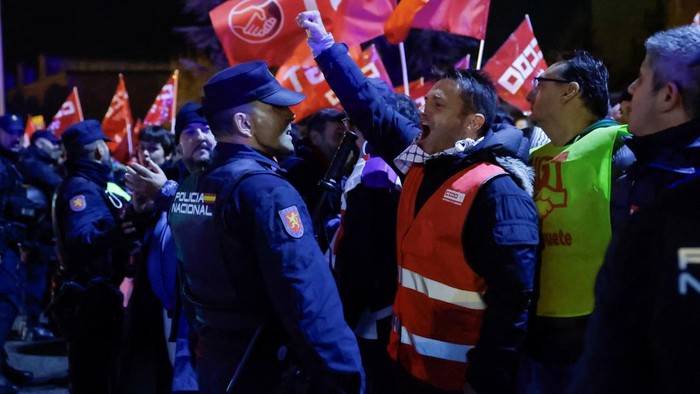
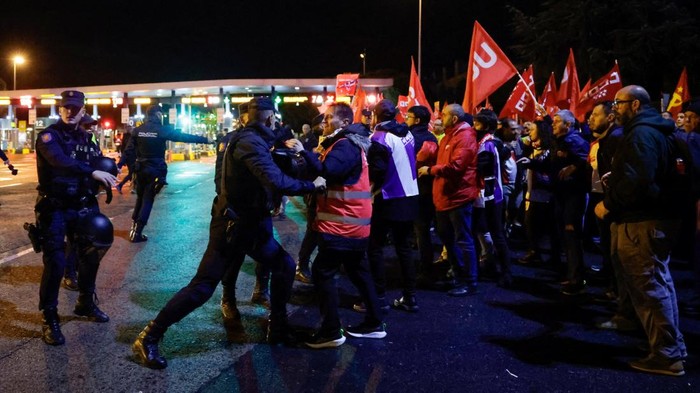
In the early hours of the morning, trade union members and labor activists deployed in coordinated waves to strategic logistical bottlenecks. The most intense focal point of the day unfolded at the gates of Mercamadrid, the sprawling central wholesale food market that supplies fresh produce to millions of consumers throughout central Spain. Activists established robust picket lines aimed at halting the distribution of goods to exert maximum economic pressure on commercial supply chains.
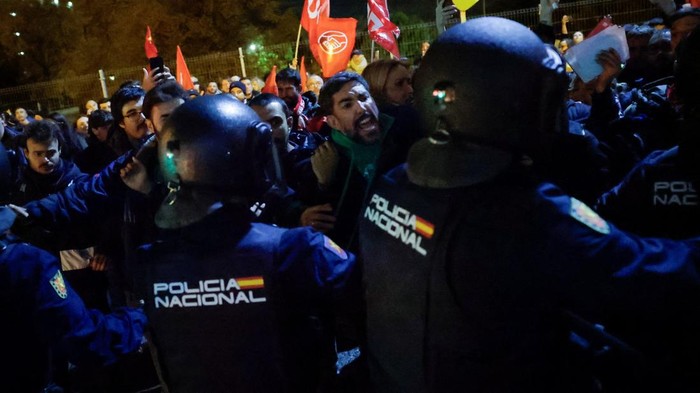
The atmosphere at Mercamadrid quickly escalated into a tense standoff. Heavily equipped units of the National Police (Policía Nacional) were deployed in large numbers to secure the perimeter, maintain public order, and ensure that commercial vehicles could ingress and egress the facility. Throughout the morning, several heated verbal confrontations erupted between union picketers and law enforcement officers. While minor skirmishes and pushing matches were reported, security forces maintained a firm containment strategy, and sporadic arrests were avoided through tense negotiations on-site.
Beyond the capital, the strike footprint was visible nationwide. Public transportation networks experienced skeleton services, manufacturing plants reported significant absenteeism, and commercial districts observed lowered shutters as workers joined rallies, marches, and neighborhood assemblies. The geographic breadth of the stoppage underscored that the housing affordability crisis is no longer confined to affluent urban enclaves, but has metastasized into a universal burden affecting Spain’s entire demographic fabric.
The Political Catalyst: The Impending Snap Election of November 29
The timing of the general strike—occurring precisely eighteen days before the crucial snap general election on November 29, 2026—was engineered by labor leadership to maximize political leverage. The snap election itself was triggered earlier in the year following legislative gridlock over fiscal budgets and housing reform packages, creating a volatile political vacuum.
For months, labor confederations have accused political parties across the ideological spectrum of complacency, arguing that electoral platforms have historically treated housing as a speculative asset class rather than a social utility. By halting the nation’s economic engine for a full day, unions intended to shatter the political class’s complacency, demanding immediate, binding commitments from all political contenders.

Key demands articulated by the striking workers include:
- Aggressive Wage Realignment: A legally mandated adjustment of collective bargaining agreements to tie minimum and median wages directly to local real estate and rental indices.
- Strict Rent Controls: The implementation of nationwide, enforceable caps on residential rental prices, particularly in designated "stressed housing markets."
- Public Housing Expansion: A massive, federally funded expansion of public and social housing stock to permanently increase the availability of non-market affordable rentals.
- Speculative Restrictions: Severe legislative curbs on corporate landlords, multi-property speculative investors, and the conversion of long-term residential properties into unregulated tourist accommodations.
Official Responses and Institutional Reactions
The response from political authorities and business associations to the November 11 strike has been multifaceted, reflecting deep polarization within Spanish society.
Government spokespersons issued statements acknowledging the legitimate grievances of the working class regarding the cost of living and housing accessibility. Representatives from the ruling administration emphasized that historic investments have been channeled into public housing initiatives and rental assistance subsidies over the preceding legislative term. However, critics point out that these measures have been bogged down by bureaucratic delays, regional jurisdiction disputes, and a lack of enforcement capacity.
Conversely, business federations and employers’ organizations strongly condemned the 24-hour general strike, arguing that industrial shutdowns inflict irreversible damage on an already fragile economic recovery. Industry leaders asserted that forced wage hikes decoupled from productivity metrics, coupled with heavy-handed market interventions like rent controls, would ultimately backfire by discouraging private real estate development and exacerbating supply shortages.
Broader Economic and Sociological Implications
The November 2026 Spanish general strike serves as a cautionary bellwether for advanced industrial economies grappling with post-industrial urbanization and wealth inequality. The core conflict in Spain mirrors systemic urban crises unfolding simultaneously in major global cities from London and New York to Berlin and Toronto.
Economists analyzing the long-term implications of the strike warn that sustained failure to resolve structural housing deficits could trigger severe demographic consequences. These include accelerated brain drain, plummeting birth rates as young families delay milestones due to financial insecurity, and long-term systemic risks to consumer-driven economic growth as disposable incomes are perpetually siphoned off by landlords and mortgage lenders.

As Spain marches toward the pivotal ballot boxes on November 29, 2026, the events of this historic 24-hour stoppage have permanently altered the electoral calculus. Whether the incoming administration will possess the political capital and institutional will to dismantle entrenched real estate interests and restore economic dignity to the Spanish workforce remains the defining question of the nation’s contemporary political era.

