
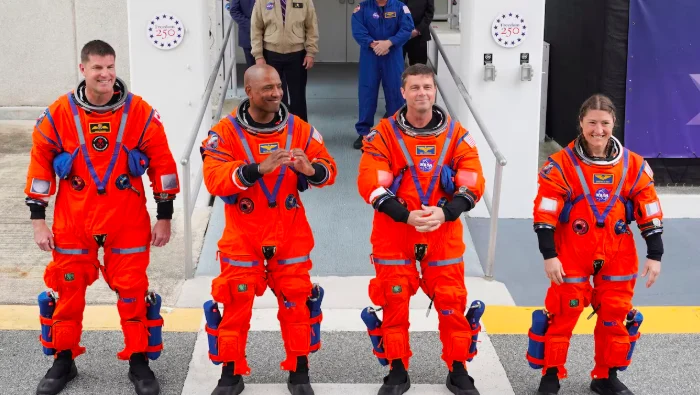
Jakarta, Indonesia – The recent public appearance of the Artemis II astronauts, clad in vibrant orange launch and entry suits for their upcoming journey to the Moon, has drawn considerable attention and sparked curiosity regarding the rationale behind space suit coloration. Far from being a mere aesthetic choice, the distinctive hue of these suits, known as ‘International Orange,’ is a calculated decision rooted deeply in the principles of crew safety and mission visibility, particularly in potential post-landing recovery operations. This choice marks a significant chapter in the long and varied history of space suit design, which has seen materials, technologies, and colors evolve dramatically over decades, each iteration reflecting the changing demands and lessons learned from humanity’s ambitious venture into space. The Artemis II mission, slated to carry four astronauts on a lunar flyby, represents a critical step in NASA’s broader Artemis program, aiming to return humans to the lunar surface. The safety of its crew—Commander Reid Wiseman, Pilot Victor Glover, Mission Specialist Christina Koch, and Canadian Space Agency astronaut Jeremy Hansen—remains the paramount concern, influencing every aspect of mission planning, including their protective gear.
The specific shade of orange employed for the Artemis II suits is not arbitrary. It is the highly recognizable #FF4F00, a color precisely defined within the aerospace and maritime industries for its unparalleled visibility against most natural backgrounds. The primary driver for its adoption in the Artemis program is straightforward: enhanced visibility for search and rescue operations. Imagine a scenario where the Orion spacecraft, after its return from the Moon, executes a water landing—a common procedure for capsule-based missions. Whether it’s in the vast expanse of the Atlantic or Pacific Ocean, locating a crew capsule and its occupants quickly and efficiently is paramount. A bright, high-contrast color like International Orange dramatically improves the chances of visual detection by rescue teams, aircraft, and ships, significantly reducing search times in critical situations. This is especially vital when factoring in potential challenging weather conditions or vast search areas.
Historically, the journey to the orange suit has been a fascinating chronicle of engineering innovation, scientific discovery, and tragic lessons. Early pioneers of spaceflight wore suits vastly different from those seen today, reflecting the nascent understanding of the extreme conditions of space and the evolving priorities of mission profiles.
The Dawn of Spaceflight: Metallic Silvers and Thermal Control (Mercury Era)
In the nascent days of human spaceflight, particularly during Project Mercury in the late 1950s and early 1960s, astronauts wore pressure suits that bore a striking metallic, silvery appearance. These were adaptations of the U.S. Navy Mark IV full-pressure suit, initially designed for high-altitude military aviators. Crafted from multiple layers, including a rubberized inner bladder and an outer layer of nylon coated with aluminum, these suits served a crucial purpose: thermal control. The reflective aluminum surface was intended to bounce off solar radiation, helping to regulate the astronaut’s body temperature within the confines of the small, unpressurized Mercury capsules. While these suits lent a distinctive, futuristic aesthetic that heavily influenced 1960s science fiction, their primary function was to protect astronauts from a sudden loss of cabin pressure, providing a self-contained environment for breathing and survival. Mobility was limited, but the primary concern was survival within the capsule. The suits, while iconic, represented the initial, cautious steps into human spaceflight, where the immediate threats of vacuum and temperature extremes were the focus.
Stepping Out: White for EVAs and Lunar Exploration (Gemini and Apollo)
The Gemini program, which followed Mercury, introduced the capability for Extravehicular Activity (EVA), or spacewalks. This necessitated a fundamental shift in suit design. With astronauts venturing outside the spacecraft into the direct glare of unfiltered sunlight and the cold of shadow, thermal regulation became even more critical. The metallic silver suits, while effective for in-cabin thermal control, were not optimized for the diverse thermal environments encountered during spacewalks. Thus, the color of choice transitioned to white. White, being highly reflective across the electromagnetic spectrum, proved superior in radiating heat away from the astronaut and reflecting solar radiation, preventing overheating during prolonged exposure to direct sunlight.
This shift continued with the Apollo program, which aimed to land humans on the Moon. The Apollo A7L space suit, arguably one of the most iconic pieces of human engineering, was predominantly white. These suits were far more complex than their Mercury predecessors, featuring multiple layers of fabric, insulation, and pressure bladders, all designed to protect astronauts from the vacuum of space, micrometeoroids, and extreme temperature fluctuations ranging from over 250°F (120°C) in sunlight to -250°F (-150°C) in shadow. The white outer layer, often made of Beta cloth (a fire-resistant, Teflon-coated fiberglass fabric), was essential for maintaining a stable internal temperature during lunar EVAs. The Apollo suits also incorporated life support systems carried in a backpack, enabling extended periods of independent operation on the lunar surface. The visual purity of white became synonymous with the lunar explorers, embodying the clean, scientific endeavor of reaching another celestial body.
Functional Aesthetics: Skylab and Early Shuttle Suits
Following the Apollo era, the Skylab program, America’s first space station, continued the tradition of white space suits for EVAs, but with subtle variations. Skylab suits sometimes featured accents of blue and red, colors that aligned with the contemporary NASA logo and branding, adding a touch of visual flair to the otherwise utilitarian design. These suits were primarily designed for on-orbit maintenance and repair, reflecting the shift towards long-duration missions in Earth orbit.
The Space Shuttle era introduced new challenges and design philosophies. Early Space Shuttle missions utilized what were known as Ejection Escape Suits (EES), often in a distinctive mustard yellow color. These suits were worn by astronauts during launch and re-entry phases, providing protection in the event of a cabin depressurization and aiding in crew escape from the orbiter. However, the true catalyst for the adoption of orange suits emerged from a profound tragedy.
The Challenger Disaster and the Birth of International Orange (Shuttle Era)
The pivotal shift to the orange launch and entry suits occurred directly in the wake of the Space Shuttle Challenger disaster on January 28, 1986. The Challenger disintegrated 73 seconds after liftoff, killing all seven crew members, including teacher Christa McAuliffe. The devastating incident prompted a comprehensive re-evaluation of all NASA safety protocols and equipment. A key takeaway from the post-Challenger analysis was the critical need for enhanced visibility for crew members in the event of an emergency landing or ditching, particularly in the ocean.
Prior to Challenger, the focus for launch/entry suits was more on in-cabin survival and limited escape capabilities. The disaster underscored that while escape might not always be possible, maximizing the chances of locating and recovering crew members, even in a worst-case scenario, was paramount. This led to the development and implementation of the Advanced Crew Escape Suit (ACES), colloquially known as the "Pumpkin Suit" due to its striking orange color. The ACES suit was designed to be highly visible against both blue ocean waters and green landmasses, significantly improving the chances of detection by search and rescue teams.
The ACES suit, a full-pressure garment, was equipped with several critical features for post-landing survival, including a parachute, flotation devices, a survival kit, and communications equipment. It protected astronauts from depressurization, hypothermia in cold water, and provided a visible beacon for rescuers. This move cemented the International Orange color as the standard for NASA’s launch and re-entry suits throughout the remainder of the Space Shuttle program. The choice was a direct, tangible consequence of learning from tragedy, placing crew survivability and recovery at the absolute forefront of design considerations.
Post-Shuttle Era: Commercial Diversification and Enduring Principles
After the retirement of the Space Shuttle fleet in 2011, NASA’s human spaceflight capabilities for low-Earth orbit transitioned to reliance on Russian Soyuz spacecraft and, more recently, commercial partners. This period saw a diversification in launch suit designs and colors. Russian Soyuz missions, which transport astronauts to the International Space Station (ISS), typically use the Sokol-KV2 pressure suit, which is predominantly white with blue accents. These suits are designed for in-capsule protection during launch, docking, and re-entry.
With the advent of NASA’s Commercial Crew Program, private companies like SpaceX and Boeing developed their own crew transportation systems and corresponding space suits. SpaceX, known for its sleek, futuristic aesthetic, designed custom-fitted white suits for its Dragon capsule astronauts. These suits are lightweight, feature integrated gloves, boots, and communications, and are designed to be visually appealing while meeting critical safety requirements for in-cabin pressure protection. Boeing, for its Starliner capsule, opted for a distinctive blue launch and entry suit. Both commercial partners, while choosing different colors, adhere to strict safety standards, ensuring crew protection against depressurization and providing essential life support during critical mission phases. The color choice for these commercial suits often reflects corporate branding while still meeting the functional requirement of visibility, albeit potentially less overtly than International Orange.
Artemis Returns to Orange: A Legacy of Safety for Lunar Missions
For the Artemis program, NASA has consciously returned to the proven efficacy of International Orange for its Orion Crew Survival System (OCSS) suits. These suits, worn by the Artemis II astronauts, are a direct evolution of the ACES suit and are specifically designed to interface with the Orion spacecraft’s systems. The decision to use orange is not merely a nostalgic nod to the Shuttle era but a pragmatic choice based on the detailed analysis of Orion’s mission profile and potential abort scenarios.
The Orion spacecraft is equipped with multiple sophisticated abort systems designed to separate the crew capsule from the Space Launch System (SLS) rocket in the event of an anomaly during launch or ascent. These abort scenarios can result in the Orion capsule splashing down in various locations. For instance, some scenarios could lead to a relatively close splashdown in the Atlantic Ocean, near the Florida coast, while others might send Orion to the eastern Atlantic, potentially near Ireland, the United Kingdom, Spain, or Morocco. Another scenario involves an orbital abort that could necessitate re-entry and splashdown in the vast Pacific Ocean.
In all these potential water landing scenarios, the critical factor remains the swift and successful recovery of the crew. The vivid International Orange of the OCSS suits ensures maximum visibility for the joint search and rescue teams—comprising elements from the U.S. Navy, Coast Guard, Air Force, and international partners—that would be deployed. The color provides a stark contrast against the blue water, whitecaps, and even coastal environments, making the astronauts easier to spot from aircraft or ships, particularly in challenging sea states or limited visibility conditions.
Beyond Color: The Engineering Marvel of Modern Space Suits
While color is a prominent feature, it is just one aspect of the intricate engineering that goes into modern space suits. The OCSS suits are complex, multi-layered garments designed to provide a miniature, mobile life support system. They are full-pressure suits, meaning they can be pressurized to maintain a habitable environment for the astronaut even if the spacecraft cabin loses pressure. Key features include:
- Pressure Garment: Prevents ebullism (the formation of gas bubbles in bodily fluids due to low pressure) and provides a stable atmosphere.
- Life Support Connections: Umbilical lines connect to the spacecraft’s environmental control system for oxygen, cooling water, and communication.
- Thermal Control: Layers of insulation and a liquid cooling garment worn beneath the suit help regulate body temperature.
- Mobility: While pressure suits inherently restrict movement, modern designs incorporate bellows and specialized joints to maximize flexibility for operating controls and performing necessary tasks.
- Integrated Communications: Microphones and speakers within the helmet facilitate clear communication with mission control and fellow crew members.
- Survival Gear: Small survival kits, signaling devices, and flotation aids are integrated or easily accessible for post-landing scenarios.
The design philosophy behind the OCSS, like its predecessors, balances the need for robust protection with the practicalities of a mission profile. For Artemis II, which is an in-cabin mission (no planned EVAs), the primary focus of the suit is launch, abort, and re-entry protection, with an emphasis on water landing survival.
Implications and Future Directions
The continuous evolution of space suit design, from the Mercury era’s reflective silvers to Artemis II’s striking International Orange, underscores a fundamental truth about space exploration: safety is non-negotiable. Each change, each new material, and each design iteration represents lessons learned, technological advancements, and a relentless pursuit of protecting the most valuable asset in space—the human crew.
The choice of International Orange for Artemis II is a powerful symbol of this commitment to safety. It is a visual reminder of the rigorous planning, the extensive testing, and the historical understanding that informs every aspect of human spaceflight. As humanity sets its sights on returning to the Moon and eventually venturing to Mars, the design of space suits will continue to evolve, incorporating new materials, advanced life support systems, and perhaps even new colors tailored to the unique demands of future deep-space missions. What remains constant, however, is the foundational principle that the suit is the astronaut’s last line of defense, a meticulously engineered cocoon designed to keep them safe, visible, and ultimately, alive. The orange suits of Artemis II are not just garments; they are a vibrant testament to this enduring legacy of safety and innovation in space exploration.

