
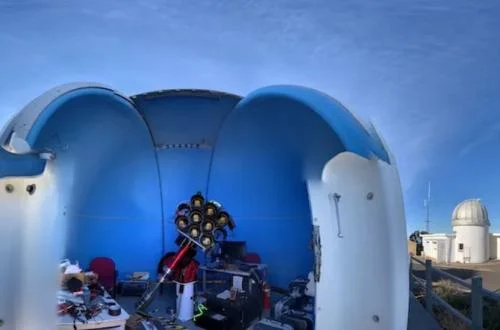
Astronomers at Macquarie University in Australia have unveiled a pioneering technique that allows for the precise observation of stars, satellites, and other celestial targets during broad daylight, effectively overcoming one of the oldest limitations in ground-based optical astronomy. By utilizing a sophisticated array of light filters and high-speed imaging technology on the university’s unique Huntsman Telescope, researchers have demonstrated that it is possible to maintain high-sensitivity surveillance of the sky 24 hours a day. This development marks a significant leap forward in both stellar research and the critical field of Space Situational Awareness (SSA), providing a new tool to monitor the increasingly crowded orbital environment surrounding Earth.
The Huntsman Telescope, located at the Siding Spring Observatory near Coonabarabran, New South Wales, was originally conceived for ultra-sensitive night-sky surveys. However, a research team led by Sarah Caddy, a doctoral candidate and lead designer of the Huntsman system, has successfully adapted the facility to operate under the harsh glare of the sun. The results of this study, published on May 20, 2024, in the Publications of the Astronomical Society of Australia, detail how the telescope can achieve scientific-grade results during daylight hours, a feat that has challenged astronomers for centuries.
The Engineering Behind the Huntsman Array
Unlike traditional telescopes that rely on a single large mirror or lens, the Huntsman Telescope employs a "multi-eye" design. It consists of an array of 10 high-end, off-the-shelf Canon 400mm f/2.8 L-series lenses. These lenses are specifically chosen for their exceptional anti-reflective coatings and optical clarity. In the Huntsman configuration, these lenses are mounted in parallel on a single highly accurate tracking mount, allowing them to point at the same region of the sky simultaneously.
Each lens is equipped with a dedicated science-grade CMOS camera and astro-mechanical focusing equipment. This setup allows the telescope to capture thousands of short-exposure images per second. By processing these rapid-fire images, the system can mitigate the blurring effects of atmospheric turbulence—a technique often referred to as "lucky imaging"—and extract clear signals from celestial objects that would otherwise be lost in the "noise" of the bright blue sky.
The breakthrough in daylight observation specifically involves the use of specialized broadband light filters. Under normal conditions, the Earth’s atmosphere scatters sunlight (Rayleigh scattering), creating a brilliant blue background that drowns out the relatively faint light from stars and planets. The Huntsman team’s technique involves using filters that block the majority of this scattered visible sunlight while allowing specific, narrower wavelengths of light from celestial objects to pass through to the sensors. By pairing these filters with the array’s high-speed data processing capabilities, the astronomers can "see" through the daylight.
From Concept to Reality: A Chronology of Development
The journey toward functional daylight astronomy at Macquarie University began several years ago with the conceptualization of the Huntsman Telescope as a cost-effective alternative to massive monolithic telescopes.
- Initial Design (2018–2019): Inspired by the Dragonfly Telephoto Array in North America, the Macquarie team began designing a system optimized for low-surface-brightness imaging, such as detecting faint dwarf galaxies and the outer halos of nearby galaxies.
- The "Mini-Huntsman" Phase: Before committing the full 10-lens array to daylight testing, researchers spent months experimenting with a "pathfinder" version consisting of a single lens. This phase was crucial for determining the optimal exposure times and identifying the specific wavelengths that offered the best contrast against the daytime sky.
- Full Array Integration (2022–2023): The full 10-lens array was commissioned at Siding Spring Observatory. During this period, the team refined the astro-mechanical hardware to ensure that all 10 lenses could track moving targets, such as satellites, with sub-arcsecond precision.
- Daylight Testing and Validation (Late 2023): The team conducted rigorous tests, targeting well-known stars like Betelgeuse to calibrate the system’s photometric accuracy. They also began tracking known satellites to test the system’s utility for orbital debris monitoring.
- Peer-Reviewed Publication (May 2024): The findings were officially released, proving that the Huntsman could match or exceed the performance of much more expensive dedicated tracking systems.
Case Study: Monitoring the Supergiant Betelgeuse
One of the most significant applications of this new technology is the continuous monitoring of variable stars. The Huntsman team focused their efforts on Betelgeuse, a red supergiant star in the constellation Orion. Located approximately 650 light-years from Earth, Betelgeuse is a candidate for a future supernova—an event that would be visible even in the daytime.
In late 2019 and early 2020, Betelgeuse underwent a "Great Dimming" event, where its brightness dropped to its lowest point in recorded history. While later analysis suggested this was due to a massive ejection of surface material that cooled into a dust cloud, the event highlighted the need for 24/7 monitoring of such stars. Traditional telescopes lose track of stars like Betelgeuse for several months each year when they appear too close to the sun in the sky.
With the Huntsman’s daylight capability, astronomers no longer have to wait for the sun to set or for the Earth to move further along its orbit to observe these critical targets. Continuous monitoring allows for the detection of rapid changes in brightness or spectral characteristics, providing early warning signs of stellar collapses or other transient phenomena.
Addressing the Global Satellite Congestion Crisis
Beyond pure astrophysics, the Huntsman Telescope’s daylight capabilities address a pressing geopolitical and commercial concern: the rapid expansion of satellite constellations. According to data cited by Sarah Caddy, there are currently approximately 10,000 active satellites in orbit. However, with the rise of "mega-constellations" from companies like SpaceX (Starlink), Amazon (Project Kuiper), and others, that number is expected to climb by an additional 50,000 within the next decade.
This "new space" era brings a high risk of orbital collisions. If two satellites or pieces of space debris collide at orbital velocities, they can create thousands of smaller fragments, potentially leading to a chain reaction known as the Kessler Syndrome, which could render certain orbits unusable for generations.
To prevent such disasters, space agencies and private operators require constant, precise tracking of every object in Low Earth Orbit (LEO) and Geostationary Orbit (GEO). Currently, most optical tracking is limited to the "terminator" hours—just after sunset or just before sunrise—when the ground is dark but the satellites are still illuminated by the sun. The Huntsman’s ability to track objects in the middle of the day significantly expands the window for monitoring, allowing for more accurate orbital predictions and timely collision-avoidance maneuvers.
Scientific and Industrial Reactions
The announcement has been met with enthusiasm within the Australian astronomical community and among international space surveillance experts. The use of off-the-shelf hardware (Canon lenses) combined with sophisticated software and filtering is seen as a "democratization" of high-end space tracking.
"Astronomy daylight is an exciting field, and with advances in camera sensors, filters, and other technologies, we are seeing dramatic improvements in the sensitivity and precision that can be achieved under clear sky conditions," Caddy stated. Her remarks underscore a shift in the industry toward agile, modular telescope designs that can be deployed in networks rather than relying on a single, multi-billion-dollar facility.
Experts in Space Situational Awareness have noted that the Huntsman technique could be integrated into global "space fence" networks. By placing similar arrays at different longitudes around the world, the international community could maintain a "live" map of every significant object in orbit, regardless of the time of day at any specific location.
Future Implications and Technological Evolution
The success of the Huntsman Telescope at Macquarie University suggests a future where the distinction between "nighttime" and "daytime" astronomy becomes increasingly blurred for certain types of observations. While deep-space imaging of incredibly faint, distant galaxies will likely always require the darkest possible skies, the monitoring of our own solar system and galactic neighborhood is moving toward a 24-hour model.
Moving forward, the Macquarie team plans to expand the Huntsman array. There is potential to increase the number of lenses, which would further improve the signal-to-noise ratio and allow for the detection of even smaller pieces of space debris. Additionally, the software used to process the thousands of short-exposure images is being refined using machine learning algorithms to automatically identify and categorize objects in real-time.
The economic implications are also noteworthy. Because the Huntsman uses mass-produced camera lenses rather than custom-ground mirrors, the cost of building and maintaining such a facility is a fraction of that of a traditional observatory. This makes the technology accessible to universities, smaller nations, and private companies interested in securing the space environment.
In conclusion, the work being done at Siding Spring Observatory with the Huntsman Telescope represents a paradigm shift. By reclaiming the daylight hours for optical astronomy, Macquarie University researchers have not only opened a new window into the life cycles of stars like Betelgeuse but have also provided a vital safeguard for the infrastructure of the modern world—the satellites that power our communication, navigation, and global security. As the sky grows more crowded, the ability to see clearly through the sun’s glare will transition from a scientific novelty to an essential global utility.

