
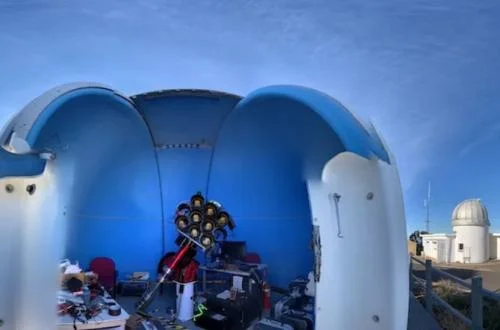
The field of optical astronomy has long been defined by a fundamental limitation: the blinding glare of the Sun. For centuries, the study of the cosmos through optical lenses has been a nocturnal pursuit, as the scattering of sunlight in Earth’s atmosphere effectively masks the faint signatures of stars, planets, and orbiting satellites. However, a team of researchers at Macquarie University in Australia has successfully challenged this paradigm. By utilizing the specialized Huntsman Telescope, astronomers have demonstrated a sophisticated new technique that allows for high-precision measurements of celestial bodies and man-made objects during broad daylight. This development, recently detailed in a study published in the Publications of the Astronomical Society of Australia, marks a significant shift in how researchers can monitor the sky, offering a 24-hour window into both deep space and the increasingly crowded orbital environment of Earth.
Located at the Siding Spring Observatory in Coonabarabran, New South Wales, the Huntsman Telescope is not a conventional single-mirror instrument. Instead, it is a "telephoto array" inspired by the design of the Dragonfly Telephoto Array in North America. The Huntsman consists of 10 high-performance Canon 400mm f/2.8 L-series lenses, which are more commonly found on the sidelines of professional sporting events than in astronomical observatories. These lenses are equipped with specialized "nano-structure" coatings that significantly reduce internal reflections and light scattering. By orienting these lenses to work in parallel, the telescope can capture extremely faint structures in the universe. The recent breakthrough involves the integration of advanced broadband light filters and high-speed CMOS sensors, which allow the system to differentiate between the diffuse blue light of the daytime sky and the specific wavelengths emitted by stars and satellites.
The Engineering Behind the Huntsman Breakthrough
The primary challenge of daytime astronomy is Rayleigh scattering, the phenomenon where sunlight is scattered by the Earth’s atmosphere, creating a bright background that overwhelms the light from distant objects. To overcome this, the Macquarie team, led by Sarah Caddy, an astronomer and doctoral candidate who helped design and build the Huntsman, implemented a strategy involving rapid-fire imaging and precise filtering. The telescope’s 10-lens array captures thousands of short-exposure images every second. This high-cadence approach allows the system’s computers to process out the atmospheric "noise" and turbulence in real-time.
Central to this success is the use of specialized broadband filters. These filters are designed to block the majority of the solar spectrum while allowing specific, narrow bands of light from celestial targets to pass through to the sensors. During the testing phase, the researchers utilized a "Mini-Huntsman" pathfinder—a single-lens version of the array—to calibrate the optimal exposure times and tracking parameters. Over several months of rigorous testing, the team refined the algorithms necessary to track targets through the intense heat-induced turbulence of the daytime atmosphere, which typically distorts light much more severely than the cooler night air.
Monitoring the Red Supergiant: The Case of Betelgeuse
One of the most significant applications of this technology is the continuous monitoring of variable stars, specifically the red supergiant Betelgeuse. Located approximately 650 light-years away in the constellation Orion, Betelgeuse is one of the most scrutinized stars in the sky. In late 2019 and early 2020, the star underwent a "Great Dimming" event, where its brightness dropped by about 60%. This sudden change sparked intense debate among the scientific community, with some speculating that the star was on the verge of a supernova explosion. Subsequent analysis suggested the dimming was caused by a massive ejection of surface material that cooled into a giant dust cloud, temporarily blocking the star’s light.
Because Betelgeuse’s behavior is unpredictable, astronomers require constant data to understand its lifecycle. However, traditional observatories often lose sight of the star for months at a time when it appears too close to the Sun in the sky or during the daylight hours of its visible season. The Huntsman’s daytime capability ensures that there are no "blind spots" in the observation timeline. By tracking Betelgeuse during the day, astronomers can detect the earliest signs of another dimming event or the precursor signals of a supernova, providing a level of temporal coverage that was previously impossible for optical telescopes.
Space Situational Awareness and Satellite Tracking
Beyond deep-space exploration, the Huntsman’s daytime capabilities address a pressing modern problem: Space Situational Awareness (SSA). As of 2024, there are approximately 10,000 active satellites orbiting Earth, alongside hundreds of thousands of pieces of space debris. This number is projected to grow exponentially, with companies like SpaceX and Amazon planning to launch "mega-constellations" that could bring the total number of low-Earth orbit (LEO) satellites to over 60,000 within the next decade.
The risk of collisions in orbit, known as the Kessler Syndrome, poses a threat to global communication, navigation, and weather forecasting systems. Currently, most optical tracking of satellites is limited to the "terminator" hours—dawn and dusk—when the satellite is illuminated by the Sun against a dark sky. The ability to track these objects in the middle of the day significantly expands the window for collision avoidance maneuvers. Sarah Caddy emphasized the necessity of this shift, noting that a dedicated network of telescopes capable of both day and night observation is essential for maintaining the safety of the orbital environment. The Huntsman’s ability to accurately pinpoint the trajectory of satellites and debris during the day provides a vital tool for space traffic management.
Chronology of the Huntsman Project
The journey of the Huntsman Telescope from a conceptual design to a revolutionary daytime observatory has spanned several years:
- 2019–2020: Initial design and assembly of the Huntsman Telescope began at Macquarie University, utilizing the multi-lens array concept to achieve high sensitivity at a lower cost than traditional large-mirror telescopes.
- 2021: The telescope was installed at the Siding Spring Observatory. Early night-time trials focused on detecting "ultra-diffuse" galaxies and the faint outskirts of nearby galactic systems.
- 2022–2023: The team began exploring daytime applications. The "Mini-Huntsman" pathfinder was used to test filter combinations and software algorithms for atmospheric compensation.
- Late 2023: Successful daytime tracking of Betelgeuse and several LEO satellites confirmed the efficacy of the broadband filtering technique.
- May 20, 2024: The formal research findings were published in the Publications of the Astronomical Society of Australia, detailing the technical specifications and the potential for wide-scale adoption of daytime optical astronomy.
Broader Implications for Global Astronomy
The success of the Huntsman Telescope has broader implications for the global astronomical community. Traditionally, optical astronomy has been a geographically constrained field, with the best results coming from high-altitude, remote locations like the Atacama Desert in Chile or the peaks of Hawaii. While Siding Spring is an excellent site, the ability to observe during the day effectively doubles the utility of any given observatory site.
Furthermore, the Huntsman’s reliance on off-the-shelf commercial hardware—specifically Canon lenses—demonstrates a cost-effective model for building powerful telescope arrays. While a single large-diameter mirror telescope can cost hundreds of millions of dollars and take decades to build, a multi-lens array like the Huntsman can be assembled for a fraction of the cost using existing high-quality optics. This democratization of high-precision astronomy allows universities and smaller research institutions to contribute significantly to global space surveillance and astrophysical research.
Expert Reactions and Future Outlook
The scientific community has reacted with optimism to the Macquarie team’s findings. Experts in orbital dynamics have noted that daytime optical tracking could complement radar-based tracking, which is currently the primary method for monitoring space debris during the day. Radar is effective but expensive and limited in the number of objects it can track simultaneously. An optical system like the Huntsman offers a high-resolution alternative that can be scaled into a global network.
Sarah Caddy remains focused on the future potential of the technology. "Astronomy during the day is an exciting field, and with the progress in camera sensors, filters, and other technologies, we are seeing dramatic improvements in the sensitivity and precision that can be achieved under clear sky conditions," she stated. The next steps for the Huntsman team involve further refining the "lucky imaging" software—a technique that selects only the sharpest images from the thousands captured to create a final, clear composite—to push the boundaries of what can be seen through the daytime haze.
As the world enters an era of unprecedented space activity, the ability to keep a constant eye on the heavens is no longer just a scientific luxury; it is a logistical necessity. The Huntsman Telescope’s breakthrough ensures that whether the Sun is up or down, our understanding of the stars and our protection of Earth’s orbital pathways remain uninterrupted. The research published in May 2024 serves as a blueprint for a new generation of observatories that never sleep, bridging the gap between the day and night sky.

