
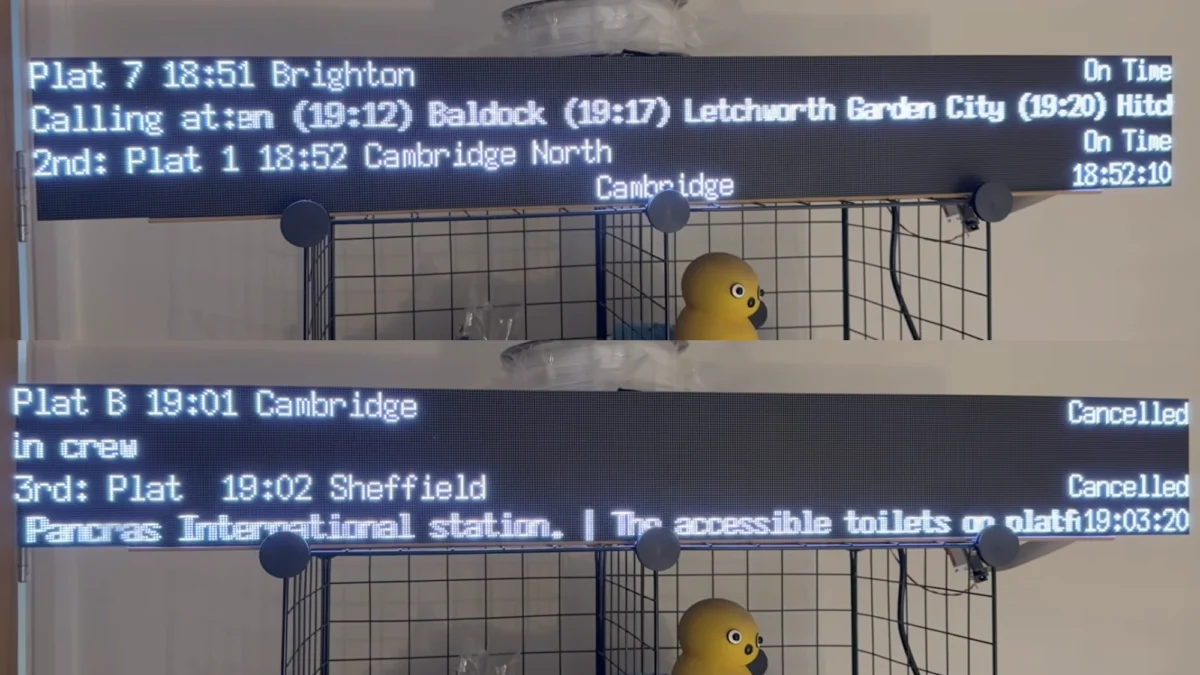
The intersection of nostalgic industrial design and modern computing has birthed a unique home-engineering project that transforms a common piece of public infrastructure into a functional domestic accessory. Jon Morris Smith, a DIY enthusiast and technologist, recently unveiled a bespoke train departure board designed for home use, utilizing the versatile Raspberry Pi 4 and high-density LED matrices. This project, while born from the personal necessity of a regular commuter, highlights a growing trend in the "Maker" community: the repurposing of public data streams into personalized "information radiators" that blend seamlessly into the home environment.
For many, the train station departure board is a symbol of transition—a source of both anxiety and anticipation. The rhythmic cycling of information, the glow of the pixelated text, and the utility of real-time updates have long been confined to the concourses of major transit hubs. Smith’s project effectively deconstructs this experience, offering a blueprint for enthusiasts to recreate the "train lounge" aesthetic while gaining a practical tool for daily transit management.
The Genesis of the Homebrew Departure Board
The motivation behind the project was two-fold: aesthetic appreciation and practical frustration. As a lifelong rail enthusiast and a daily commuter in the United Kingdom, Jon Morris Smith sought a way to monitor his regular route without the constant need to check a smartphone or a browser tab. While commercial versions of such displays exist, they often come with significant drawbacks, including high entry costs and mandatory monthly subscription fees to access live data.
Writing on his project website, "Another Partial Success," Smith noted that the market for premade LED dot-matrix screens was either prohibitively expensive or tied to proprietary ecosystems. This led to the classic "maker" question: "How hard can it be?" The resulting journey involved navigating the complexities of hardware synchronization, real-time API integration, and physical housing design.
The project represents a significant shift from "cool-but-useless" replicas to functional edge-computing devices. By leveraging open-source software and public data feeds, Smith has demonstrated that high-end transit information systems can be replicated at a fraction of the cost of industrial alternatives.
Technical Specifications and Hardware Architecture
At the heart of the departure board is a Raspberry Pi 4 with 1GB of RAM. While the Raspberry Pi 4 is more powerful than strictly necessary for a simple text display, its robust GPIO (General Purpose Input/Output) pins and reliable networking capabilities make it an ideal choice for a device that must remain connected to the internet 24/7.
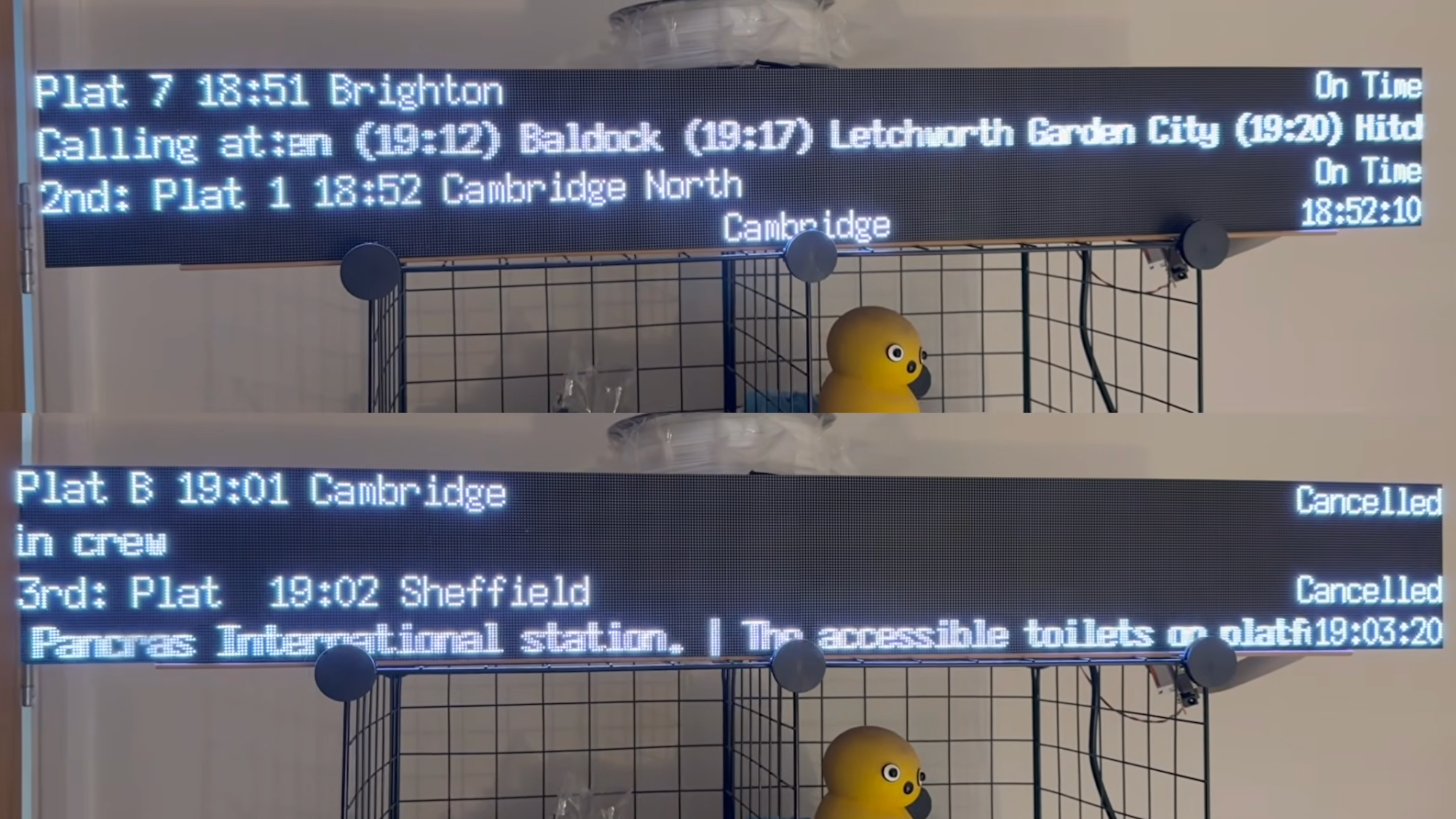
The visual component of the board consists of four LED matrices, each measuring 128 by 64 pixels. When combined, these matrices provide a high-resolution canvas capable of mimicking the typography and layout of official UK National Rail boards. The choice of LED matrices over standard LCD screens is a critical design decision; the "glow" and "pixel-perfect" nature of the LEDs are what provide the authentic station atmosphere.
Powering such an array requires more than a standard USB phone charger. Smith utilized a 5-volt, 5-amp power supply to ensure that the LED matrices receive a steady current. Insufficient power in LED projects often leads to flickering, color inaccuracies, or system instability—issues that are particularly problematic for a device intended to be a permanent fixture in a living space.
On the software side, the Raspberry Pi runs a custom software stack designed to fetch, parse, and display data. The system relies on a Linux-based environment, with scripts likely written in Python or C++ to handle the matrix drivers. The software must not only display text but also handle the scrolling animations and layout transitions that characterize real-world departure boards.
Data Integration: The Rail Data Marketplace
The functionality of the board is entirely dependent on its ability to access live transit data. In the United Kingdom, this is made possible through the Rail Data Marketplace (RDM). Launched to centralize and simplify access to rail-related data, the RDM provides developers with APIs for real-time train movements, platform assignments, and delay notifications.
By subscribing to these data feeds, Smith’s board can provide information that is identical to what a passenger would see at London Waterloo or Manchester Piccadilly. This includes:
- Scheduled departure times.
- Expected departure times (factoring in delays).
- Destination and intermediate calling points.
- Platform numbers (once assigned).
- Service status (e.g., "On time," "Delayed," or "Cancelled").
However, the reliance on the Rail Data Marketplace presents a geographic limitation. The current iteration of the software is specifically tailored to the UK’s data structures. For enthusiasts in the United States or Europe, the project requires a degree of "localization." In the U.S., for instance, developers would need to interface with the General Transit Feed Specification (GTFS) Realtime feeds provided by agencies like Amtrak, the MTA (New York), or CTA (Chicago). While the data structures differ, the underlying logic remains the same: a persistent connection to a cloud-based transit API.
The Maker Movement and Information Radiators
Smith’s project falls into a category of technology known as "information radiators." These are devices designed to display important information in a way that is easily consumable at a glance, without requiring active interaction. In an era of "notification fatigue," where smartphones constantly compete for attention with pings and buzzes, a static, dedicated display offers a more passive and less intrusive way to stay informed.
The growth of the Raspberry Pi ecosystem has been a primary driver of this movement. Since its inception in 2012, the Raspberry Pi has evolved from a simple educational tool into the backbone of the global DIY electronics scene. Projects like the departure board highlight the democratization of technology; what was once the domain of specialized industrial contractors is now accessible to any hobbyist with a soldering iron and basic coding knowledge.
Comparative Analysis: DIY vs. Commercial Solutions
The DIY approach offers several advantages over commercial "smart" displays. First is the matter of cost. A commercial LED departure board can retail for several hundred dollars, often with additional fees for "premium" data access. A DIY version, using a Raspberry Pi and bulk-ordered LED matrices from suppliers like Adafruit or AliExpress, can be constructed for significantly less.

Second is the issue of privacy and longevity. Commercial smart devices are often "black boxes" that may collect user data or become "bricks" if the manufacturer decides to shut down their servers. A DIY project, built on open-source principles, gives the user total control over their data and ensures the device will function as long as the public APIs remain active.
Third is customization. Smith’s board is programmed to show his specific commute. A user could easily tweak the code to show only certain train operators, filter out specific stations, or even change the color scheme to match their home decor.
Broader Implications and Future Applications
The success of the DIY departure board suggests a broader appetite for "physicalized" data. As the Internet of Things (IoT) continues to mature, we are seeing a move away from multi-purpose screens (tablets and phones) toward dedicated, single-purpose objects.
This project also highlights the importance of "Open Data" initiatives. Governments and transit agencies that provide free, machine-readable data feeds enable a secondary economy of innovation. These feeds allow independent developers to create tools that improve the commuting experience, often in ways that the original agencies had not envisioned.
Looking forward, the architecture used in Smith’s train board could be adapted for a variety of other uses:
- Air Travel: Displaying live flight statuses for a nearby airport.
- Public Transit: Real-time bus or subway arrivals for specific city blocks.
- Finance: Live stock tickers or cryptocurrency trackers.
- Environmental Monitoring: Real-time air quality indices (AQI) or weather warnings.
Conclusion
Jon Morris Smith’s DIY train departure board is more than just a novelty for railfans; it is a testament to the power of accessible technology and the enduring appeal of industrial design. By bridging the gap between public data and private spaces, the project provides a blueprint for how we might interact with information in the future—less through the frantic checking of handheld devices and more through the calm, ambient presence of dedicated displays.
For those looking to replicate the project, Smith has provided resources through his YouTube channel and website, encouraging a new wave of "homebrew" engineers to bring the station experience into their own living rooms. As the DIY community continues to refine the code and adapt it for different regions, the sight of a glowing LED departure board may soon become a common feature in the modern, data-connected home.

