
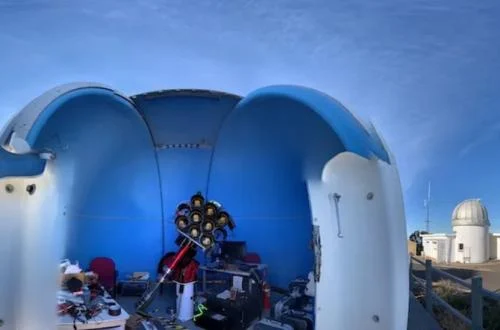
In a significant leap for the field of observational astrophysics, a team of researchers at Macquarie University in Australia has successfully pioneered a technique that allows for the precise measurement of stars, satellites, and other celestial bodies during broad daylight. Utilizing the innovative Huntsman Telescope, which was originally designed for ultra-sensitive night-sky observations, the team has demonstrated that the traditional barriers between day and night astronomy are beginning to dissolve. This development, detailed in a study published in the Publications of the Astronomical Society of Australia on May 20, 2024, marks a pivotal shift in how astronomers and space agencies might monitor the increasingly crowded orbital environment of Earth, as well as transient stellar events that do not adhere to a nocturnal schedule.
The Huntsman Telescope is located at the Siding Spring Observatory near Coonabarabran, New South Wales—a site long regarded as Australia’s premier optical astronomy hub. Unlike traditional monolithic telescopes that rely on a single large mirror, the Huntsman employs a unique "multi-eye" design inspired by the Dragonfly Telephoto Array. It consists of an array of ten high-performance Canon 400mm f/2.8 L-series lenses, which are more commonly seen on the sidelines of professional sporting events than in deep-space observatories. By aligning these lenses to work in parallel, the Huntsman can capture an immense amount of data with extreme sensitivity to low-surface-brightness features. However, its latest achievement—successful daytime operation—relies not just on the glass, but on a sophisticated combination of broadband light filters and high-speed digital processing.
The Challenge of the Blue Sky
For centuries, the primary adversary of the optical astronomer has been the Sun. During the day, sunlight enters Earth’s atmosphere and undergoes Rayleigh scattering, where shorter wavelengths of light (blue) are scattered in every direction by the gases in the atmosphere. This creates the bright blue canopy that effectively "drowns out" the much fainter light coming from distant stars and orbiting satellites. Historically, this has restricted optical astronomy to a narrow window of darkness, often further limited by lunar cycles and weather conditions.
Sarah Caddy, a doctoral candidate and the lead architect behind the Huntsman Telescope’s daytime capabilities, noted that while the concept of daytime observation is not new, the precision required to make it scientifically useful has remained elusive. "People have tried to observe stars and satellites in optical wavelengths during the day for centuries, but it is incredibly difficult to do," Caddy stated. The breakthrough at Macquarie University involves using specialized broadband filters that are finely tuned to block out the dominant wavelengths of scattered sunlight while allowing specific, high-contrast wavelengths from celestial targets to pass through to the sensors.
Technological Innovation: The Multi-Lens Advantage
The Huntsman Telescope’s hardware configuration is central to this success. Each of the ten lenses is equipped with a high-end astronomical camera and astro-mechanical focusing equipment. The system is designed to take thousands of short-exposure images per second. In daytime conditions, long exposures would simply result in a washed-out white frame due to atmospheric glare. By taking rapid-fire, short exposures, the Huntsman’s computers can process the data in real-time, "stacking" the images to cancel out atmospheric noise and enhance the signal of the target object.
Before deploying the full ten-lens array for daytime use, the researchers spent months conducting rigorous testing with a "mini-Huntsman" pathfinder—a single-lens version of the system. This phase was crucial for determining the optimal exposure timings and understanding how atmospheric turbulence, which is significantly more volatile during the day due to ground heating, affects the "twinkling" or blurring of the target. Through this iterative process, the team developed algorithms capable of tracking targets with high precision despite the shimmering heat of the New South Wales interior.
Monitoring the Red Supergiant: The Betelgeuse Case Study
One of the most high-profile targets used to prove the Huntsman’s daytime efficacy was Betelgeuse, the massive red supergiant located in the constellation Orion. Approximately 650 light-years from Earth, Betelgeuse is one of the most studied stars in the sky, primarily because it is in the final stages of its life cycle and is expected to eventually explode as a supernova.
In late 2019 and early 2020, Betelgeuse underwent what astronomers called the "Great Dimming," a sudden and dramatic drop in its brightness. While it was eventually determined that the dimming was caused by a massive ejection of surface material that cooled into a dust cloud, the event highlighted a major gap in astronomical infrastructure: if a star begins to behave erratically during a period when it is only visible from Earth during the day, astronomers might miss the critical early stages of a supernova.
The ability of the Huntsman to track Betelgeuse during daylight hours ensures that such "transient" events can be monitored 24/7. Continuous monitoring is essential for building accurate models of stellar evolution and for providing early warnings of cosmic events that could have implications for our understanding of physics.
Addressing the Global Satellite Crisis
Beyond the realm of pure astrophysics, the Huntsman Telescope’s daytime capabilities have immediate practical applications for "Space Situational Awareness" (SSA). The orbital environment around Earth is currently experiencing an unprecedented surge in activity. There are currently approximately 10,000 active satellites in orbit, a number that has grown exponentially over the last five years due to the rise of "mega-constellations" like SpaceX’s Starlink and Amazon’s Project Kuiper.
Industry projections suggest that as many as 50,000 additional satellites could be launched into Low Earth Orbit (LEO) within the next decade. This congestion creates a significant risk of collisions, which can produce clouds of high-velocity debris—a phenomenon known as the Kessler Syndrome, which could potentially render certain orbits unusable for generations.
Currently, most satellite tracking is done via radar or by optical telescopes operating at night. However, radar can be expensive and has limits on the size of objects it can detect, while nocturnal optical tracking leaves a massive gap in surveillance during the day. "Astronomy during the day is an exciting field, and with advances in camera sensors, filters, and other technologies, we are seeing dramatic improvements in the sensitivity and precision that can be achieved under clear sky conditions," Caddy explained. By providing a cost-effective method for daytime optical tracking, the Huntsman project offers a way to maintain a "constant eye" on the sky, helping to prevent collisions and track the movements of space junk in real-time.
Economic and Strategic Implications
The Huntsman Telescope represents a shift toward "off-the-shelf" innovation. By using mass-produced Canon lenses rather than custom-ground mirrors, Macquarie University has created a world-class research instrument at a fraction of the cost of traditional observatories. This scalability is vital for the future of space surveillance. To effectively manage tens of thousands of satellites, a global network of telescopes is required. The Huntsman model proves that such a network can be built using relatively affordable, modular components.
From a strategic perspective, the ability to track satellites during the day is of immense interest to both civilian and defense agencies. Space is increasingly viewed as a critical domain for national security, telecommunications, and global navigation. The ability to monitor the assets of both allies and adversaries without the "blind spot" of daylight hours enhances a nation’s ability to respond to orbital anomalies or hostile maneuvers.
Future Outlook and Academic Impact
The success of the Macquarie University team has already sparked interest across the international astronomical community. The methodology used—combining specific broadband filtering with high-frame-rate CMOS (Complementary Metal-Oxide-Semiconductor) sensors—is likely to be adopted by other observatories looking to maximize their utility.
As the Huntsman Telescope continues its mission at Siding Spring, the team plans to expand the array and refine the software further. Future iterations may include even more lenses, increasing the light-gathering power and allowing for the detection of even smaller, fainter pieces of space debris during the day.
The implications of this research extend to the very way we train the next generation of astronomers. By proving that the sky is "always open," Macquarie University is expanding the curriculum and the opportunities for student research. The project serves as a testament to the power of interdisciplinary engineering, combining optics, mechanical design, and advanced data science to solve a problem that has hampered the field for centuries.
In conclusion, the Huntsman Telescope’s transition to a 24-hour instrument is more than just a technical milestone; it is a necessary evolution in an era where our reliance on space-based technology is at an all-time high. Whether it is watching a distant star prepare for its final explosion or ensuring that a communication satellite avoids a piece of drifting debris, the ability to see through the blue of our own atmosphere opens a new window into the universe—one that never has to close.

