
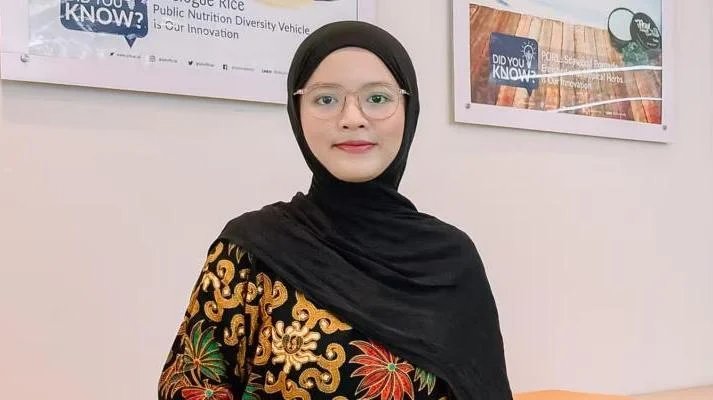
The graduation ceremony of IPB University for Phase VIII of the 2025/2026 Academic Year served as a platform for recognizing exceptional academic talent, yet one story resonated with particular intensity among the faculty and attendees. Aulia Nurul Hikmah, a student from the Department of Silviculture, was officially named the best graduate of the Faculty of Forestry and Environment. Her achievement is not merely a reflection of a high Grade Point Average (GPA) of 3.87, but a testament to her resilience in overcoming significant socio-economic barriers. Born into a family where her father worked as a laborer and a tire repairman (tukang tambal ban), Aulia’s journey to the pinnacle of academic success at one of Indonesia’s most prestigious institutions highlights the transformative power of education and the potential for social mobility within the nation’s specialized scientific sectors.
Aulia’s academic journey began with a profound interest in the intersection of biological sciences and ecological preservation. She chose the Silviculture study program, a discipline focused on the art and science of controlling the establishment, growth, composition, health, and quality of forests and woodlands to meet the diverse needs and values of landowners and society. For Aulia, the forest represents the ultimate manifestation of life sciences, an intricate web of biological processes that sustain the planet. Her motivation was fueled by a desire to understand these ecosystems from their very foundation—starting from the germination of seeds and the maintenance of saplings to the sustainable harvesting and eventual rehabilitation of degraded landscapes.
The Academic Rigor of Silviculture at IPB University
IPB University, located in Bogor, West Java, has long been recognized as the premier institution for agricultural and forestry sciences in Indonesia. The Faculty of Forestry and Environment, established in 1963, maintains a rigorous curriculum designed to produce experts capable of managing Indonesia’s vast tropical rainforests, which are among the most biodiverse in the world. The Silviculture program, in particular, requires a deep understanding of botany, soil science, climatology, and forest pathology.
Aulia’s success in this demanding field is underscored by her final GPA of 3.87. Maintaining such a high standard requires not only intellectual capacity but also disciplined time management. Throughout her four years of study, Aulia balanced intense laboratory work, field practicums in various forest environments across Indonesia, and non-academic responsibilities. She noted that the pressure of the curriculum forced her to become an adaptive and flexible individual. The necessity of balancing theoretical knowledge with the physical and logistical demands of forestry field studies helped her develop critical thinking skills that are essential for modern environmental scientists.
Socio-Economic Context and the Path to Higher Education
Aulia’s background as the daughter of a laborer and a tire repairman places her achievement within a broader sociological context in Indonesia. According to data from the Indonesian Central Bureau of Statistics (BPS), access to higher education for children from the lowest income deciles remains a significant challenge, despite government interventions such as the KIP-Kuliah (Kartu Indonesia Pintar Kuliah) scholarship program. While the specific financial aid Aulia received was not detailed in her citation, her story mirrors that of many "first-generation" university students who must navigate the higher education system without the financial safety nets or professional networks available to their more affluent peers.
The economic reality of a "tukang tambal ban"—a micro-entrepreneur in the informal sector—often involves fluctuating daily income and a lack of formal social security. For a child from such a background to not only graduate but to excel as the top student in a competitive faculty at IPB University is a rare feat. It serves as a data point in the ongoing discussion regarding the effectiveness of merit-based admissions and the importance of supporting students from marginalized backgrounds who demonstrate high potential.
Addressing Indonesia’s Forestry Crisis
Aulia’s academic focus on silviculture comes at a critical time for Indonesia’s environmental landscape. Indonesia possesses the third-largest area of tropical rainforest in the world, yet it has historically faced high rates of deforestation due to palm oil expansion, mining, and illegal logging. Although recent data from the Ministry of Environment and Forestry (KLHK) suggests a downward trend in net deforestation rates over the last few years, the challenge of forest degradation remains acute.
In her statements following the graduation ceremony, Aulia emphasized the importance of being an "agent of preservation." She highlighted that the current issues of forest degradation and the loss of biodiversity require innovative silvicultural interventions. Her choice of study was deliberate; she views silviculture not just as a career path, but as a technical solution to global environmental crises. By focusing on forest rehabilitation, silviculturists like Aulia play a vital role in Indonesia’s commitment to the "FOLU Net Sink 2030" goal, which aims to ensure that the forestry and land use sector absorbs more greenhouse gases than it emits by the end of the decade.
The Role of Adaptability in Modern Forestry
The curriculum at IPB University has evolved to include not only traditional timber management but also the management of non-timber forest products and ecosystem services. Aulia reflected on how her time at the university prepared her for this multifaceted industry. "The forest is a complex ecosystem that serves as a primary life support system," she stated. Through her studies, she gained insights into the entire lifecycle of a forest, which is essential for developing sustainable management plans that satisfy both environmental protection and economic necessity.
Her emphasis on being "adaptive and flexible" is particularly relevant in the context of climate change. Modern forestry professionals must be prepared to manage forests under changing climatic conditions, which may involve assisted migration of species, managing new types of pests and diseases, and implementing fire prevention strategies in increasingly dry peatlands. Aulia’s high GPA suggests a mastery of these complex, evolving scientific concepts.
Institutional and Peer Reactions
While the graduation ceremony celebrated hundreds of graduates, the recognition of Aulia as the "Best Graduate" of her faculty drew praise from the university leadership. While official remarks from the Rector of IPB University often emphasize the "Agromaritime 4.0" vision—integrating technology with agriculture and forestry—Aulia’s story provides a human face to these institutional goals. Faculty members in the Department of Silviculture described her as a student who demonstrated exceptional tenacity, often going beyond the required reading to understand the practical implications of forest policy on local communities.
Peers and fellow graduates noted that Aulia’s success served as a source of motivation. In an environment where many students come from specialized high schools or families with a history in the civil service or corporate sectors, Aulia’s rise from a modest background to the top of her class challenged existing stereotypes regarding the correlation between wealth and academic performance.
Future Prospects and Broader Implications
Looking forward, Aulia Nurul Hikmah intends to continue her journey of self-development, aiming to translate her academic knowledge into tangible solutions for society. The job market for silviculture graduates in Indonesia is expanding beyond traditional logging companies. With the rise of the "Green Economy," there is an increasing demand for environmental consultants, carbon credit auditors, and restoration experts in both the private and public sectors.
Furthermore, her success has broader implications for Indonesia’s educational policy. It reinforces the argument that investing in students from low-income families yields high returns for the nation’s scientific community. As Indonesia strives to achieve its "Golden Indonesia 2045" vision—a plan to become one of the world’s top five economies by its centenary—the cultivation of highly skilled experts like Aulia will be paramount.
In conclusion, Aulia Nurul Hikmah’s graduation as the best student of the Faculty of Forestry and Environment at IPB University is more than a personal victory. It is a narrative of breaking generational cycles of poverty through academic excellence. Her mastery of silviculture equips her with the tools to address some of the most pressing environmental challenges of the 21st century. As she transitions from a student to a professional, her journey stands as a benchmark for what can be achieved when individual perseverance meets the opportunities provided by a world-class educational institution. Her story confirms that while economic conditions may dictate one’s starting point, they do not necessarily define the destination, provided there is a pathway for merit and dedication to flourish.

