
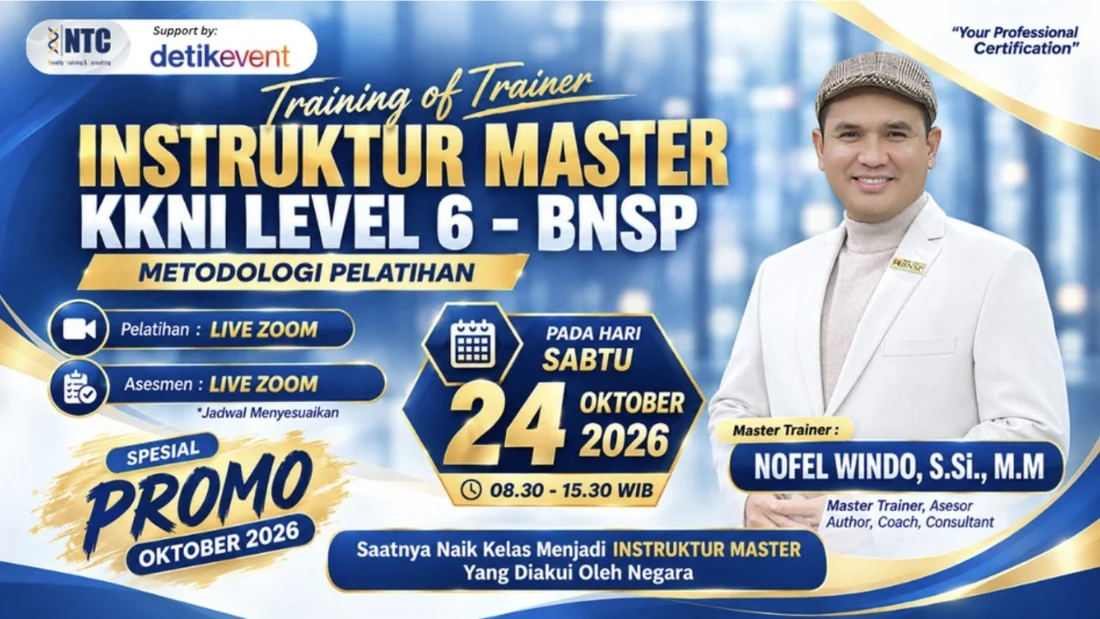
Jakarta — In the rapidly evolving landscape of human capital development, the proliferation of training programs, workshops, and coaching sessions has made professional differentiation more critical than ever. For years, seasoned educators, corporate trainers, workshop facilitators, and academic lecturers have relied on accumulated field experience, participant feedback, and informal testimonials to validate their expertise. However, as organizations, government bodies, and corporate clients increasingly demand verifiable metrics of competence, informal proof is frequently falling short. Entering the next tier of the professional training industry now requires formal state-sanctioned validation, a need addressed directly by the BNSP Master Instructor Certification under the Indonesian National Qualification Framework (KKNI) Level 6.
This professional credential serves as an official benchmark for educators, trainers, and learning practitioners who wish to formalize their mastery. Designed to bridge the gap between practical field experience and nationally recognized accreditation, the program responds to a growing institutional demand for standardized excellence. As the corporate training sector shifts toward stringent compliance and measurable learning outcomes, holding a certification endorsed by the Badan Nasional Sertifikasi Profesi (BNSP)—the National Professional Certification Agency of Indonesia—has transformed from an optional resume booster into a fundamental necessity for career progression and institutional credibility.
Program Architecture and Mentorship Framework
At the core of the BNSP KKNI Level 6 Master Instructor scheme is a comprehensive curriculum meticulously structured to elevate instructional capabilities, instructional design proficiency, and assessment methodologies. The program is not merely a testing ground but a rigorous developmental journey tailored for professionals who have spent years in the trenches of corporate training, academic lecturing, and specialized coaching.
Guiding the participants through this intricate developmental pathway is Nofel Windo, S.Si., M.M., a recognized figure in the Indonesian learning and development ecosystem. Operating in multiple capacities as a Master Trainer, BNSP Assessor, author, coach, and consultant, Windo brings decades of applied insights to the program. Under his direct mentorship, candidates are prepared not only to pass the statutory competency assessments but to internalize the highest standards of instructional delivery.
The curriculum encompasses several critical competency units, including the design of training programs, the utilization of varied learning methodologies, the management of training administration, and the execution of objective competency-based assessments. By aligning practical experience with standardized assessment criteria, participants learn how to construct learning modules that yield predictable, measurable improvements in participant performance.
Furthermore, the program offers specialized mentoring that extends all the way to the formal competency assessment phase. Successful candidates are granted not only the national certification but also the exclusive right to obtain the BNSP RI Trainer PIN, a prestigious identifier designed to reinforce professional portfolios and significantly enhance market competitiveness in both domestic and regional arenas.
Event Chronology and Operational Logistics
Recognizing the geographical diversity and busy schedules of modern professionals, the upcoming batch of the certification program has been engineered for maximum accessibility without compromising instructional integrity. The initiative utilizes a hybrid-ready, live-streaming operational model hosted via Zoom, allowing participants from across the archipelago to engage in real-time learning without the friction of physical relocation.
The administrative timeline for the upcoming session is fixed as follows:
- Event Date: Saturday, October 24, 2026
- Operational Hours: 08:30 – 15:30 Western Indonesia Time (WIB)
- Delivery Mode: Live Online Session via Zoom
- Registration Portal: Accessible through dedicated event platforms such as detikEvent
To maintain the highest standard of mentorship and ensure that every candidate receives individualized guidance during the preparatory phase, the organizing body has strictly limited the total number of participants per batch. This deliberate constraint ensures an optimal student-to-mentor ratio, allowing Master Assessors to thoroughly evaluate instructional portfolios, provide constructive feedback on training design documents, and address specific competency gaps prior to the formal assessment board.
Macro Industry Context: The Shift Toward Formal Competency Accreditation
The launch of targeted certification schemes such as the KKNI Level 6 Master Instructor program occurs against a backdrop of sweeping transformation within the national and global labor markets. Over the past decade, Indonesia has systematically advanced the implementation of the Indonesian National Qualification Framework (Kerangka Kualifikasi Nasional Indonesia or KKNI), a strategic instrument designed to integrate, level, and equate learning achievements from formal, non-formal, and informal education sectors, as well as work experience.
Within this framework, Level 6 specifically targets practitioners who operate at a supervisory and advanced execution level—individuals capable of planning, executing, and evaluating complex learning systems. Historically, the training sector suffered from a lack of standardized entry barriers, permitting self-proclaimed experts to deliver corporate training without verifiable pedagogical credentials. This absence of standardization frequently resulted in highly variable training qualities across industries.
Data from manpower development agencies indicate a steady rise in corporate spending on human resource training, coupled with a simultaneous demand for accountability from procurement departments and human resource directors. Organizations commissioning external trainers are increasingly bound by internal compliance mandates that require proof of vendor competency. Consequently, corporate clients now routinely audit the qualifications of contracted facilitators. In this competitive climate, trainers lacking official state certification face significant hurdles in securing high-value contracts with multinational corporations and state-owned enterprises (BUMN).
Implications for Diverse Learning Practitioners
The necessity for formal accreditation extends across multiple professional segments, each facing unique operational pressures that the BNSP certification directly alleviates.
Corporate Trainers and Independent Consultants
For freelance trainers and corporate consultants, the primary challenge lies in establishing immediate trust with prospective corporate clients. While client testimonials and LinkedIn recommendations provide social proof, they lack institutional weight. A BNSP Master Instructor certification functions as an objective, third-party verification of skill. It transforms a trainer’s pitch from a subjective marketing claim into a verifiable statement of state-recognized competence, thereby commanding higher professional fees and opening doors to executive-level coaching engagements.
Academic Educators: Teachers and Lecturers
Within the formal education sector—spanning vocational schools, high schools, and higher education institutions—educators face mounting pressure to align curricula with industry demands. The "Link and Match" policy championed by educational authorities requires teachers and lecturers to possess practical industry insights alongside pedagogical mastery. By acquiring a KKNI Level 6 Master Instructor credential, academic educators validate their ability to design competency-based learning experiences that mirror actual workplace requirements, thereby enhancing the employability of their graduates.
Internal Enterprise Facilitators
Large corporations frequently maintain internal academies and continuous learning departments. To ensure that internal training teams deliver world-class learning experiences, progressive enterprises are increasingly mandating that their internal trainers achieve external certifications. The BNSP Master Instructor program offers these internal talent developers a standardized pathway to benchmark their skills against national benchmarks, ensuring consistency and high ROI on internal training expenditures.
Analytical Perspective: The Future of Professional Training Regulation
Industry analysts observe that the professionalization of the training sector is an irreversible trend. As artificial intelligence and digital learning platforms democratize the dissemination of theoretical knowledge, the value of human facilitators increasingly shifts toward experiential guidance, personalized mentoring, and rigorous competency assessment.
In this new paradigm, the role of the instructor is no longer merely to transmit information—a task increasingly handled by automated systems—but to curate learning journeys, evaluate practical competencies, and certify real-world capability. Consequently, regulatory frameworks like those administered by BNSP will play an increasingly vital role in maintaining the integrity of the nation’s human capital pipeline.
Experts suggest that professionals who proactively secure these credentials position themselves as industry leaders capable of navigating future regulatory shifts. Conversely, those who rely solely on historical reputation risk marginalization as institutional buyers establish stricter procurement guidelines for educational and training services.
Strategic Action and Registration Procedures
Given the limited seating arrangement enforced to preserve the quality of mentorship under Master Trainer Nofel Windo, prospective candidates are advised to complete their registration well in advance of the October 2026 deadline. The rigorous nature of the preparatory phase requires participants to organize their instructional portfolios and readiness materials prior to the live online session.
Professionals ready to elevate their standing in the national training ecosystem, satisfy institutional compliance requirements, and secure definitive proof of their instructional mastery can access full program details and secure their enrollment slots through the official event registration portal at detikEvent. Taking this decisive step ensures that years of dedicated instructional experience are officially recognized, validated, and poised for greater impact in the years to come.

