
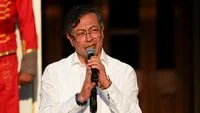
The political landscape of Colombia has been thrust into a state of profound volatility following the announcement by the Supreme Court of Justice that a formal investigation has been launched into former President Gustavo Petro. The probe, which centers on explosive allegations of corruption and sexual misconduct, stems from claims that the former head of state allegedly exchanged government contracts for sexual favors during his tenure in public office. This development marks a significant escalation in the legal challenges facing the leftist leader, who transitioned from the presidential palace in August of this year to a prominent role leading the opposition against the current administration of President Abelardo de la Espriella.
The allegations were brought to the forefront by Chief Justice Mauricio Lenis, who confirmed that the high court, in coordination with the Office of the Prosecutor General, is scrutinizing a series of events spanning several years. According to official statements, the scope of the inquiry covers activities dating back to Petro’s long-standing tenure as a member of the Colombian Congress, as well as specific incidents alleged to have occurred while he occupied the nation’s highest executive office.
The Genesis of the Allegations
The investigation was triggered by a formal complaint filed by a woman, whose identity remains protected, detailing an alleged systemic practice of corruption. In her testimony to the prosecution, the complainant asserted that she, along with an estimated group of 30 other women, had been granted lucrative government contracts in direct exchange for sexual relations with Petro.
The gravity of these claims was further amplified by the emergence of digital evidence. Deicy Jimenez, a former government contractor, disseminated a video on social media platforms that quickly gained viral status. The footage depicts Jimenez and Petro in an intimate setting, characterized by embraces and displays of physical affection, following what the claimant describes as a transactional encounter. While the video does not explicitly confirm the exchange of state funds for sexual acts, its circulation has provided a focal point for public outcry and intensified the legal scrutiny directed at the former president.
A Chronology of the Legal Crisis
Gustavo Petro’s career has been defined by his long-term presence in Colombian politics, spanning over three decades. His legislative career, which began in 1991 and continued intermittently through 2022, is now under the microscope alongside his presidential term (2022–2026).
- 1991–2022: Petro serves five terms in the Colombian Congress, building a reputation as a fierce critic of the political establishment. The Supreme Court is currently reviewing whether patterns of behavior established during these years provided the blueprint for the alleged corruption during his presidency.
- August 2022: Petro is inaugurated as the President of Colombia, promising a "government of change."
- August 2026: Petro completes his presidential term and transitions into the role of opposition leader against the administration of Abelardo de la Espriella.
- November 2026: The Supreme Court of Justice publicly acknowledges the existence of a secret investigation into the allegations of sexual misconduct and contract peddling.
Official Responses and Defense Strategies
In the wake of the public disclosure, Gustavo Petro has categorically denied all allegations of wrongdoing. Speaking through legal representatives, the former president characterized the claims as a politically motivated attempt to dismantle his legacy and undermine his current role as the leader of the opposition.
"There has been no government contract issued for the purpose of obtaining benefits or rewards from any individual," Petro stated in a formal rebuttal. He emphasized his commitment to the judicial process, pledging to address the accusations through established legal channels rather than engaging in a war of words in the public sphere.
The Petro family has also weighed in on the unfolding scandal. His daughters, Antonella and Sofia Petro, issued a joint statement urging the public and the media to exercise restraint, specifically cautioning against the re-victimization of the woman who filed the initial complaint. "We believe that our father, as he has expressed, will appear before the courts without delay to clear his name," the statement read, striking a note of confidence in the judicial proceedings.
Broader Implications for Colombian Governance
The investigation into Petro carries significant implications for the stability of Colombia’s political institutions. The case touches on two sensitive areas: the integrity of public procurement processes and the ethical standards expected of the nation’s highest officials.
The allegation that government contracts were distributed as personal favors is particularly damaging. Colombia has long grappled with systemic corruption, and the potential for "contract-for-sex" schemes suggests a level of institutional decay that could erode public trust in both the executive and legislative branches. Economists have frequently cited the lack of transparency in government contracting as a primary barrier to economic development in Latin America; should these allegations be proven, it could lead to a sweeping overhaul of the nation’s procurement laws and oversight mechanisms.
Furthermore, the scandal has ignited a broader cultural debate regarding the treatment of women in Colombian politics. Petro has faced criticism in the past for his rhetoric, most notably when he referred to a group of female journalists as "mafia puppets." This history has emboldened critics who argue that the current investigation is symptomatic of a deeper, long-standing disregard for women within his political orbit.
The Role of Social Media in Modern Political Warfare
The current situation is also a case study in the influence of social media on political accountability. The rapid spread of the video featuring Petro and Jimenez demonstrates how visual evidence, regardless of its legal admissibility, can dictate the pace of a criminal investigation.
Simultaneously, the digital landscape has become a battleground for public opinion. Pro-Petro factions have attempted to deflect the controversy through meme culture, using slogans like "let us practice the politics of love" to defend the former leader. However, these attempts to trivialize the situation have faced significant pushback from feminist groups and anti-corruption watchdogs, who argue that the nature of the allegations warrants a serious, evidence-based inquiry rather than partisan deflection.
Analytical Perspective: The Judicial Path Ahead
For the Supreme Court of Justice, the challenge lies in maintaining impartiality in a highly polarized environment. The investigation is currently in a "reserve" phase, meaning details regarding the specific contracts in question and the testimonies of the other 30 women remain sealed.
Legal experts suggest that the court will focus on three key pillars:
- Financial Audit: Analyzing the specific government contracts mentioned in the complaint to determine if they were awarded to unqualified individuals or through non-competitive bidding processes.
- Digital Forensics: Determining the authenticity of the viral footage and establishing a timeline of the interactions between Petro and the complainants.
- Witness Corroboration: Verifying the testimonies of the other women mentioned in the report to see if a systematic pattern of behavior exists, which could elevate the case from isolated claims to a charge of racketeering or abuse of power.
As the investigation proceeds, the international community will likely keep a close watch on Colombia. The country, which has been a key strategic partner for Western nations, is currently navigating a delicate period of transition. The outcome of the Petro investigation will not only determine the political future of the former president but will also serve as a barometer for the strength of Colombia’s democracy and its ability to hold its most powerful figures accountable under the rule of law.
In conclusion, while Gustavo Petro remains the presumed innocent until proven guilty, the mere existence of a formal Supreme Court investigation into such grave allegations represents a critical juncture for the nation. Whether this leads to a landmark legal precedent or ends as a failed political witch hunt, the proceedings will undoubtedly reshape the political landscape of Colombia for years to come.

