
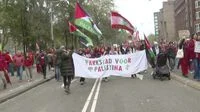
The historic city center of Amsterdam transformed into a sea of red this past Sunday as more than 200,000 demonstrators took to the streets in a massive show of solidarity with the Palestinian people. The protest, branded as the "Red Line" (Garis Merah) demonstration, represents one of the largest public mobilizations in the Netherlands in recent years. Organized by a coalition of human rights groups, including the Dutch branch of Amnesty International, the event served as a clarion call for the Dutch government to pivot from passive diplomatic rhetoric to concrete, punitive action against Israel’s ongoing military campaign in the Gaza Strip.
The scale of the mobilization underscores a deepening rift between the Dutch public sentiment and the government’s cautious diplomatic posture. As the marchers navigated the cordoned-off thoroughfares of Amsterdam, the chants of "Free Palestine!" resonated through the canals, signaling a profound frustration with the perceived inaction of Western powers in the face of what protesters described as a humanitarian catastrophe of historic proportions.
The Genesis of the Red Line Protest
The Red Line campaign derives its name from the metaphorical boundary that participants believe the Israeli military crossed long ago. For organizers, the sheer volume of casualties and the systemic destruction of civilian infrastructure in Gaza represent a violation of international law that can no longer be ignored by the international community, specifically the Dutch administration.
Mike van Dongen, a participant who traveled from the outskirts of Amsterdam to join the march, articulated the sentiment shared by many in the crowd. "What is happening there is fundamentally inhumane," he stated. "The Dutch authorities appear paralyzed. They talk of mediation and concern, but they lack the political courage to impose the serious measures required to compel a change in Israel’s strategy."
This sentiment is not isolated. The Sunday demonstration follows a series of escalating protests that have occurred periodically since the intensification of the conflict in October 2023. Previous gatherings in The Hague—the seat of the Dutch government—served as precursors to this massive assembly in Amsterdam, indicating a sustained and growing movement that refuses to be sidelined by shifting political winds.
Chronology of a Protracted Conflict
To understand the intensity of the current protests, one must examine the timeline of the conflict that has fueled such widespread public outcry. Since the escalation in October 2023, the death toll in Gaza has reached staggering levels. According to reports cited by health officials and international monitors, at least 74,000 Palestinians have been killed. Perhaps most devastatingly, international aid organizations estimate that approximately 21,000 of these casualties are children, a statistic that has been central to the emotional and ethical arguments presented by the protesters.
- October 2023: The conflict escalates, triggering widespread international condemnation and immediate public outcry in Europe.
- October 10, 2024: A tentative ceasefire agreement is reached; however, monitoring groups note that sporadic violence, localized strikes, and systemic humanitarian hurdles persist, effectively rendering the truce fragile at best.
- June and October 2024: Major protest waves hit The Hague, with thousands demanding a change in Dutch foreign policy regarding arms exports.
- November 2026: The "Red Line" protest in Amsterdam sets a new benchmark for public participation, marking the largest anti-war demonstration in the Netherlands since the start of the conflict.
The persistence of violence, despite intermittent diplomatic efforts, has fostered a sense of betrayal among the Dutch electorate. Protesters argue that the existence of a ceasefire agreement is meaningless if the humanitarian situation on the ground continues to deteriorate due to blockade-induced famine and infrastructure collapse.
Diplomatic Friction and Governmental Response
The war in Gaza has not only impacted the streets of Amsterdam but has also destabilized the internal mechanics of the Dutch government. The diplomatic fallout from the conflict reached a breaking point last year when the Minister of Foreign Affairs resigned, citing an inability to influence the cabinet to adopt more stringent sanctions against Israel.
The current minority coalition, which assumed power in February, has found itself in a precarious position. Attempting to balance traditional alliances with the demands of a vocal and mobilized populace, the government has taken modest steps, such as banning the import of products originating from Israeli settlements in occupied Palestinian territories. While these moves were welcomed by human rights groups, they triggered a sharp diplomatic dispute with Israel, which views such measures as a departure from traditional bilateral cooperation.
Prime Minister Rob Jetten, who has previously participated in pro-Palestinian demonstrations in a private capacity, now finds himself on the other side of the protest line. In a press conference held last Friday, Jetten sought to defend his administration’s record. "Every day and every week, we are working to the best of our ability to alleviate the horrific situation in the region," he stated. He emphasized that the government is engaged in constant political and diplomatic maneuvering to pressure Israel into adhering to international agreements.
However, the protesters remain unconvinced. The primary demand of the Sunday demonstration was clear: the immediate cessation of all arms sales to Israel. For the marchers, the sale of military equipment is viewed as direct complicity in the conflict, and they argue that diplomatic "pressure" without economic consequences is essentially ineffective.
Implications of the Dutch Stance
The Dutch position is reflective of a broader tension within the European Union. While many member states are hesitant to break from long-standing security partnerships, the internal pressure from citizens is creating a new political reality. The "Red Line" demonstration serves as a signal to the Dutch government—and by extension, European leadership—that the status quo is becoming politically unsustainable.
From an analytical standpoint, the implications are two-fold:
- Domestic Political Realignment: The continued pressure from the electorate is likely to push mainstream parties to adopt more critical stances on foreign policy. If the current coalition fails to address these concerns, it risks further erosion of its support base, potentially leading to a more polarized political environment in upcoming electoral cycles.
- International Diplomatic Precedent: Should the Netherlands decide to impose a total embargo on arms sales or further restrict trade with Israel, it could trigger a domino effect within the EU. Such a move would force other nations to define their own "red lines," potentially leading to a unified European strategy that is significantly more aggressive toward the current Israeli military strategy.
The Human Cost and the Path Forward
The narrative of the protest is rooted in the overwhelming data concerning civilian suffering. International humanitarian organizations have consistently highlighted that the destruction of healthcare facilities, schools, and essential utility grids in Gaza has created a multi-generational crisis. The "Red Line" participants argue that by continuing to facilitate trade and military exchange, the Netherlands is ignoring the long-term geopolitical and moral consequences of the war.
As the protesters dispersed on Sunday evening, the message left behind was one of resolve. The organizers have already indicated that if their demands regarding a total arms embargo are not met, the scale of future demonstrations is likely to grow even larger.
For the government in The Hague, the challenge is clear. They must navigate a path that addresses the intense moral imperatives of their citizens while maintaining the complexities of international relations. Whether the government will bow to the pressure of the 200,000 people who walked the streets of Amsterdam remains to be seen, but one thing is certain: the conversation surrounding the Dutch role in the Gaza conflict has shifted from the fringes of political discourse to the very center of national debate.
The events of this weekend in Amsterdam will likely be remembered as a pivotal moment in the domestic response to the war. It signifies a transition from symbolic support to active, organized advocacy, placing the Dutch government under a spotlight that will not dim until tangible, visible changes in policy are enacted. As the world watches, the "Red Line" protesters have made their position clear: they are no longer willing to wait for diplomacy to resolve a crisis they believe has already crossed every threshold of human decency.

