
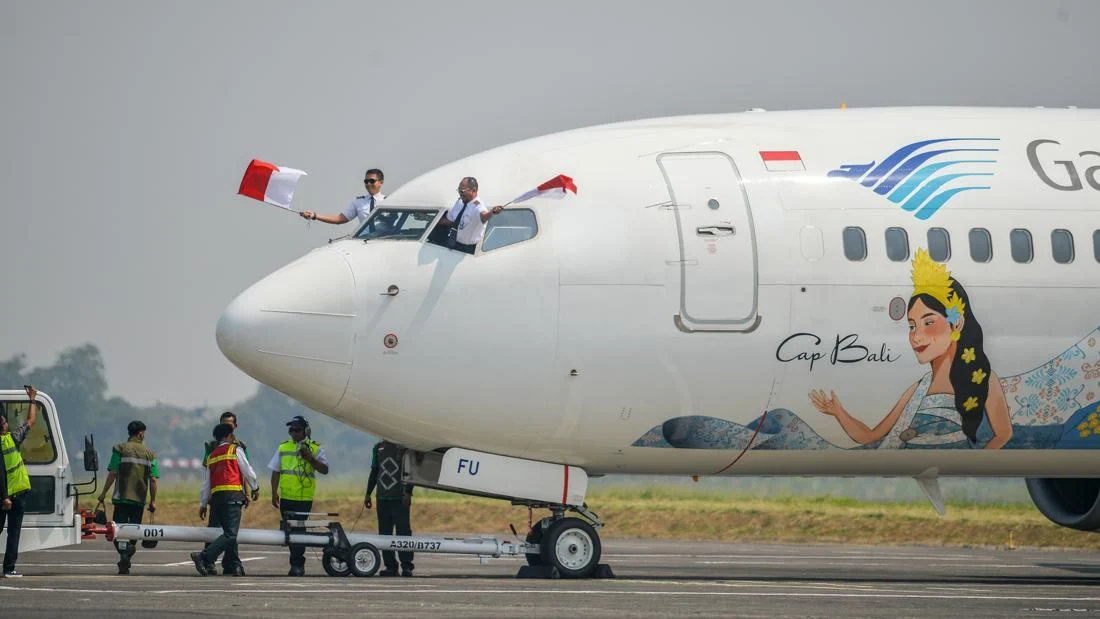
The Indonesian government has officially set its sights on a comprehensive revitalization of the national flag carrier, PT Garuda Indonesia (Persero) Tbk. President Prabowo Subianto has explicitly instructed the airline’s newly appointed leadership to execute a total operational and structural transformation. The ultimate objective of this sweeping mandate is twofold: to restore Garuda Indonesia to its former prestige as a world-class airline, and to ensure that the corporate entity transitions into a financially sustainable, highly profitable business model capable of weathering volatile global aviation markets.
This directive was officially communicated during a high-level presidential meeting held at the State Palace in Jakarta. The closed-door session brought together President Prabowo Subianto and the newly installed Director-General and Chief Executive Officer of Garuda Indonesia, Thomas Sugiarto Oentoro. Speaking to members of the press corps following the briefing, CEO Thomas Sugiarto Oentoro elaborated on the administration’s core expectations, emphasizing that the government views the national airline not merely as a symbol of national pride, but as a strategic economic asset that must no longer rely on state bailouts or unsustainable operational practices.
The demand for an overhaul comes at a critical juncture for Garuda Indonesia. While the airline carries immense historical significance as the aerial ambassador of the archipelago, its path forward is fraught with operational hurdles, legacy financial burdens, and rising consumer expectations. As the airline embarks on this ambitious journey of renewal, the management team faces the formidable task of reconciling high-level government ambitions with the gritty, day-to-day realities of passenger service delivery and fleet management.
The Leadership Mandate and Corporate Governance Shift
The appointment of Thomas Sugiarto Oentoro to the helm of Garuda Indonesia serves as the cornerstone of this ongoing corporate restructuring. Oentoro was officially installed as the President Director during an Extraordinary General Meeting of Shareholders (RUPSLB) convened on October 8, 2026. He stepped into the role succeeding Glenny H. Kairupan, who subsequently transitioned to a governance oversight role, assuming the mandate of President Commissioner.
Since taking office, Oentoro has faced immediate pressure from both the board of shareholders and the executive branch to chart a clear, unyielding course toward operational efficiency. During the recent presidential consultation, President Prabowo underscored the necessity for strict accountability, requesting that the executive team submit regular, detailed progress reports concerning every phase of the transformation roadmap.
Industry analysts note that this level of direct executive oversight highlights the current administration’s hands-on approach to state-owned enterprise (SOE) reform. Under the leadership of President Prabowo, state enterprises, particularly those operating in strategic sectors such as aviation and transportation, are increasingly being held to strict key performance indicators (KPIs) regarding profitability, corporate governance, and public service obligations. For Garuda, this means that the traditional narrative of the national carrier being "too big to fail" has been decisively replaced by a mandate for commercial viability.
The Operational Reality: Analyzing Passenger Complaints and Service Gaps
While the pursuit of global prestige and profitability forms the overarching vision of the transformation agenda, Garuda Indonesia’s immediate operational metrics reveal substantial areas requiring urgent remediation. A deep dive into the company’s internal metrics, as highlighted in the official Garuda Indonesia Sustainability Report 2025, underscores the immense pressure facing the airline’s customer service and ground operations divisions.
Throughout the 2025 reporting period, the airline recorded a staggering total of 164,668 formal customer complaints. These grievances were systematically categorized by the carrier into five primary operational pain points, shedding light on systemic bottlenecks within the network:
- Flight Schedule Alterations: By far the most significant driver of consumer dissatisfaction, schedule changes accounted for 106,140 separate reports. Frequent adjustments to departure times, route cancellations, and itinerary shifts severely impacted passenger trust and travel planning.
- Off-Site Check-In Experiences: Difficulties and friction points associated with check-in processes conducted outside of traditional airport terminals generated 30,077 complaints. As digital and remote check-in avenues expand, ensuring seamless integration with legacy systems remains a persistent challenge.
- Processing and Administrative Timeframes: The general speed, bureaucracy, and efficiency of administrative customer service processes accounted for 13,978 grievances, pointing to bottlenecks in bureaucratic responsiveness.
- Delay Management: The handling, communication, and mitigation strategies surrounding flight delays drew 7,643 complaints. In the aviation sector, transparent communication during operational disruptions is critical to preserving brand loyalty.
- Baggage Handling Issues: Incidents involving delayed, damaged, or lost luggage resulted in 6,830 formal complaints.
Notably, within the parameters of the 2025 Sustainability Report, all five categories of these customer complaints were officially logged as "on progress," indicating that while remediation frameworks were actively deployed, structural resolutions remained ongoing at the close of the financial year.
Balancing Feedback: The Customer Voice Management Ecosystem
To contextualize the volume of grievances, company data indicates that complaints represent only a fraction of the total consumer interaction ecosystem. Throughout 2025, Garuda Indonesia’s centralized customer voice management system captured a massive total of 2,052,411 individual customer touchpoints.
This overarching metric encompasses a wide spectrum of engagement, ranging from direct complaints and formal suggestions to positive commendations, service inquiries, and general informational requests. While the sheer volume of over two million interactions demonstrates robust customer engagement with the brand, it also highlights the monumental administrative undertaking required to process, analyze, and act upon consumer feedback in real-time. Customer relations experts argue that unlocking the value of this vast data repository will be vital for the success of Garuda’s transformation, as it provides actionable intelligence regarding passenger preferences and pain points.
The Synergy Discourse: Garuda Indonesia and Pelita Air
In tandem with internal operational overhauls, the broader strategic landscape of Indonesia’s aviation sector involves structural consolidation. When pressed regarding the much-anticipated merger or strategic integration between Garuda Indonesia and Pelita Air—another prominent player in the national airspace—CEO Thomas Sugiarto Oentoro maintained a measured stance.
Oentoro clarified that any future consolidation moves will strictly adhere to ongoing, formalized dialogues involving Pelita Air management and PT Danantara Indonesia, the premier state-owned investment management body acting as a principal shareholder.
"That matter will be discussed in strict accordance with the parameters that have already been deliberated upon with the team at Pelita and with Danantara as our shareholder," Oentoro stated.
The potential synergy between Garuda Indonesia and Pelita Air has long been a subject of intense discussion among macroeconomic analysts and aviation experts. Proponents of the consolidation argue that integrating the fleets, route networks, and administrative overheads of the two carriers could yield significant economies of scale, eliminate redundant domestic competition, and optimize the deployment of aircraft across both premium and regional budget segments. However, institutional stakeholders remain cautious, emphasizing that any structural merger must be executed without diluting brand equity or overwhelming Garuda’s delicate balance sheet during its ongoing recovery phase.
Broader Economic Implications and Path Forward
The mandate handed down by President Prabowo to Garuda Indonesia carries significant implications for the broader Indonesian economy and the national tourism sector. As an archipelagic nation reliant on robust air connectivity to drive commerce, regional development, and international tourism, Indonesia requires an anchor airline capable of bridging domestic destinations with major global hubs.
Achieving a "world-class" standing requires more than just pristine cabin interiors or marketing campaigns; it demands rigorous adherence to international safety standards, punctual schedule execution, digitized infrastructure, and a customer-centric corporate culture. For an airline that has navigated through high-profile debt restructurings, global pandemics, and complex ownership shifts over the past decade, the pathway mandated by the current administration is both a lifeline and an ultimate test.
As CEO Thomas Sugiarto Oentoro and his executive team move forward with executing the total transformation framework, all eyes will be on how effectively the airline can translate high-level presidential ambitions into tangible service improvements. By addressing the root causes of passenger dissatisfaction—particularly regarding schedule reliability and ground operations—while simultaneously securing long-term financial profitability, Garuda Indonesia stands at a historic crossroads. The decisions made and executed over the coming months will determine whether the national carrier can successfully reclaim its legacy as a proud, self-sustaining pillar of global aviation.

