
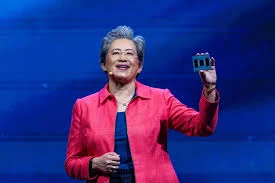
Advanced Micro Devices (AMD) stands today as a formidable force in the global technology landscape, boasting a market capitalization of approximately $675 billion. This staggering valuation represents one of the most remarkable corporate turnarounds in modern business history. When Lisa Su assumed the role of Chief Executive Officer in 2014, AMD was widely considered a failing enterprise on the brink of bankruptcy. Under her visionary leadership, the company not only survived a near-fatal financial crisis but successfully pivoted to become a premier supplier of high-performance computing and artificial intelligence infrastructure. Today, AMD aggressively challenges the market dominance of Nvidia—a technology titan led by Jensen Huang, who happens to be Su’s distant cousin.
The Genesis of a Crisis: AMD in 2014
To understand the magnitude of Lisa Su’s achievement, one must examine the perilous state of AMD when she took the helm. Founded in 1969, the semiconductor company had historically played second fiddle to Intel in the personal computer processor market. By 2014, however, the situation had deteriorated far beyond historical rivalries. AMD was burdened with nearly $2.5 billion in long-term debt, its share price had plummeted to a dismal $1.61, and its total market capitalization had shrunk to less than $2 billion.
Financial distress was compounded by operational paralysis. The company’s annual revenue had grown in only one of the preceding five years, forcing leadership to execute drastic cost-cutting measures. AMD had already laid off roughly a quarter of its global workforce, sold and leased back its corporate headquarters in Austin, Texas, and spun off its capital-intensive manufacturing operations as the global PC market weakened. Rumors of impending bankruptcy and corporate breakup swirled endlessly through Wall Street and Silicon Valley. Former AMD executive Patrick Moorhead famously described the company during that era as being in a state of "literal corporate life support."
Despite the daunting landscape, Su viewed the position as the fulfillment of a lifelong ambition. Having dedicated her professional life to the semiconductor industry, she recognized the scarcity of major American chipmakers and embraced the challenge. Upon taking office, she immediately addressed the workforce, establishing a clear, streamlined recovery plan focused on three core objectives: building great products, deepening customer trust, and simplifying company operations to maintain absolute focus.
An Engineering Pedigree: From MIT to the C-Suite
Lisa Su’s journey to executive leadership was forged through rigorous academic discipline and hands-on technical expertise. Born in Taiwan, she immigrated to the United States with her family at the age of three so her father, a trained statistician, could pursue graduate studies. Growing up in New York City, Su displayed an early fascination with how things worked, frequently dismantling toys to examine their internal mechanisms.
Her academic capabilities were honed at the prestigious Bronx High School of Science, an institution renowned for producing leading researchers and scientists. Following her graduation in 1986, Su enrolled at the Massachusetts Institute of Technology (MIT) to study electrical engineering, deliberately choosing what she perceived as the most rigorous curriculum available. She earned both her undergraduate degree and her Ph.D. from MIT, completing doctoral research centered on MOSFETs—the microscopic switches that regulate electrical current inside computer chips.
Su’s early professional trajectory provided invaluable exposure to operational management and large-scale enterprise strategy. She spent formative years at Texas Instruments and IBM, where she rotated through diverse technical and managerial assignments every two years. In 2012, she joined AMD as senior vice president and general manager of global business units, viewing the post as the ultimate testing ground for her accumulated knowledge. Two years later, she shattered a glass ceiling by becoming the first female CEO in AMD’s history.
Strategic Pivot and the Zen Revolution
One of Su’s most consequential strategic maneuvers was steering AMD away from low-margin consumer electronics and redirecting its resources toward high-performance computing, cloud infrastructure, data centers, and advanced gaming. Recognizing that semiconductor development requires immense capital investment and multi-year planning cycles, she committed the company’s engineering teams to a complete architectural overhaul.
The cornerstone of this turnaround materialized in 2017 with the launch of the "Zen" CPU architecture. The Zen microarchitecture shattered Intel’s long-standing monopoly on high-end desktop and server processors, instantly restoring AMD’s competitive edge. By 2020, AMD processors had established industry benchmarks for speed and efficiency, enabling the company to forge lucrative partnerships with global technology leaders including Microsoft, Meta, NASA, Oracle, Lenovo, and Dell Technologies.
Furthermore, AMD hardware was selected to power some of the world’s most powerful supercomputers, such as the Frontier system at Oak Ridge National Laboratory and the El Capitan system at Lawrence Livermore National Laboratory. These technological triumphs laid the groundwork for AMD’s subsequent expansion into artificial intelligence, a market that would soon redefine the global technology sector.
The AI Boom and Modern Milestones
As artificial intelligence evolved from a specialized research field into the primary driver of global IT spending, AMD positioned itself as a critical alternative to market leader Nvidia. The company’s ambitions in the AI space reached a significant inflection point in October 2025, when AMD announced a multi-billion-dollar partnership with OpenAI. This landmark agreement integrated AMD’s advanced Graphics Processing Units (GPUs) into OpenAI’s infrastructure, providing massive computational capacity to support next-generation large language models.
Market response to AMD’s AI strategy has been overwhelmingly positive. Financial reports released throughout 2025 and into 2026 consistently surpassed Wall Street consensus estimates, fueled by insatiable enterprise demand for specialized AI accelerators. Company valuations soared, with Su’s personal net worth reflecting the meteoric rise of the stock through equity ownership and performance-based compensation. Her leadership style—characterized by rigorous operational oversight, late-night report reviews, and a relentless demand for speed—has earned widespread acclaim. Notably, she was named Time magazine’s CEO of the Year for 2024, marking the first time a woman received the distinction.
The Nvidia Rivalry and Future Implications
The narrative of AMD’s resurgence is frequently intertwined with its relationship with Nvidia, currently valued at over $5 trillion. The dynamic between the two competing firms carries a personal dimension, as Lisa Su and Nvidia CEO Jensen Huang are distant relatives. Huang’s mother is a sister to Su’s grandfather. However, because Su grew up in New York while Huang spent his childhood in Thailand and Oregon, the two executives did not cross paths until they were already established figures in the semiconductor industry.
Despite Nvidia’s commanding lead in AI hardware, Su maintains an objective perspective on market dynamics, rejecting the notion of a winner-takes-all industry. She has repeatedly emphasized that healthy competition benefits the broader technology ecosystem by preventing monopolistic pricing and proprietary lock-in. By championing open standards and high-performance alternatives, AMD continues to carve out a dominant market share.
As the semiconductor industry navigates the complexities of the AI era, Lisa Su remains focused on execution and technical innovation. Observers and industry historians agree that her engineering background, combined with disciplined strategic foresight, has permanently altered the competitive landscape of global technology, securing AMD’s legacy as a cornerstone of modern computing infrastructure.

