

Modern cybersecurity paradigms are shifting rapidly as threat intelligence providers uncover the sophisticated, prolonged methodologies employed by contemporary cybercriminal syndicates. A comprehensive new whitepaper released by regional cybersecurity firm ITSEC Asia has fundamentally challenged the traditional understanding of ransomware campaigns. Titled From Sample to Signal: Uncovering the GodDamn Ransomware Operation, the research reveals that malicious actors routinely establish deep, persistent footholds within corporate networks weeks—and sometimes months—before executing the final payload that locks a victim’s files and displays a ransom note.
For decades, organizational incident response protocols have treated ransomware primarily as an acute event: a malicious binary arrives, executes swiftly, encrypts critical data, and paralyzes business operations. However, ITSEC Asia’s deep-dive analysis into the operational mechanics of the "GodDamn" ransomware strain demonstrates that encryption is merely the dramatic concluding act of a protracted, stealthy campaign. By the time an organization notices locked screens or altered file extensions, the threat actors have typically already completed extensive reconnaissance, credential harvesting, privilege escalation, and lateral movement across multiple internal hosts.
The findings underscore an urgent need for enterprise security leadership to pivot away from reactive defense mechanisms and toward proactive, early-stage behavioral detection. As corporate networks grow increasingly complex and hybrid work models expand attack surfaces, understanding the lifecycle of a ransomware attack has become critical for survival in the digital economy.
Decoding the Pre-Encryption Phase: A Multi-Stage Infiltration
The ITSEC Asia research paper meticulously maps out the behavioral indicators that precede the ultimate deployment of ransomware. Rather than operating as a sudden hit-and-run malware variant, the GodDamn ransomware operations examined in the study exhibited advanced capabilities tailored for both Windows and Linux environments, indicating a cross-platform versatility designed to target diverse enterprise infrastructures.
According to the analysis, the lifecycle of the attack begins well before any files are modified. In one specific incident evaluated during the research, threat actors systematically leveraged remote access tools, gathered administrative and user credentials, mapped network topologies, and executed lateral movement across at least ten distinct internal hosts before initiating the encryption sequence.
This phased approach allows attackers to quietly compromise domain controllers, exfiltrate sensitive intellectual property, and disable or tamper with security controls before the victim realizes a breach has occurred. The research highlights a series of warning signs that security operations centers (SOCs) should monitor during this precursor window. These indicators include unusual script executions, unauthorized modifications to system registries and critical Windows services, address resolution protocol (ARP) scanning, server message block (SMB) probing, sudden massive file modification spates, and the eventual generation of ransom notes.
Furthermore, the research touched upon reports regarding the utilization of PoisonX, a malicious kernel driver allegedly deployed to disrupt and neutralize endpoint protection products before the encryption phase commences. While ITSEC Asia categorized the PoisonX finding strictly under "Reported"—signifying that it stemmed from external investigative reports rather than independent reverse engineering within this specific study—it underscores the extreme measures modern threat actors take to blind security teams prior to striking the final blow.
Methodology and the Tri-Categorization Framework
To maintain absolute empirical rigor and prevent the misattribution of isolated anomalies as universal industry trends, ITSEC Asia structured its research methodology using a strict three-tier categorization framework: Observed, Reported, and Assessed.
This analytical approach ensures that data points derived from a single malware sample, an isolated incident response engagement, or external threat intelligence feeds are contextualized accurately. By separating firsthand forensic observations from third-party reports and analytical assessments, the firm provides a reliable baseline for security professionals attempting to parse through the noise of modern threat intelligence feeds.
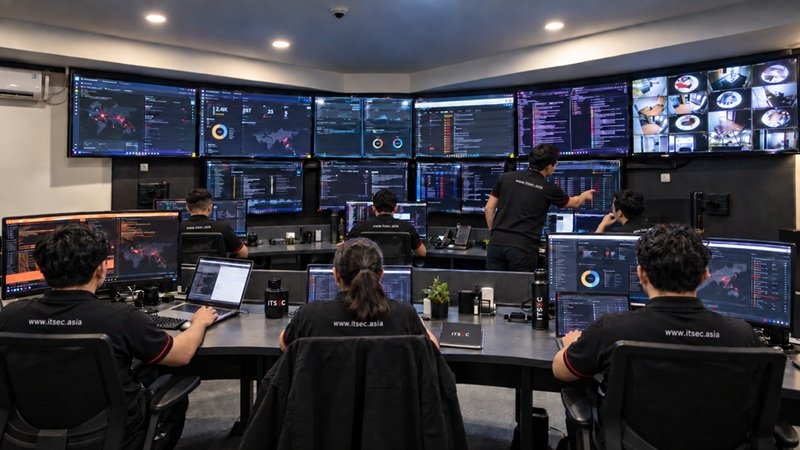
Patrick Dannacher, President Director of ITSEC Asia, emphasized the profound implications of this structured visibility during a briefing on the whitepaper’s release.
"Ransomware often remains invisible to organizations until files are already encrypted and operational continuity is severely disrupted," Dannacher stated. "However, before that stage is ever reached, attackers have typically spent considerable time acquiring access, harvesting credentials, and navigating freely within the internal network architecture."
Dannacher’s remarks point to a glaring blind spot in traditional security architectures. Many organizations heavily invest in perimeter defenses and endpoint detection and response (EDR) agents configured primarily to catch known malicious file signatures at the moment of execution. If an attacker utilizes legitimate administrative tools (Living off the Land techniques) or steals valid credentials, traditional signature-based security alerts may remain completely silent.
The Strategic Imperative: Moving from Reactive to Behavioral Detection
The implications of the ITSEC Asia findings call for an immediate overhaul of enterprise threat-hunting strategies. Security teams are strongly advised to transition their focal points away from the moment of encryption and toward the subtle precursors of lateral movement and credential abuse.
To effectively intercept campaigns like the GodDamn ransomware operation, organizations must enhance their behavioral detection capabilities, achieve comprehensive endpoint and network visibility, and implement robust, immutable data backup and recovery infrastructures. Furthermore, security analysts must be trained to aggressively investigate anomalies that are frequently dismissed as false positives or routine administrative actions.
Specific operational recommendations highlighted in the whitepaper include:
- Rigorous monitoring of unusual or unauthorized remote access sessions across non-standard hours.
- Heightened vigilance against internal reconnaissance behaviors, such as SMB probing and ARP scanning.
- Immediate escalation protocols for unexpected lateral movement between workstation endpoints and critical server environments.
- Continuous tracking of anomalous, high-volume file modifications that could indicate early-stage staging or mass renaming.
- Strict protection and behavioral auditing of endpoint protection mechanisms to spot unauthorized attempts to disable security agents or drivers.
"The faster an organization can correlate disparate signals originating from user identities, endpoints, and network traffic, the higher their probability of neutralizing an active intrusion before it reaches mission-critical systems," Dannacher explained.
Broader Industry Implications and Future Outlook
The publication of From Sample to Signal arrives at a critical juncture for the global cybersecurity landscape. As ransomware-as-a-service (RaaS) models continue to lower the technical barrier of entry for cybercriminal organizations, the frequency and sophistication of attacks are scaling exponentially. Threat actors are no longer relying on crude, automated scripts; instead, they operate with the persistence and stealth traditionally associated with Advanced Persistent Threat (APT) nation-state groups.
This convergence of criminal enterprise and sophisticated tradecraft means that organizations can no longer afford to view cybersecurity as a static compliance checkbox. The cost of failing to detect a breach during the pre-encryption phase extends far beyond the immediate ransom demands. Enterprises face protracted operational downtime, regulatory scrutiny, severe reputational damage, and the potential loss of proprietary data.
Ultimately, the research by ITSEC Asia serves as a sobering reminder that the timeline of a ransomware attack is far longer than the panic of a locked screen. By the time a ransom note appears, the battle has usually been lost days or weeks prior. For modern enterprises, securing the network requires shifting the defensive line of sight backward—embracing the reality that identifying and stopping an attacker during the infiltration phase is the only truly effective defense against modern digital extortion.

