
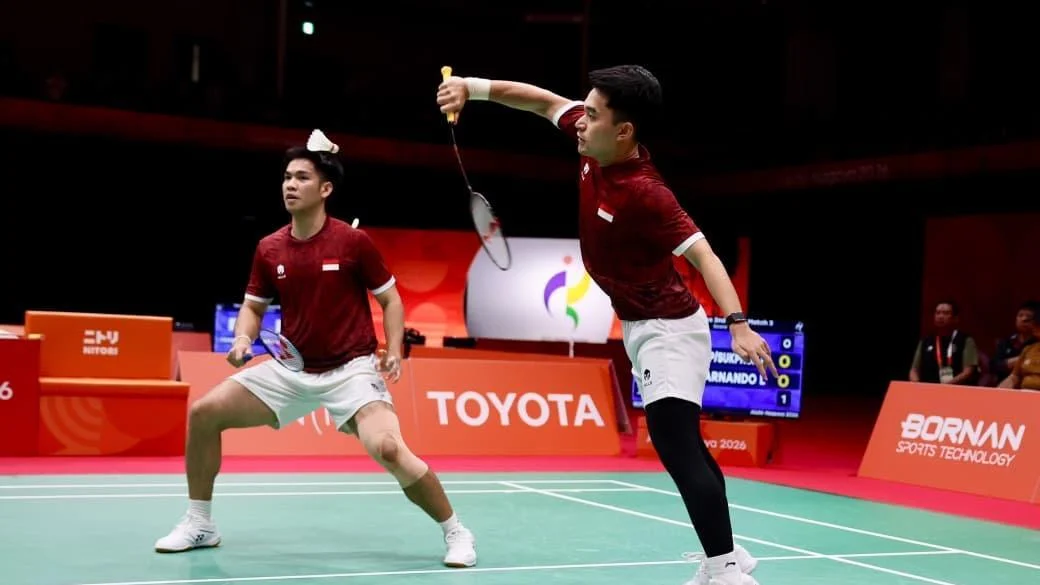
The Indonesian contingent competing at the 2026 Asian Games has etched another golden chapter in the nation’s rich sporting history, courtesy of the men’s doubles badminton pair Leo Rolly Carnando and Daniel Marthin. Emerging triumphant in a high-stakes final held on Tuesday, September 29, 2026, the dynamic duo not only claimed the ultimate prize of the tournament but also propelled Indonesian badminton to a monumental milestone: the thirtieth gold medal in this specific discipline across the history of the quadrennial multi-sport event.
This victory at the 2026 Asian Games further solidifies badminton’s status as the most successful and reliable source of gold medals for Indonesia on the continental stage. By defeating the formidable Chinese pair of Liang Weikeng and Wang Chang in a gripping title match, Leo and Daniel capped off a stellar campaign for the national badminton squad, cementing their legacy alongside legendary predecessors who have flown the Red and White flag high over decades of international competition.
The Path to Glory: A Campaign Defined by Resilience
The journey to the top of the podium in the 2026 edition was far from a solitary achievement; it was the culmination of a broader team effort that demonstrated depth, tactical discipline, and immense mental fortitude. Prior to their individual glory in the men’s doubles bracket, Leo and Daniel had already proven their mettle in the fiercely contested men’s team event.
During the men’s team final, Indonesia faced a titanic struggle against arch-rivals China. In a nail-biting tie that swung back and forth, the Indonesian squad ultimately prevailed with a 3-2 scoreline to capture the team gold. Crucially, Leo and Daniel played a pivotal role in that championship tie, delivering a vital point for the contingent by overcoming the Chinese combination of He Ji Ting and Liu Yi. That initial triumph not only set the tone for the rest of the badminton campaign but also provided the necessary momentum that carried Leo and Daniel through the rigorous individual tournament rounds culminating in the September 29 showdown.
Entering the individual men’s doubles final, the Indonesian pair faced an elite test against Liang Weikeng and Wang Chang. The Chinese duo, known for their aggressive attacking style and suffocating net play, pushed the Indonesians to their absolute limits. However, Leo and Daniel displayed remarkable poise under pressure, neutralizing their opponents’ power game with sharp defensive displays and clinical counter-attacks. The victory not only sealed the individual title but also provided a sweet crescendo to their multi-medal campaign in 2026.
Historical Context and the Expanding Legacy of Indonesian Badminton
Before the commencement of the 2026 Asian Games, the historical records of the Olympic Council of Asia and the Indonesian National Sports Committee indicated that badminton had accumulated a total of 28 gold medals throughout the history of the Games. This legacy began decades ago, built upon the sweat and brilliance of past legends such as Rudy Hartono, Liem Swie King, Taufik Hidayat, Christian Hadinata, Rexy Mainaky, Ricky Subagja, Tony Gunawan, Candra Wijaya, Markis Hendra, Hendra Setiawan, and a host of other legendary doubles and singles champions.
With the addition of the men’s team gold and the subsequent individual men’s doubles gold secured by Leo and Daniel at the 2026 Games, the cumulative gold medal tally for Indonesian badminton officially reached the milestone figure of 30. This achievement moves the sport further ahead of its closest domestic competitor in terms of Asian Games productivity, widening the gap at the summit of Indonesia’s all-time sporting triumphs.
To understand the sheer dominance of badminton in Indonesia’s Asian Games history, one must examine the broader distribution of gold medals across various disciplines. A statistical breakdown of the nation’s top five gold-producing sports reveals a distinct hierarchy:
Table: Top Five Gold-Producing Sports for Indonesia in Asian Games History (Post-2026)
| No. | Sport | Gold Medals |
|---|---|---|
| 1 | Badminton | 30 |
| 2 | Tennis | 15 |
| 3 | Pencak Silat | 14 |
| 4 | Cycling | 6 |
| 5 | Athletics | 4 |
As illustrated by the data, badminton holds double the number of gold medals compared to tennis, which occupies the second position with 15 titles, and comfortably eclipses traditional martial arts powerhouse pencak silat, which stands at 14 golds. This statistical chasm highlights badminton not merely as a popular pastime in the archipelago, but as a systematic producer of world-class athletic excellence.
Official Responses and National Pride
The historic feat achieved by Leo and Daniel, alongside the wider badminton team, immediately drew praise from sports administrators, government officials, and millions of fans across the nation. Observers within the Indonesian Contingent headquarters noted that the psychological boost provided by the badminton squad served as an invaluable anchor for the entire delegation participating in the 2026 Games.
"The achievement of Leo Rolly Carnando and Daniel Marthin is a testament to the enduring strength of our badminton development pipeline," remarked a high-ranking official from the Indonesian Olympic Committee (KOI). "Reaching thirty gold medals in badminton alone at the Asian Games is a phenomenal record that reflects decades of dedication from athletes, coaches, and support staff. It proves that when our athletes step onto the court, they carry the hopes of an entire nation with profound responsibility and skill."
Coaching staff members echoed these sentiments, emphasizing that the victory was born out of rigorous preparation, tactical adaptability, and intense psychological conditioning. The transition of Leo and Daniel from supporting pillars in the team event to outright champions in the individual category showcased their maturation into elite global competitors capable of handling the heaviest burdens of expectation.
Broader Implications and Future Outlook
The implications of this milestone extend far beyond the immediate celebrations in the host city and Jakarta. Securing the thirtieth gold medal in badminton reinforces the strategic importance of continued financial and infrastructural investment into the sport’s national training center (Pelatnas). As international competition grows increasingly fierce—with traditional powerhouses like China, South Korea, Japan, and emerging nations raising their standards—maintaining Indonesia’s competitive edge requires institutional backing and scientific approaches to sports science and recovery.
Furthermore, this triumph serves as a powerful source of inspiration for the grassroots development of badminton throughout the archipelago. In a country where the sport is woven into the cultural fabric, seeing role models like Leo and Daniel conquer the continental stage motivates a new generation of children picking up a racket in neighborhood halls and local clubs. The visibility of such success ensures a continuous influx of talent into the developmental pipeline, safeguarding the future of the sport.
As the 2026 Asian Games draw toward their conclusion, the images of Leo and Daniel standing atop the podium, watching the Red and White rise while Indonesia Raya plays, will be etched into the collective memory of the sporting public. Their victory is not just a personal triumph or a temporary headline; it is a permanent addition to the annals of Indonesian sports history, anchoring badminton’s legacy as the undisputed crown jewel of the nation’s athletic achievements on the international stage.

