
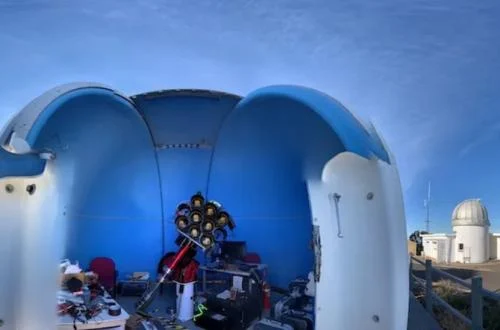
In a significant leap forward for ground-based astronomy, researchers at Macquarie University in Australia have successfully demonstrated a groundbreaking technique that allows for the precise measurement of stars, satellites, and other celestial bodies during broad daylight. Utilizing the unique multi-lens Huntsman Telescope, the team has integrated specialized light filters and advanced processing algorithms to overcome the long-standing barrier of solar glare. This development, led by Sarah Caddy and her colleagues at the Siding Spring Observatory, transforms the traditional limitations of optical astronomy, which has historically been restricted to the darkest hours of the night. By enabling 24-hour monitoring of the sky, this innovation promises to enhance our understanding of stellar behavior and significantly improve the tracking of an increasingly crowded orbital environment.
The Technical Foundations of the Huntsman Telescope
The Huntsman Telescope is not a conventional astronomical instrument. Located at the Siding Spring Observatory near Coonabarabran, New South Wales, the array is inspired by the "Dragonfly Telephoto Array" developed by Yale and Toronto universities. Rather than employing a single, massive primary mirror, the Huntsman utilizes a suite of high-quality, off-the-shelf commercial lenses. Specifically, it features a unique configuration of 10 Canon 400mm f/2.8 L-series IS II telephoto lenses. These lenses are equipped with world-class anti-reflective coatings—originally designed for sports and wildlife photography—which are exceptionally efficient at reducing stray light and ghosting.
The lenses are mounted in a parallel orientation, allowing them to focus on the same patch of sky simultaneously. Each lens is paired with a high-performance CMOS camera and an astro-mechanical focusing system. This multi-aperture approach allows the telescope to capture thousands of short-exposure images per second. When processed collectively, these images can reveal incredibly faint structures around galaxies or, as recently proven, detect bright point sources against the backdrop of a sunlit sky. The parallel processing capability mimics the compound eye of a huntsman spider, providing both a wide field of view and high sensitivity to light, which is the namesake of the project.
Overcoming the Barrier of Solar Rayleigh Scattering
For centuries, the primary obstacle to daytime optical astronomy has been Rayleigh scattering. As sunlight enters Earth’s atmosphere, it scatters off molecules and small particles, creating the bright blue canopy that drowns out the light of distant stars and planets. While radio telescopes can operate during the day without interference from the sun’s optical glare, optical telescopes have generally been rendered blind once the sun rises above the horizon.
The Macquarie University team addressed this by employing specialized broadband filters. These filters are engineered to block the vast majority of the sun’s scattered light while allowing specific, narrow wavelengths of light from celestial targets to pass through. To refine this method, the researchers conducted months of testing on a "mini-Huntsman" pathfinder—a single-lens version of the larger array. This testing phase was crucial for determining the optimal exposure times and understanding how to track targets accurately through the increased atmospheric turbulence (scintillation) caused by daytime heat.
The results, published in the Publications of the Astronomical Society of Australia on May 20, 2024, confirm that the Huntsman can achieve high-precision photometry during the day. This allows astronomers to transition from night-only observations to a continuous monitoring cycle, effectively doubling the operational utility of ground-based optical facilities.
Case Study: Continuous Monitoring of Betelgeuse
One of the most compelling applications of this technology is the observation of "variable stars"—stars that change in brightness over time. The Macquarie team specifically targeted Betelgeuse, a red supergiant in the constellation Orion located approximately 650 light-years from Earth. Betelgeuse gained international attention in late 2019 and early 2020 during the "Great Dimming" event, where its luminosity dropped significantly. This phenomenon was later attributed to a massive surface mass ejection that created a dust cloud, temporarily obscuring the star’s light.
Because Betelgeuse is a candidate for a future supernova, consistent monitoring is essential for astrophysicists. However, traditional optical observations are interrupted for several months each year when the star’s position in the sky is too close to the sun. During this "seasonal gap," astronomers are often left in the dark regarding critical changes in the star’s behavior. The Huntsman’s daytime capability fills this gap, allowing for year-round tracking of Betelgeuse and other high-interest targets. By monitoring the star through the daylight hours, researchers can detect the earliest signs of another dimming event or the precursors to a supernova explosion, providing invaluable data for stellar evolution models.
Space Situational Awareness and Satellite Tracking
Beyond pure astrophysics, the ability to observe the sky during the day has profound implications for Space Situational Awareness (SSA). The orbital space around Earth is becoming increasingly congested. Currently, there are approximately 10,000 active satellites in orbit, but that number is expected to skyrocket. With "mega-constellations" like SpaceX’s Starlink and other planned commercial and governmental projects, estimates suggest that upwards of 50,000 additional satellites could be launched into Low Earth Orbit (LEO) within the next decade.
This surge in orbital traffic increases the risk of collisions, which can produce clouds of space debris—a phenomenon known as the Kessler Syndrome. Tracking these objects is a matter of global security and the long-term sustainability of space exploration. Sarah Caddy, the lead author of the study, emphasized that the current reliance on nighttime tracking is insufficient for the scale of the coming satellite boom.
"Astronomy daytime is an exciting field," Caddy stated. "With about 10,000 active satellites already circulating the planet and plans to launch 50,000 more, there is a clear need for dedicated day-and-night telescope networks to continuously detect and track these objects."
Daytime observation allows for a much more responsive tracking system. If a satellite maneuvers or if two pieces of debris are on a collision course, every hour of data counts. The Huntsman’s ability to pinpoint these objects during the day ensures that operators have the most up-to-date information to execute avoidance maneuvers. Furthermore, the telescope’s high-speed imaging capability is well-suited for tracking fast-moving objects in LEO, which move across the sky at high angular velocities.
Implications for the Future of Ground-Based Astronomy
The success of the Huntsman Telescope’s daytime mission signals a shift in how ground-based observatories might be designed in the future. The project demonstrates that high-quality scientific data does not always require multi-billion dollar, monolithic mirrors. By leveraging mass-produced consumer optics and sophisticated software, Macquarie University has created a cost-effective platform that rivals more expensive traditional systems in specific niches.
The broader implications of this research include:
- Increased Efficiency: Observatories can now maximize their uptime. Instead of sitting idle for 12 hours a day, telescopes equipped with Huntsman-style filters can continue working, providing a better return on investment for research funding.
- Global Networks: Because the Huntsman uses relatively portable and affordable components, it is easier to deploy similar arrays in various geographic locations. A global network of such telescopes would provide seamless, 24-hour coverage of the entire sky, essential for tracking transient events like gamma-ray bursts or fast radio bursts.
- Atmospheric Research: The study of how light behaves during the day through atmospheric turbulence provides secondary benefits for meteorology and atmospheric science. Understanding "daytime seeing" can help improve the adaptive optics used by the world’s largest telescopes.
- Democratization of Space Tracking: Affordable daytime tracking technology allows more nations and institutions to participate in space traffic management, rather than relying solely on the radar and optical networks of major space powers.
Conclusion and Research Outlook
The breakthrough by the Macquarie University team represents a milestone in the evolution of optical astronomy. By proving that the "blue sky" is no longer an impenetrable veil, Sarah Caddy and her team have opened a new window into the universe. The ability to monitor stars like Betelgeuse without seasonal interruptions and the capacity to track the growing swarm of satellites around our planet are just the beginning.
As camera sensors become more sensitive and filter technology continues to advance, the precision of daytime observations will only improve. The Huntsman Telescope stands as a testament to the power of innovative thinking—showing that sometimes, the best way to see the stars is to look at them differently, even when the sun is shining. The findings published in the Publications of the Astronomical Society of Australia serve as a roadmap for the next generation of 24-hour observatories, ensuring that our eyes remain on the skies, regardless of the time of day.

