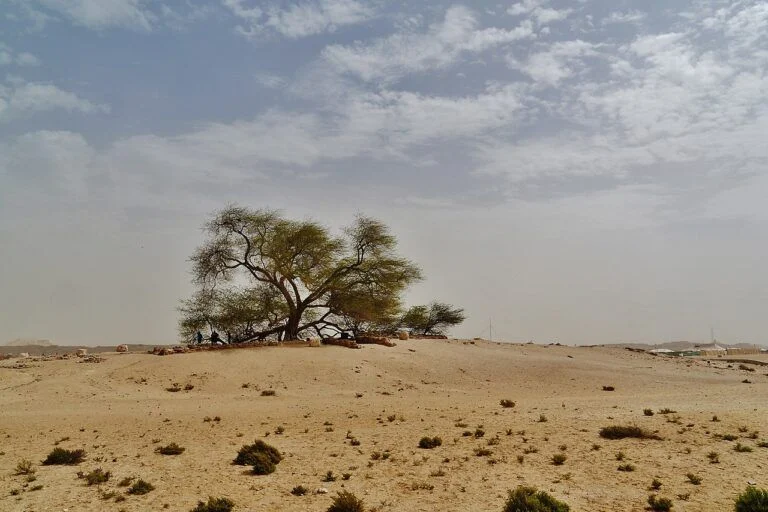
Standing defiantly amidst the relentless, sun-scorched expanse of the Arabian Desert, a solitary tree commands the horizon near the Jebel Dukhan, the highest point in Bahrain. Known locally as Shajarat al-Hayat, or the Tree of Life, this botanical anomaly has defied the harsh realities of its environment for an estimated 400 years. With no visible source of water, no nearby oasis, and surrounded by miles of barren, arid terrain, its continued survival remains one of the most compelling biological mysteries in the Middle East. As it continues to draw thousands of visitors annually, the Tree of Life serves not only as a natural curiosity but as a symbol of endurance in an age of climate uncertainty.
A Botanical Mystery in the Desert
The Shajarat al-Hayat is a specimen of remarkable hardiness, standing approximately 9.75 meters (32 feet) tall. Botanists and researchers have long debated its classification, with primary consensus pointing toward the genus Prosopis. It is widely speculated to be a member of either Prosopis cineraria or Prosopis juliflora. Both species are renowned for their extreme xerophytic adaptations—traits that allow plants to survive in environments with little liquid water.
However, the specific identity of the Tree of Life remains unconfirmed, adding to its mystique. The Prosopis genus is known for its deep-reaching taproot systems, which can descend dozens of meters into the earth. This biological feature is the leading hypothesis for the tree’s survival. Scientists posit that the tree’s roots have tapped into a deep, pressurized subterranean aquifer—a reservoir of fossil water trapped beneath the desert crust that remains inaccessible to surface-level vegetation. While this theory is scientifically plausible, it has not been definitively proven, as the depths required to reach such water tables would be immense.
Historical and Archaeological Context
The existence of the tree is not merely a modern-day observation; its presence has been documented in local folklore for centuries. Bedouin legends have long attributed the tree’s survival to the Garden of Eden, claiming that the location was once the site of a lush, fertile paradise protected by the ancient Sumerian god of water, Enki. These cultural narratives have elevated the tree to a status of near-reverence, marking it as a protected site long before formal government intervention.
In 2010, the intrigue surrounding the site intensified when archaeological excavations were conducted in the immediate vicinity. Researchers discovered remnants of ancient settlements, as well as evidence of what appeared to be historic water management systems, including possible wells or irrigation channels. These findings suggest that the area surrounding the tree was once inhabited and perhaps supported by a more stable water source than is present today. While these discoveries provide a glimpse into the human history of the region, they do not fully explain how the current tree maintains such a vibrant, leafy canopy in a climate that regularly sees temperatures exceeding 45 degrees Celsius (113 degrees Fahrenheit).
Physiological Adaptations for Survival
Beyond the deep-root hypothesis, the Tree of Life employs a suite of physiological mechanisms to minimize moisture loss—a process known as transpiration. The leaves of the Prosopis genus are characteristically small and pinnate, a structural design that reduces the surface area exposed to direct solar radiation. By minimizing surface area, the tree effectively lowers the rate of evaporation.
Furthermore, these trees are highly responsive to environmental stress. In periods of extreme drought, the tree is capable of shedding its foliage, entering a state of dormancy to conserve internal energy and hydration until more favorable conditions return. Microbiological research also suggests a symbiotic relationship between the tree and the soil ecosystem. The presence of specific nitrogen-fixing bacteria and mycorrhizal fungi in the rhizosphere—the narrow region of soil directly influenced by root secretions—likely aids the tree in extracting essential nutrients and moisture from the nutrient-poor desert soil. While some have suggested that night-time dew collection on the leaves contributes to the tree’s water intake, most experts agree that this factor alone would be insufficient to sustain a tree of this size and age.
Challenges of Modern Tourism and Conservation
As the Tree of Life gained international fame, it transitioned from a remote local landmark to one of Bahrain’s most prominent tourist attractions, drawing over 65,000 visitors annually. This surge in popularity brought unintended consequences. The delicate soil surrounding the root zone became compacted by foot traffic, and the tree itself became a target for vandals who carved names into its bark, causing physical trauma to the living tissue.
Recognizing the environmental and cultural value of the landmark, the Bahraini government, through the Bahrain Authority for Culture and Antiquities, implemented stringent protection measures. The site is now enclosed by a protective fence, and access is strictly regulated. A dedicated information center was constructed to educate the public on the importance of preserving the site, and security personnel monitor the area to prevent further damage. These measures have been critical in stabilizing the health of the tree, which had shown signs of stress during the peak of the unregulated tourism era.
Implications for Climate and Ecological Research
The study of the Shajarat al-Hayat extends beyond mere curiosity; it holds significant implications for ecological research in the face of global climate change. As desertification continues to threaten arid regions across the globe, understanding the survival strategies of the Prosopis genus is of vital importance to botanists and agronomists. The ability of the Tree of Life to thrive in a hyper-arid environment offers a living blueprint for drought-resistant reforestation and sustainable land management in similar climates.
Moreover, the tree serves as a benchmark for local environmental education. By studying how the tree navigates the absence of surface water, students and scientists in Bahrain are gaining insights into the delicate balance of the desert ecosystem. The tree has become a focal point for environmental advocacy, reminding the public that even in the harshest conditions, life persists if provided the right conditions and proper protection from anthropogenic interference.
Future Outlook
Despite the scientific, archaeological, and environmental efforts to understand the Shajarat al-Hayat, the core question—the exact mechanism of its water supply—remains elusive. Is it a singular, ancient aquifer? Is it an incredibly efficient adaptation to ambient humidity? Or is it a combination of factors that science has yet to fully map?
For now, the Tree of Life remains a silent witness to history, a green anomaly in a sea of gold. As long as the current conservation efforts remain in place, it will continue to stand, providing a unique intersection of nature, history, and mystery. For the people of Bahrain, it is more than just a tree; it is a testament to the resilience of life itself, enduring in a place where, by all traditional standards, it should not be able to exist. The ongoing preservation of the site is not only a tribute to its past but a necessary investment in ensuring that this natural wonder continues to defy the desert for generations to come.