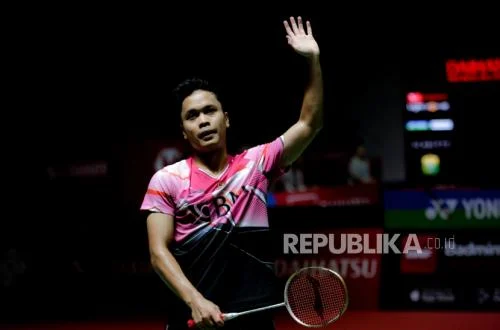
DUBAI, UAE – Indonesian badminton sensation Anthony Sinisuka Ginting commenced his campaign at the Badminton Asia Mixed Team Championships (BAMTC) 2023 with a decisive victory on Tuesday, February 14, 2023, at the Dubai Exhibition Centre. The world No. 3 showcased his formidable skills by defeating Lebanon’s Abi Younes Christophe in a swift opening match of the tournament. Beyond the court, the encounter highlighted a moment of admirable sportsmanship, as Younes Christophe expressed his profound admiration for Ginting, culminating in a memorable photo opportunity and autograph request.
The BAMTC 2023, a crucial event in the international badminton calendar, serves as a vital platform for nations to vie for supremacy in mixed team competition. This year’s edition, hosted in Dubai, United Arab Emirates, features a strong contingent of Asian badminton powerhouses, all vying for qualification for the Sudirman Cup and seeking to solidify their rankings. The championship format, which involves mixed doubles, men’s singles, women’s singles, men’s doubles, and women’s doubles, demands versatility and strategic depth from each participating team. Indonesia, a perennial contender in international badminton, has set its sights on a strong performance, aiming to leverage the talent of its top players like Ginting.
Dominant Performance on Court
Ginting, known for his powerful smashes and agile footwork, left no room for doubt in his opening encounter. He dispatched Abi Younes Christophe in straight games, with a commanding scoreline of 21-6, 21-8. The match, which lasted a mere 17 minutes, underscored Ginting’s superior ranking and experience on the international stage. His ability to control the pace of the game and execute precise shots effectively neutralized any challenge posed by his opponent.
The Indonesian ace demonstrated a professional approach, emphasizing focus and respect for his opponent despite the significant disparity in their world rankings. "I always play with focus and don’t underestimate my opponent," Ginting stated in the post-match press release. "My main focus was on adapting to the court conditions, including the wind direction, lighting, and overall atmosphere. I experimented with different shots and utilized every aspect to my advantage." This disciplined mindset is a hallmark of elite athletes, ensuring consistent performance regardless of the opponent’s standing.
A Moment of Admiration and Sportsmanship
Following the conclusion of the match, Abi Younes Christophe approached Anthony Ginting not with disappointment, but with evident enthusiasm. The Lebanese shuttler, ranked significantly lower than Ginting, expressed his sheer delight at having the opportunity to compete against a player of Ginting’s caliber. "I know Ginting is a world-class player," Younes Christophe shared. "For me, playing against him is like a dream come true. I am happy to have met Ginting."
His request for a photograph and an autograph was met with graciousness by Ginting, further exemplifying the spirit of camaraderie that badminton fosters. This interaction highlights a key aspect of professional sports beyond competition – the mutual respect and admiration that can exist between athletes, even after a challenging match. For Younes Christophe, the experience transcended a simple defeat; it was an invaluable learning opportunity and a cherished memory.
Ginting’s Strategic Approach and Preparation
Despite the lopsided scoreline and the brief duration of the match, Ginting revealed that he did not exert his maximum effort. The ease of the victory meant he felt far from fatigued. Instead, he viewed the match as a crucial opportunity for acclimatization. "I didn’t feel tired at all, especially since the match was short," Ginting explained. "That’s why I continued with training after the match. I need to adapt and make the most of this match. It’s preparation for the upcoming matches, which will undoubtedly be tougher."
His proactive approach to physical conditioning and on-court adaptation is indicative of his dedication to maintaining peak performance throughout the demanding tournament. The BAMTC 2023 format, with multiple matches in quick succession, requires athletes to manage their energy effectively and be prepared for varied playing conditions. Ginting’s strategy of using the initial match for fine-tuning his game, rather than solely focusing on securing a win, demonstrates his foresight and commitment to long-term success in the championship.
Background of the Badminton Asia Mixed Team Championships
The Badminton Asia Mixed Team Championships, first held in 2017, has quickly established itself as a significant event on the international badminton calendar. It serves as a continental championship for mixed teams, bringing together the best national squads from across Asia. The tournament is crucial for accumulating ranking points, which are vital for qualification to major events like the Olympic Games and the BWF World Championships. Furthermore, it acts as a preparatory ground for the prestigious Sudirman Cup, the world championship for mixed teams.
Dubai’s selection as the host city for the 2023 edition underscores the growing prominence of the Middle East in hosting major international sporting events. The championship typically involves a group stage followed by a knockout phase, requiring teams to demonstrate consistency and resilience over several days of competition. The unique format of mixed team events, where players compete in singles and doubles, necessitates a well-rounded squad with depth across all disciplines.
Indonesia’s Badminton Pedigree and Expectations
Indonesia boasts a rich history and a formidable legacy in the sport of badminton. The nation has consistently produced world-class players and clinched numerous international titles, including Olympic gold medals and All England Open championships. The Indonesian Badminton Association (PBSI) is known for its rigorous training programs and development of young talent.
For the BAMTC 2023, Indonesia’s aspirations are high. The team is expected to be a strong contender, with players like Anthony Ginting, Gregoria Mariska Tunjung (women’s singles), and various doubles pairings forming a formidable lineup. Their performance in this championship will not only gauge their current standing but also set the tone for their preparations for subsequent major tournaments.
Analysis of the Match and Future Implications
Ginting’s dominant performance, while expected given the ranking difference, provides valuable insights into his current form and mental preparation. His ability to adapt to the court conditions swiftly and efficiently is a positive sign for Indonesia’s campaign. The fact that he did not need to push his limits in the opening match means he conserves energy, a critical factor in a multi-day tournament.
The interaction between Ginting and Younes Christophe also serves as a reminder of the unifying power of sports. In an era often characterized by intense rivalries, such moments of mutual respect and admiration are crucial for maintaining the integrity and spirit of competition. For Younes Christophe, this encounter is likely to be a source of motivation, inspiring him to continue his badminton journey with renewed vigor.
The implications of this opening victory for Indonesia are significant. It provides an immediate morale boost for the team and sets a positive precedent for the subsequent matches. As the tournament progresses, Indonesia will face tougher opponents, and Ginting’s consistent performance, coupled with the team’s strategic adaptability, will be key to their success. The BAMTC 2023 is not just about winning matches; it’s about building momentum, fostering team cohesion, and honing individual skills in a high-pressure environment.
Looking Ahead: The Road to the Finals
The Badminton Asia Mixed Team Championships 2023 will continue with a series of group stage matches before progressing to the knockout rounds. Indonesia, as one of the top-seeded teams, will be expected to advance through the initial stages. The team’s mettle will be truly tested in the later rounds, where they will likely face other badminton giants like China, Japan, and South Korea.
Anthony Ginting’s journey in this championship is one to watch closely. His ability to consistently perform at a high level, coupled with his professional demeanor, makes him a pivotal player for Indonesia’s aspirations. The BAMTC 2023 promises to be an exciting showcase of talent, strategy, and sportsmanship, with the Indonesian contingent, led by stars like Ginting, poised to make a significant impact. The early, decisive win and the gracious interaction with his opponent set a strong, positive tone for their campaign in Dubai.