
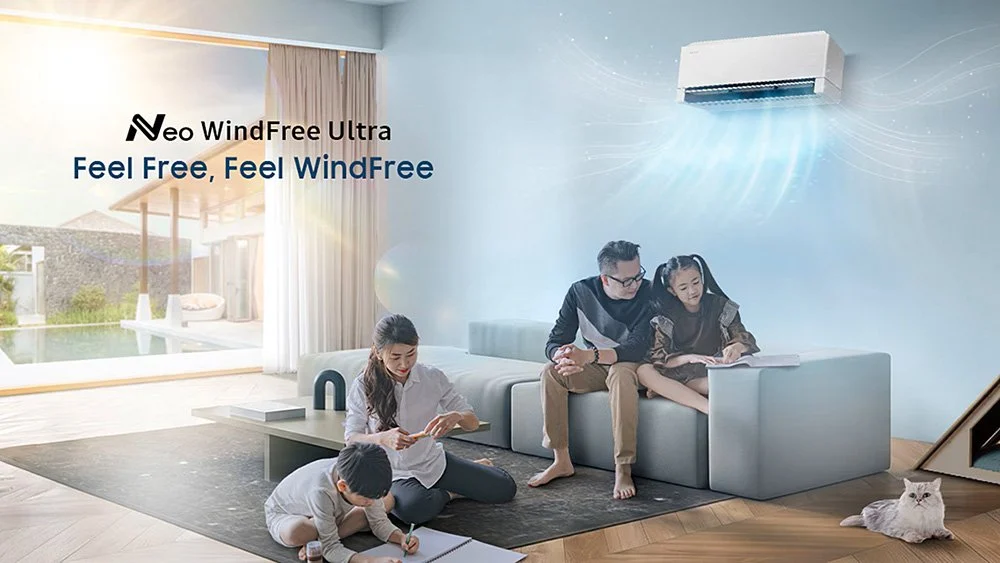
Samsung Electronics Indonesia has officially expanded its premium home climate control portfolio with the nationwide launch of the Samsung AC Neo WindFree Ultra on September 19, 2026. Designed to address the evolving demands of modern urban households, the newly introduced air conditioner merges advanced indoor climate cooling with heavy-duty air purification capabilities into a single, cohesive appliance. By integrating a sophisticated PM1.0 filtration system alongside next-generation artificial intelligence controls, the device aims to eliminate the need for standalone air purifiers while drastically cutting down household electricity consumption. The launch event underscored Samsung’s strategic shift toward holistic home wellness, positioning the appliance not merely as a temperature-regulation tool, but as an all-in-one comfort ecosystem tailored for contemporary living environments.
The official market arrival of the Neo WindFree Ultra follows months of anticipation within Southeast Asia’s consumer electronics sector, where demand for health-conscious smart home appliances has risen sharply. Industry analysts note that urban air quality fluctuations, combined with rising electricity tariffs, have pressured manufacturers to innovate beyond traditional cooling metrics. Samsung responded to these market dynamics by conceptualizing a device that marries proprietary WindFree cooling mechanics with deep-learning algorithms capable of interpreting individual usage patterns and environmental parameters. According to company executives, the development phase prioritized seamless integration between hardware performance and software automation, utilizing the SmartThings IoT framework to give consumers unprecedented remote oversight of their home climate footprint.
At the core of the Samsung AC Neo WindFree Ultra’s appeal is its dual-function architecture, which tackles both thermal comfort and microscopic airborne pollutants. The inclusion of a built-in PM1.0 Filter represents a significant engineering leap from standard residential air conditioners typically equipped only with basic dust screens. The PM1.0 designation indicates the filter’s capacity to capture ultra-fine particulate matter measuring up to 1 micrometer in diameter—encompassing hazardous microscopic dust, residual smoke particles, and various allergens that routinely bypass traditional PM2.5 filters. Samsung’s internal laboratory testing indicates that this specialized purification layer is capable of sterilizing more than 99 percent of airborne bacteria and fine particles, effectively doubling the particulate capture efficiency of older generational filters. To provide real-time visual feedback, the chassis of the indoor unit features an intuitive color-coded LED air quality indicator, allowing occupants to monitor ambient pollution levels at a glance without navigating a smartphone application. Furthermore, recognizing the maintenance challenges associated with high-efficiency filters, Samsung designed the component to be entirely removable and washable. This ensures that users can execute regular upkeep routines independently, preserving optimal airflow and filtration efficacy over years of continuous operation without incurring recurrent replacement costs.
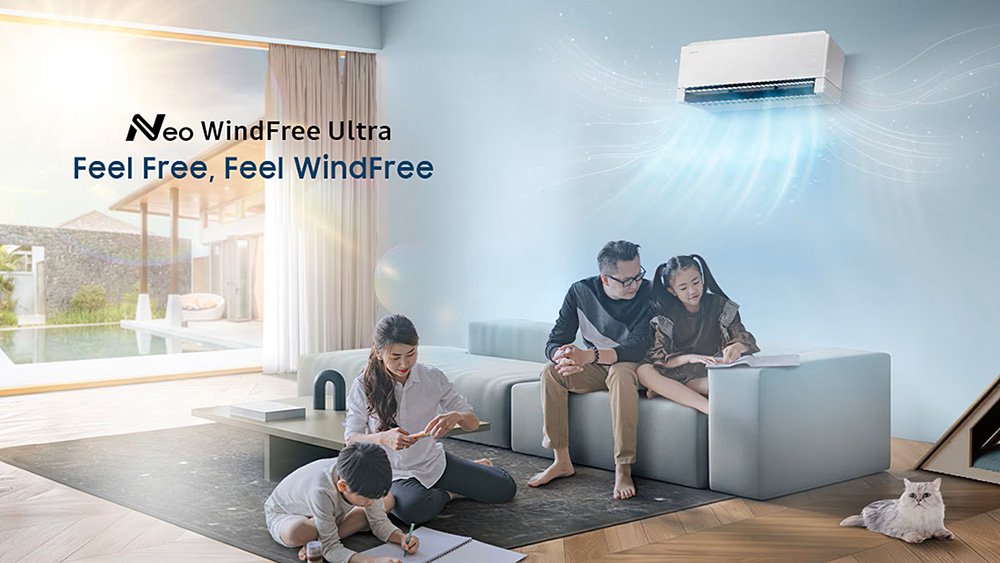
Beyond air hygiene, the device redefines thermal distribution through its upgraded WindFree Enhanced technology, anchored by 23,000 micro air holes meticulously perforated across the front chassis panel. Instead of projecting a harsh, direct stream of chilled air that often causes user discomfort or muscle stiffness, the system diffuses air gently into the room, creating what Samsung describes as a motionless, tranquil cooling effect. This mechanism is governed by the newly developed AI 7 Motion Winds suite, which dynamically calibrates airflow direction and velocity across seven distinct operational modes. These modes include Max Wind for rapid initial temperature reduction, Surround Wind for uniform thermal dispersion, Long Reach Wind designed for expansive architectural layouts, and Down Wind for vertical trajectory control. Additionally, the system features AI Direct Wind and AI Indirect Wind settings, which utilize spatial tracking logic to either target occupants needing immediate cooling relief or divert airflow around them to maintain a stable, draft-free ambient temperature. Operating at a minimum noise threshold as low as 23 dBA when utilizing the specialized WindFree Low Noise profile, the unit ensures that bedroom and study environments remain exceptionally quiet during nighttime operation.
The automation capabilities of the Neo WindFree Ultra are driven by Samsung’s proprietary AI Fast & Comfort Cooling intelligence, which continuously evaluates room load parameters, outdoor weather conditions, and historical user habits. By analyzing these variables in real-time, the system autonomously transitions between high-capacity fast cooling, dehumidifying dry comfort states, and gentle WindFree dispersion without requiring manual remote-control adjustments. This predictive learning architecture is deeply integrated with the Samsung SmartThings ecosystem, enabling users to monitor system status, schedule operational routines, and execute diagnostic checks remotely via smartphones. For select commands, voice-activation protocols allow hands-free management, transforming the air conditioner into an active node within a broader smart home network. To address long-term hygiene inside the internal heat exchanger, Samsung has incorporated a Freeze Wash feature. This automated maintenance cycle freezes moisture on the coil to trap accumulated dust and mold before melting it away, notifying users via the SmartThings application when a cleaning cycle is recommended, thereby minimizing manual technician interventions.
Energy efficiency remains a cornerstone of the Neo WindFree Ultra’s market proposition, particularly as utility costs remain a primary concern for homeowners across Indonesia. The hardware utilizes an advanced AI Inverter compressor paired with an optimized AI Energy Mode, which intelligently modulates power consumption based on real-time occupancy and thermal load analysis. Samsung reports that activating the AI Energy Mode yields power savings of up to 41 percent compared to conventional, non-inverter cooling units operating under similar conditions. While actual energy conservation figures naturally vary depending on specific room insulation, geographic climate, and user-defined temperature setpoints, the SmartThings platform provides transparent, telemetry-based energy tracking. Users can review daily, weekly, and monthly power consumption metrics directly on their mobile devices, empowering them to make informed adjustments to their energy usage habits and lower their overall carbon footprint.
Market availability and pricing strategies reflect Samsung’s ambition to capture multiple segments of the residential real estate market, ranging from compact urban apartments to spacious multi-room landed houses. The Samsung AC Neo WindFree Ultra is currently distributed across Indonesia in three distinct cooling capacities: 1 PK, 1.5 PK, and 2 PK, allowing consumers to select the precise thermal output required for their spatial dimensions. Retail pricing for the lineup commences in the IDR 10 million bracket, positioning the appliance firmly within the premium consumer goods category. Industry observers note that while the initial capital investment surpasses that of standard entry-level air conditioners, the consolidation of air purification, low-noise acoustic engineering, automated maintenance, and significant electrical savings provides a compelling long-term value proposition. By introducing an all-in-one comfort device that addresses health, sustainability, and technological convenience simultaneously, Samsung has established a formidable benchmark for the regional climate control market in 2026.
