
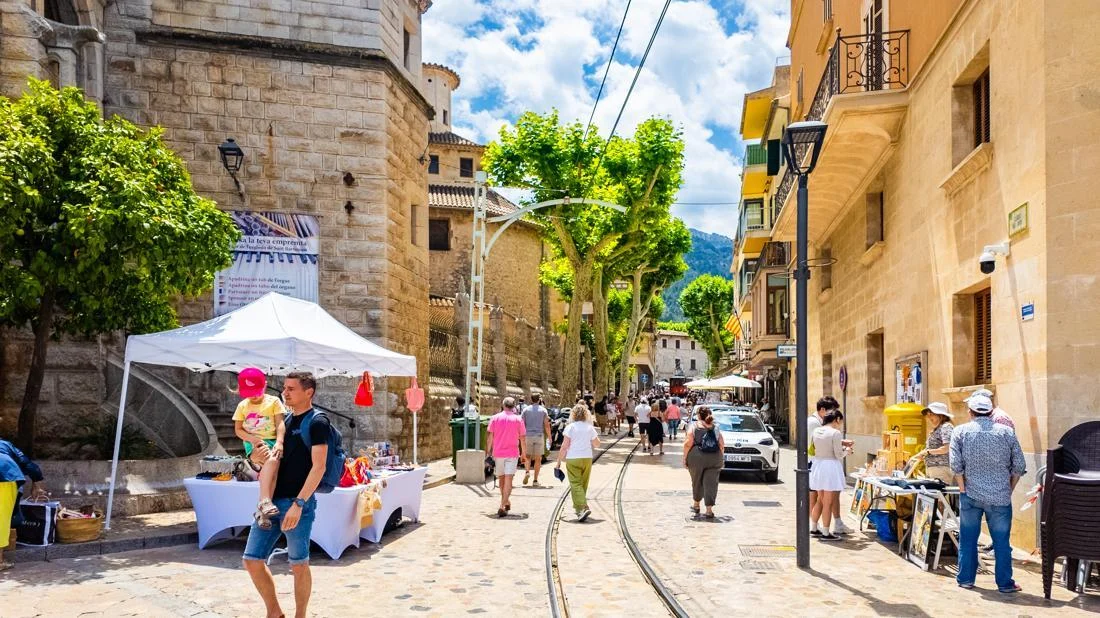
The picturesque town of Soller, nestled within the sun-drenched island of Mallorca, has officially claimed the title of the most visited Spanish destination by international motorists during the summer of 2026. Data compiled through a comprehensive joint study conducted by parking technology firm EasyPark and mobility analytics provider Arrive highlights a staggering surge in foreign drivers flocking to the Balearic enclave, overshadowing coastal and mainland competitors alike.
According to the findings, the volume of international motorists parking their vehicles in Soller skyrocketed to nearly four times that of the runner-up destination. This unprecedented influx underscores a shifting paradigm in how foreign holidaymakers choose to experience the Iberian Peninsula, increasingly favoring scenic, culturally rich, and geographically distinct locales over traditional urban tourism hubs.
Behind Soller, the glamorous Costa del Sol resort city of Marbella in Malaga secured the second position. The rankings continued with Campos, another Mallorcan municipality known for its rustic charm and proximity to pristine beaches, capturing third place. Rounding out the top four was Sant Feliu de Guixols, situated in the rugged and historically resonant province of Girona along the Costa Brava.
Demographic insights embedded within the EasyPark and Arrive study reveal distinct patterns regarding the nationalities driving the Spanish tourism economy. German tourists overwhelmingly dominated the landscape, accounting for more than 24,000 registered users navigating Spain’s extensive roadways. This robust contingent reflects a long-standing cultural affinity between German travelers and the Balearic Islands, particularly Mallorca, which frequently serves as a secondary home or a premier holiday retreat.
France trailed closely behind Germany in second place, contributing a substantial share of cross-border motorists taking advantage of the overland proximity. Following France, travelers hailing from Italy, the Netherlands, and Sweden rounded out the top five international demographics traversing the Spanish highway network. These motorists collectively utilized digital parking applications, facilitating a granular tracking of vehicular movement that has provided urban planners and tourism boards with unprecedented data visibility.
While international travelers demonstrated a clear preference for coastal paradises, island retreats, and scenic coastal towns, domestic tourists exhibited a markedly different travel philosophy. Statistics covering domestic road users point toward a distinct favoring of major metropolitan areas and inland cultural destinations.
Madrid dominated the domestic travel charts, welcoming roughly three times the volume of local motorists recorded in A Coruna, a major port city in the northwest. This divergence highlights a bifurcated tourism market in Spain, where foreign visitors prioritize leisure landscapes and coastal aesthetics, while domestic travelers leverage the summer season for urban exploration, family visits, and cultural tourism in the country’s interior.
Nevertheless, areas of crossover did exist within the data ecosystem. Marbella emerged as a rare point of convergence, proving equally magnetic to international jet-setters and domestic vacationers seeking luxury amenities and coastal recreation. Furthermore, historic inland municipalities such as Segovia featured prominently in the popularity indexes, signaling that Spain’s rich architectural heritage and interior gastronomy continue to hold significant sway over discerning travelers looking to escape the coastal crowds.
The staggering influx of vehicular traffic has inevitably triggered severe logistical challenges for Soller, a municipality unaccustomed to bearing the brunt of modern mass automotive tourism. The sheer volume of cars threatens to choke narrow historical streets, compromise pedestrian safety, and degrade the local environment. In response to mounting congestion and resident grievances, the local government initiated a radical overhaul of the municipal traffic system, a policy decision that immediately became a lightning rod for political controversy and public debate.
Critics from opposition parties alongside various community groups fiercely condemned the adjustments, arguing that the localized policy changes were ill-conceived and liable to exacerbate gridlock rather than alleviate it. The contentious nature of the traffic redesign thrust the municipal administration onto the defensive, forcing local officials to publicly justify their urban planning strategies.
Josep Porcel, the municipal councilor responsible for mobility, stepped forward to vehemently refute claims that the municipal traffic alterations had worsened congestion. Porcel insisted that the newly engineered road designs were specifically formulated to alleviate bottlenecks by introducing alternative dispersion vectors for vehicular traffic.
"This structural evolution has successfully supplied an alternative egress channel for vehicles that were previously forced to funnel exclusively through Calle Cetre," Porcel explained during a press briefing addressing the municipal backlash. "Consequently, the cumulative volume of automobiles constrained to that specific historical thoroughfare has likely experienced a net reduction rather than an amplification."
To substantiate his defense, Porcel pointed to historical traffic metrics recorded during the peak summer seasons of 2024 and 2025. During those preceding years, municipal sensors documented a punishing volume of up to 75,000 vehicles traversing the affected corridor within a single twenty-four-hour period. Porcel maintained that these unsustainable figures materialized precisely because the obsolete traffic management architecture lacked the elasticity required to handle contemporary vehicular loads.
The contentious traffic adjustments implemented in Soller are intrinsically linked to the broader European regulatory push toward establishing Low Emission Zones (LEZs). In alignment with national and continental environmental mandates, the Soller municipal government moved aggressively to restrict high-emission vehicular access to the urban core, prioritizing air quality and pedestrian accessibility.
Crucially, the policy package was not merely restrictive; it incorporated a major expansion of residential infrastructure. Authorities established more than 1,000 designated parking spaces exclusively reserved for local residents, a massive scaling up from the meager six resident-only spaces that existed prior to the reform. This measure was designed to protect the local population from losing their urban spaces to visiting motorists, attempting to strike a delicate balance between welcoming the economic engine of tourism and preserving the liveability of the town.
The unfolding situation in Soller serves as a micro-cascading case study for the broader implications facing high-density tourist destinations across Southern Europe. As post-pandemic travel volumes fully rebound and surpass historical benchmarks, municipalities are increasingly forced to grapple with the externalities of hyper-tourism.
The reliance on data analytics firms like EasyPark and Arrive marks a vital evolution in municipal governance, allowing civic leaders to base infrastructure decisions on empirical behavioral patterns rather than anecdotal estimates. However, as Soller’s experience demonstrates, even data-driven policies must navigate the treacherous waters of public perception, local resistance, and political opposition.
Economically, the dominance of international motorists—led by Germany, France, and the Netherlands—cements the financial necessity of maintaining open, accessible corridors for European travelers. Yet, the environmental and infrastructural strain documented in Mallorca suggests that the traditional model of unmitigated vehicular tourism is reaching a physical breaking point.
Looking forward, the policy trajectory initiated in Soller—combining Low Emission Zones, restricted central access, and prioritized residential amenities—is likely to become a template for other municipalities listed in the 2026 study. Whether destinations like Marbella, Campos, and Sant Feliu de Guixols will adopt similar aggressive traffic interventions remains to be seen. What is clear, however, is that the era of unfettered, vehicle-heavy tourism in fragile historical and coastal communities is drawing to a close, replaced by an era of stringent regulation, technological monitoring, and continuous administrative friction.
