

The modern consumer technology landscape is defined by an intricate web of competing ecosystems, where switching between an Android smartphone and an Apple device has historically introduced friction, particularly when transferring personal media. Addressing this long-standing industry bottleneck, Xiaomi has officially rolled out comprehensive cross-platform connectivity features for its flagship Xiaomi 17T Pro. By integrating native Quick Share capabilities and its proprietary HyperConnect framework within the Xiaomi HyperOS ecosystem, the company is eliminating the reliance on third-party applications, physical cables, or cloud storage workarounds for transferring high-resolution photographs and videos directly from Android devices to iPhones.
This strategic technological leap arrives as smartphone manufacturers increasingly recognize that user experience extends far beyond capture capabilities into the realm of content management and frictionless sharing. For millions of consumers who operate dual-device workflows—such as utilizing an Android flagship for its superior camera optics alongside an Apple ecosystem for desktop or tablet integration—this development marks a significant shift toward open, interoperable mobile computing.
The Evolution of Cross-Platform Interoperability: A Historical Timeline
The ability to seamlessly transfer files between Android and iOS devices has been a holy grail for mobile operating system developers for over a decade. Historically, users trapped between the two dominant platforms had to resort to cumbersome methods: emailing files to oneself, compressing folders into third-party messaging applications, utilizing web-based transfer tools, or uploading massive video files to cloud storage services like Google Drive or iCloud, all of which degrade file quality and consume valuable data quotas.
The technological groundwork for this cross-ecosystem breakthrough began to materialize significantly in late 2025. In November 2025, Google officially initiated broader interoperability protocols for its Quick Share architecture, aiming to bridge the gap with Apple’s proprietary AirDrop standard, with an initial rollout debuting on the Google Pixel 10 product family. Building upon this foundational framework, Google announced plans in May 2026 to scale the technology to its extensive network of hardware manufacturing partners.

Xiaomi has swiftly capitalized on this initiative, embedding the functionality directly into its software update roadmap for 2026. By aligning the Xiaomi 17T Pro with these new cross-ecosystem protocols, Xiaomi has positioned itself at the forefront of Android manufacturers adopting unified file-sharing standards. This evolution reflects a broader regulatory and consumer-driven push toward device agnosticism, where hardware barriers are intentionally lowered to improve overall consumer convenience and utility.
Decoding the Mechanics: How Quick Share and HyperConnect Work on Xiaomi 17T Pro
The Xiaomi 17T Pro achieves cross-ecosystem file transfer through two distinct yet complementary mechanisms: native Quick Share interoperability and the proprietary Xiaomi HyperConnect platform. While both systems facilitate the movement of data between Xiaomi devices and Apple hardware, their underlying architectures and operational requirements differ.
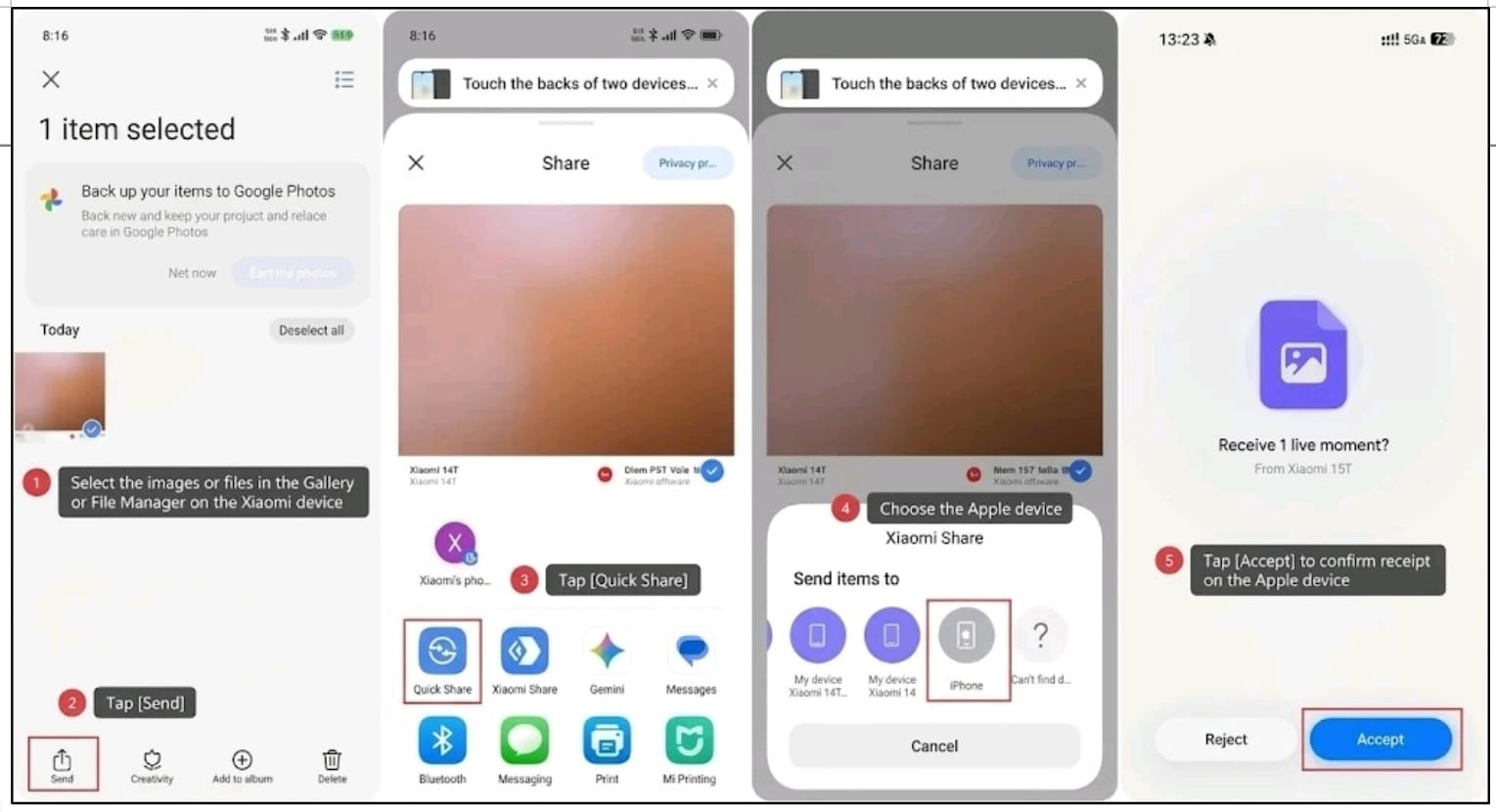
The Quick Share integration leverages protocol adaptations designed to communicate directly with AirDrop-enabled Apple devices. To utilize this feature on the Xiaomi 17T Pro, users must ensure their device is signed into a verified Google account and has received the requisite Google Play System updates that enable Apple device discovery protocols. When activated, the smartphone scans for nearby compatible Apple hardware—such as iPhones and iPads—allowing users to select files from their native gallery and execute wireless transfers without intermediary hardware. If devices fail to establish an initial handshake, troubleshooting protocols dictate verifying that the "Share with Apple Devices" setting is toggled on within the Google Play Services menu and confirming that both devices operate on compatible software builds.
In parallel, Xiaomi offers HyperConnect, an advanced feature housed within the Xiaomi HyperOS infrastructure. Unlike the direct AirDrop-style handshake of Quick Share, HyperConnect operates via the Xiaomi Interconnectivity application ecosystem. To use this method, Apple device users must download the official Xiaomi Interconnectivity application from the Apple App Store. Once installed, users open the native Xiaomi Gallery app, select the desired media, tap the transmission prompt, and choose the detected Apple device from the list. The recipient then authorizes and receives the transfer through the iOS application interface. This dual-track approach ensures that users have multiple redundant pathways to move heavy files, regardless of specific software version constraints.
Executive Insights: The Philosophy Behind Cross-Ecosystem Freedom

Industry leaders have increasingly emphasized that hardware specifications alone no longer dictate consumer satisfaction. Andi Renreng, Marketing Director of Xiaomi Indonesia, elaborated on this philosophy during the device’s feature rollout, noting that the modern smartphone lifecycle encompasses a continuous loop of creation, processing, and sharing.
"We understand that the experience of using a smartphone today does not stop the moment a user successfully captures a photo or records a video," Andi stated. "There is a continuous, evolving need to process, enjoy, and share every single one of those moments effortlessly with others, regardless of the hardware they happen to be carrying in their pockets."
According to executive briefings from Xiaomi, the integration of HyperOS was engineered from its inception to dismantle siloed software environments. By pairing high-end imaging hardware with cross-platform connectivity protocols, Xiaomi aims to alleviate the cognitive load traditionally associated with managing media across mixed-device households and professional environments.
Hardware Excellence: Leica Optics and MediaTek Processing Power
While the software innovations of HyperOS and Quick Share dominate the productivity narrative, the physical architecture of the Xiaomi 17T Pro remains engineered to serve as a powerhouse for mobile content creators. The device’s imaging system is anchored by a sophisticated triple-camera array developed in strategic collaboration with legendary German camera manufacturer Leica, featuring high-grade Leica Summilux optical lenses.
The primary imaging sensor is a 50MP Light Fusion 950 sensor boasting a large 1/1.31-inch footprint, paired with Optical Image Stabilization (OIS) to mitigate motion blur and hand tremors during low-light photography and steady-state videography. This is complemented by a 50MP periscope telephoto lens capable of delivering 5x optical zoom for detailed long-range composition, alongside a 12MP ultra-wide-angle lens offering a expansive 120-field-of-view for landscapes and group compositions.
Videographers benefit from native recording capabilities scaling up to cinematic 8K resolution at 30 frames per second, as well as high-frame-rate 4K capture at 120 frames per second for ultra-smooth slow-motion sequences. The inclusion of Leica Live Moment further empowers users by capturing micro-videos alongside still frames, preserving the ambient context of dynamic environments.
To process these intensive multimedia workloads, the Xiaomi 17T Pro relies on MediaTek’s cutting-edge Dimensity 9500 chipset, built upon an advanced 3-nanometer semiconductor fabrication node. Utilizing an All-Big-Core processing architecture, the processor balances maximum computational throughput for rendering and editing with thermal and electrical efficiency. Thermal mitigation is managed by an integrated 3D IceLoop cooling system, ensuring sustained performance during extended gaming sessions, 4K video rendering, or heavy multitasking.
Visual consumption is handled by an expansive 6.83-inch AMOLED display featuring a 1.5K resolution, an adaptive refresh rate scaling up to 144Hz, 12-bit color depth, and native Dolby Vision certification. Under peak operating conditions, the panel can achieve a blinding maximum brightness of 3,500 nits, ensuring legibility under direct sunlight. Powering this hardware package is a high-density 7,000 mAh silicon-carbon battery, supported by blistering 100W wired HyperCharge and 50W wireless HyperCharge technologies, which significantly minimize downtime for active users.
Implications for the Competitive Smartphone Market
The introduction of native cross-platform sharing features on the Xiaomi 17T Pro signals a broader, consumer-centric maturation of the smartphone industry. For years, major original equipment manufacturers (OEMs) utilized proprietary ecosystems as digital moats, locking consumers into single-brand households through artificial software incompatibilities. Apple’s AirDrop and ecosystem continuity features long served as the gold standard of this retention strategy.
By systematically opening communication pipelines to rival operating systems, Xiaomi is challenging traditional ecosystem retention paradigms. Industry analysts note that this strategy could heavily sway prospective buyers who appreciate Android hardware innovation—such as superior camera hardware, faster charging speeds, and flexible file systems—but have historically hesitated to migrate due to professional or personal reliance on Apple hardware.

Furthermore, as regulatory bodies globally scrutinize platform gatekeeping and interoperability practices, preemptive moves by manufacturers to bridge ecosystem divides position them favorably within changing regulatory frameworks. For the end user, the outcome is a frictionless, hardware-agnostic experience that prioritizes user agency over brand confinement.
As consumers increasingly demand seamless data mobility across all personal technology touchpoints, devices like the Xiaomi 17T Pro demonstrate that the future of mobile computing lies not in isolated fortresses, but in intelligent, interoperable connectivity. Detailed specifications, software update schedules, and regional rollout maps can be reviewed directly via the official Xiaomi Indonesia portal and the global Xiaomi HyperOS information network.

