
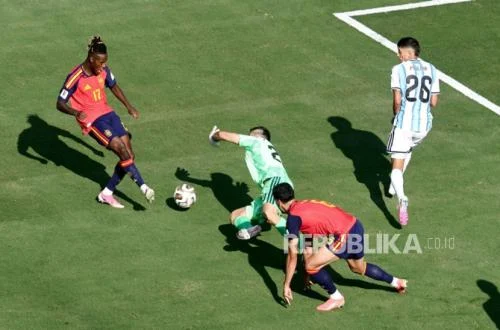
Spain has etched its name into footballing history once again, securing its second FIFA World Cup title after a dramatic 1-0 victory over ten-man Argentina in the final held at the state-of-the-art New York New Jersey Stadium in the United States. The decisive goal came deep into extra time on Monday, July 20, 2026, at 05:00 AM WIB, with Ferran Torres finding the back of the net in the 106th minute, following a crucial assist from the electrifying Nico Williams. The match, a culmination of a month-long global football spectacle, will be remembered for its intense tactical battle, a pivotal red card, and Spain’s resilience in the face of a formidable opponent.
A Decisive Moment in Extra Time
The highly anticipated final lived up to its billing as a fiercely contested affair from the opening whistle. Both teams, renowned for their distinct footballing philosophies, entered the match with immense pressure and the weight of national expectations. The first 90 minutes were a testament to the defensive discipline and tactical acumen of both Luis de la Fuente’s Spain and Lionel Scaloni’s Argentina. Chances were at a premium, with neither side willing to commit too many players forward and risk being caught on the counter. Spain, known for its intricate passing game and possession-based style, dominated periods of the ball but struggled to break down Argentina’s resolute defense, marshaled brilliantly by veteran Nicolas Otamendi. Argentina, meanwhile, sought to exploit Spain’s high defensive line with quick transitions, relying on the genius of Lionel Messi and the pace of their wingers to create openings.
The match’s trajectory dramatically shifted in the dying moments of the first half of regulation time. In the 44th minute, Argentina’s influential midfielder Enzo Fernandez, already on a yellow card from an earlier challenge, received his second booking for a cynical foul on Spain’s Gavi as the young Spaniard looked to launch a counter-attack. The referee’s decision, though controversial and met with furious protests from the Argentinian bench and players, stood firm. Fernandez was consequently sent off, leaving Argentina to play the entire second half and any potential extra time with a numerical disadvantage. This incident forced Scaloni to rethink his tactical approach, shifting from an attacking mindset to a more conservative, damage-limitation strategy, prioritizing defensive solidity to hold off the Spanish onslaught.
Despite playing with ten men, Argentina displayed remarkable tenacity throughout the second half. They defended with an unparalleled collective spirit, forming a compact defensive block that proved incredibly difficult for Spain to penetrate. Goalkeeper Emiliano Martinez was called into action on several occasions, making crucial saves to deny efforts from Dani Olmo and Álvaro Morata. Lionel Messi, though often isolated, continued to be a sporadic threat, delivering dangerous set-pieces and attempting to conjure moments of magic from deep within his own half. However, the energy expended in defending took its toll, and Argentina’s attacking opportunities became increasingly rare. The 90 minutes concluded with the score still locked at 0-0, pushing the contest into extra time.
The additional 30 minutes saw Spain intensify their pressure, leveraging their numerical advantage. The introduction of fresh legs from the bench, including the decisive Ferran Torres, injected new energy into the Spanish attack. Argentina, visibly tiring, continued to resist with admirable courage. However, their valiant defense was finally breached in the 106th minute. A brilliant piece of individual skill from Nico Williams on the left flank saw him beat his marker and deliver a perfectly weighted cross into the heart of the Argentinian penalty area. Ferran Torres, having anticipated the delivery, rose highest to meet the ball with a powerful header that flew past a despairing Martinez, sending the Spanish contingent into raptures. The goal, a testament to Spain’s persistence and Williams’s burgeoning talent, proved to be the winner.
Argentina, despite the setback, refused to surrender. In the remaining minutes of extra time, they pushed forward with desperation, even creating a few nervy moments for the Spanish defense, primarily through Messi’s exquisite set-piece deliveries. However, Spain’s defense, led by the experienced Aymeric Laporte and the emergent Pau Cubarsí, held firm, weathering the late storm. The final whistle blew, confirming Spain’s triumph and sparking scenes of jubilation among the Spanish players, staff, and fans.
Spain’s Road to Glory: A New Generation’s Ascent
This victory marks Spain’s second World Cup title, coming 16 years after their historic triumph in South Africa in 2010. That era was defined by the legendary ‘tiki-taka’ style of Xavi, Iniesta, and Casillas. The 2026 squad, under Luis de la Fuente, represents a new generation, blending the traditional Spanish possession game with a more direct, athletic approach. Key players like Nico Williams, Gavi, Pedri, and Lamine Yamal have emerged as global stars, demonstrating a blend of technical prowess, tactical intelligence, and youthful exuberance. Their journey to the final was marked by impressive performances, including a hard-fought semi-final victory over France and a dominant display against Germany in the quarterfinals, showcasing their ability to perform under pressure against elite opposition.
Spain’s tournament statistics underscored their balanced approach. They maintained an average possession rate of 62%, completing over 85% of their passes, reflecting their commitment to ball control. However, their attacking output was also significant, averaging 15 shots per game, with a conversion rate of 12%. Defensively, they were equally formidable, conceding only four goals throughout the entire tournament, a testament to their organized backline and the commanding presence of their goalkeepers. The team’s resilience was evident in their ability to grind out results in tight matches, a characteristic often associated with championship-winning sides.
Argentina’s Valiant Effort and the End of an Era?
For Argentina, the defeat was a bitter pill to swallow, particularly after their glorious World Cup victory in 2022. They had entered the tournament as one of the favorites, buoyed by their recent successes and the continued presence of Lionel Messi, widely regarded as the greatest player of all time. Their path to the final included gritty wins against Brazil in the quarterfinals and a tactical masterclass against England in the semi-finals. Despite the loss, their performance in the final, particularly after going down to ten men, was a testament to their fighting spirit and collective resolve.
The red card shown to Enzo Fernandez proved to be a pivotal moment. Fernandez, a key figure in Argentina’s midfield, had been instrumental in their defensive solidity and ability to transition from defense to attack. His absence fundamentally altered Argentina’s game plan, forcing them to adopt a more reactive posture. While the team rallied admirably, the constant pressure from Spain eventually told.
For Lionel Messi, this World Cup final might represent his last opportunity to lift the coveted trophy. At 39, his influence on the pitch, though still immense, has naturally shifted. While he continues to create moments of magic, the physical demands of a full tournament at the highest level are undeniable. His leadership and presence were invaluable, but even his genius could not overcome the numerical disadvantage and Spain’s relentless pursuit of victory. The image of Messi, head bowed in defeat, will resonate deeply with fans who hoped for one more fairytale ending. The future of several other veteran Argentinian players, including Otamendi and Angel Di Maria, also comes into question, potentially signaling a significant generational shift for the Albiceleste.
Reactions from the Camps
Following the final whistle, emotions ran high on both sides.
Luis de la Fuente, Spain’s Head Coach, beaming with pride, stated: "This is an incredible moment for Spanish football. We have worked tirelessly for this. This team has shown immense character, resilience, and a belief in our philosophy. To beat a team of Argentina’s caliber, especially with their fighting spirit, makes this victory even sweeter. This isn’t just a win; it’s a statement that Spanish football is back at the pinnacle, driven by a new generation of extraordinary talent. Nico Williams and Ferran Torres were magnificent, but every single player contributed to this historic achievement."
Ferran Torres, the match-winner, visibly emotional, shared: "It’s a dream come true. To score in a World Cup final, to help my country win the trophy… it’s indescribable. Nico put it on a plate for me; it was an incredible cross. We knew it would be tough, especially after the red card, as Argentina fought with everything they had. But we kept believing, we kept pushing, and we got our reward. This is for all the fans back home."
Nico Williams, whose assist was crucial, added: "I saw the space, I took the defender on, and I knew Ferran would be there. We have a great understanding. This team is special. We’ve grown together, we’ve fought together, and now we’re champions of the world. It’s an unbelievable feeling."
Lionel Scaloni, Argentina’s Head Coach, though visibly dejected, commended his team: "It’s difficult to accept defeat in a final, especially after the effort our boys put in. Playing with ten men for such a long time against a team like Spain is incredibly challenging. I’m immensely proud of their fight, their character, and their refusal to give up. The red card was a critical moment, but we can’t dwell on it. Spain deserved the victory; they capitalized on their advantage. We will learn from this and come back stronger."
Lionel Messi, in a brief post-match comment, reflected: "It hurts, deeply. We gave everything, absolutely everything. To lose like this… it’s part of football. I’m proud of my teammates, proud of our journey. We fought until the very end. Sometimes, it’s just not meant to be."
Broader Impact and Implications
Spain’s 2026 World Cup victory solidifies its position as a dominant force in international football. It validates the Spanish Football Federation’s long-term investment in youth development and the tactical evolution under coaches like Luis de la Fuente. This triumph is likely to inspire a new wave of talent and further strengthen La Liga’s reputation as a breeding ground for world-class players. Economically, the victory will bring significant commercial opportunities, including increased sponsorship deals, merchandise sales, and a boost to national pride.
For Argentina, while the defeat is painful, their consistent presence in major finals underscores their enduring strength as a footballing nation. The challenge now lies in managing the transition away from the era dominated by Lionel Messi. The focus will shift to developing new leaders and integrating emerging talents to ensure they remain competitive at the highest level. The emotional toll of the defeat, especially for the older players, will be profound, but the resilience shown by the ten men on the field will be a source of pride.
The 2026 FIFA World Cup, jointly hosted by the United States, Canada, and Mexico, was a monumental event, marking the first time the tournament expanded to 48 teams. The final, held in the iconic New York New Jersey Stadium (MetLife Stadium), a venue with a seating capacity of over 82,000, showcased the global appeal and economic power of football in North America. The tournament shattered attendance records and generated unprecedented revenue, further cementing football’s status as the world’s most popular sport. The success of the event sets a high bar for future World Cups and demonstrates the logistical capabilities of the host nations.
In conclusion, the 2026 FIFA World Cup final will be remembered as a captivating encounter that saw Spain crowned champions, cementing a new golden era for Spanish football. Their victory over a resilient, ten-man Argentina, marked by tactical prowess, individual brilliance, and unwavering determination, was a fitting climax to a truly memorable tournament.

