
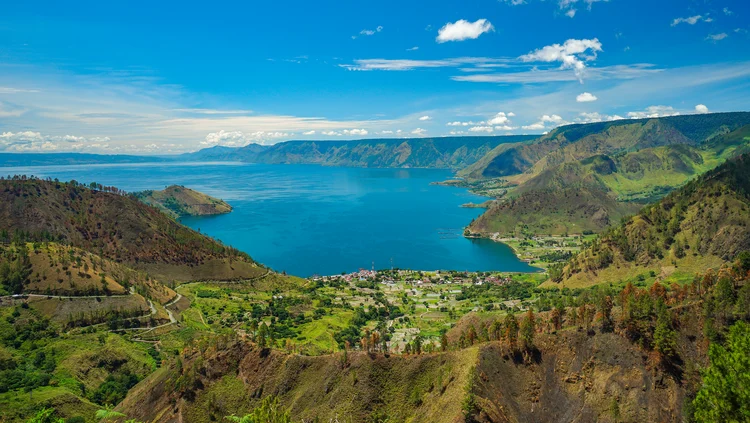
The receding water levels of Lake Toba, one of the world’s most significant volcanic lakes and a crown jewel of Indonesian tourism, have become a focal point of scientific concern as new research highlights a complex interplay between climate patterns and human development. According to a comprehensive study recently released by the National Research and Innovation Agency (BRIN), the surface of Lake Toba has undergone distinct phases of decline over the past several decades, driven by factors that vary significantly across different historical periods. This phenomenon is not merely an environmental curiosity but a burgeoning crisis that threatens the stability of North Sumatra’s fisheries, energy production, and its status as a UNESCO Global Geopark.
Researchers from BRIN’s Climate and Atmosphere Research Center (PRIMA) have identified that the fluctuations in Lake Toba’s water levels are the result of a multifaceted synergy between global climate cycles and local anthropogenic changes. By analyzing data spanning over sixty years, the research team led by Hendri, a prominent researcher at PRIMA-BRIN, has mapped out the trajectory of the lake’s hydrological health, revealing that the causes of the decline in 1957 are fundamentally different from those observed in the 21st century.
Historical Trajectory and the 1984 Turning Point
The hydrological history of Lake Toba can be divided into two primary eras, with the year 1984 serving as a critical threshold. During the first period, which stretched from 1957 to 1984, the lake’s water level dropped at an average rate of approximately 22 millimeters per year. This significant downward trend was largely attributed to natural climate variability. During these decades, the region was frequently subjected to the El Niño-Southern Oscillation (ENSO) phenomenon. El Niño typically brings prolonged dry seasons to the Indonesian archipelago, drastically reducing the precipitation required to recharge the massive Toba caldera. Without sufficient rainfall to offset evaporation and natural outflow, the lake’s surface began a steady retreat.
However, the year 1984 marked a structural shift in how the lake’s water was managed and how it responded to environmental pressures. This year coincided with the commencement of operations at the Sigura-gura Dam and the associated hydroelectric power plants (PLTA) along the Asahan River, which serves as the lake’s only natural outlet. The construction of this infrastructure was a landmark achievement for Indonesia’s industrial sector, specifically providing the massive amounts of energy required for aluminum smelting operations managed by PT Inalum.
According to Hendri, the introduction of these industrial controls changed the lake’s hydrological characteristics. Interestingly, after 1984, the long-term average rate of decline slowed significantly to about 2 millimeters per year. While this might suggest a stabilization of the water level, the reality is more nuanced. The stabilization of the average decline was accompanied by much more volatile annual fluctuations. While the dam allowed for a degree of regulated outflow, the lake became more sensitive to extreme weather events, leading to sharp drops during specific years.
The Role of Global Climate Drivers
While infrastructure changed the baseline of the lake’s levels, global climate patterns remained a dominant force in causing periodic water crises. The BRIN study points to specific years—1987, 1990, 1998, and 2016—where Lake Toba experienced extreme declines. These years were not random; they correlated with the simultaneous occurrence of El Niño and a positive Indian Ocean Dipole (IOD).
A positive IOD is characterized by cooler-than-normal sea surface temperatures in the eastern Indian Ocean, which suppresses cloud formation and rainfall over Western Indonesia. When a positive IOD coincides with El Niño, the impact on North Sumatra is compounded, leading to severe droughts. During these windows, the inflow from the 100-plus rivers that feed Lake Toba diminishes to a trickle, while the demand for water for power generation and local consumption remains constant, leading to a rapid "drawdown" of the lake’s reserves.
Ecological Degradation and Land Use Shifts
Beyond the atmosphere and the dams, the terrestrial environment surrounding the lake has undergone a radical transformation that further compromises the water level. The BRIN research highlights a staggering statistic: between 1988 and 2020, the area of natural forest within the Lake Toba catchment area decreased by approximately 29 percent. This loss of primary forest cover is a critical factor in the lake’s inability to maintain a steady water level.
Natural forests act as a biological sponge, capturing rainwater, slowing its path to the lake, and allowing it to infiltrate the groundwater table. When these forests are cleared—often replaced by industrial timber plantations, agricultural plots, or expanding residential settlements—the land loses its "water-holding" capacity. Rainwater that would have slowly fed the lake throughout the year instead turns into rapid surface runoff, leading to erosion and sedimentation during the wet season and a total lack of groundwater recharge during the dry season.
The increase in residential areas and industrial forest plantations around the caldera has created a double-edged sword. While these developments support the local economy, they increase the local demand for water and decrease the efficiency of the natural hydrological cycle. The BRIN study emphasizes that the shift from natural to man-made landscapes has fundamentally altered the "water catchment" dynamics of the Toba basin.
Socio-Economic Implications and Sectoral Impact
The decline and instability of Lake Toba’s water levels have far-reaching consequences for the region’s economy. The most immediate impact is felt in the energy sector. The Asahan hydroelectric complex relies entirely on the head of water provided by Lake Toba. When levels drop below certain technical thresholds, the efficiency of power generation plummets, potentially leading to energy shortages for the vital industrial sectors in North Sumatra.
The tourism industry, which the Indonesian government has aggressively promoted by designating Lake Toba as a "Super Priority Destination," also faces significant risks. A receding shoreline exposes unsightly mudflats, damages lakeside infrastructure such as piers and docks, and can lead to water quality issues. For a destination marketed on its pristine natural beauty, the sight of a shrinking lake is a significant deterrent for international and domestic travelers.
Furthermore, the fisheries sector, which sustains thousands of families around the lake, is highly vulnerable. Lower water levels can lead to increased concentrations of pollutants and reduced dissolved oxygen, especially in areas crowded with floating net cages (KJA). These conditions can trigger mass fish kills, as seen periodically in the lake, devastating the livelihoods of local farmers.
Expert Recommendations and the Path Forward
The findings from BRIN serve as a clarion call for a more integrated approach to managing the Lake Toba ecosystem. Hendri and his team argue that focusing solely on climate change adaptation is insufficient. While the government cannot control El Niño or the IOD, it can control land use and water management policies.
"The sustainability of Lake Toba requires more than just reacting to weather patterns," Hendri stated. "It necessitates a wiser management of land use and a more strategic utilization of water resources."
Proposed interventions include:
- Reforestation and Conservation: Aggressive efforts to restore the 29 percent of lost natural forest are essential to restoring the catchment area’s functionality. This includes creating buffer zones where industrial activity is strictly prohibited.
- Regulated Water Usage: Balancing the needs of the Sigura-gura Dam with the ecological requirements of the lake. This may involve revisiting the minimum water level mandates for power generation during drought years.
- Sustainable Urban Planning: As tourism grows, the expansion of settlements must be managed to ensure that "grey infrastructure" (concrete and buildings) does not further impede water absorption into the soil.
- Climate-Resilient Agriculture: Encouraging local farmers to adopt crops and techniques that require less water and do not contribute to the siltation of the lake.
Conclusion
Lake Toba is a testament to the Earth’s geological power, but its current state is a testament to the fragility of natural systems in the face of human progress and a changing climate. The BRIN study provides a vital roadmap, showing that while the challenges are varied—ranging from global atmospheric shifts to local deforestation—the solutions must be unified. To preserve the "Blue Jewel" of North Sumatra, stakeholders must look beyond short-term economic gains and prioritize the long-term hydrological health of the caldera. Without decisive action, the rhythmic ebb and flow of the lake may eventually give way to a permanent retreat, altering the face of the region for generations to come.

