
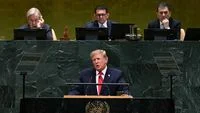
The 81st session of the United Nations General Assembly in New York City became the stage for a high-stakes diplomatic theater on Tuesday, September 22, as United States President Donald Trump delivered a speech that oscillated between aggressive unilateralism and strategic praise. In an address spanning nearly 40 minutes, the President set a combative tone for the international community, simultaneously threatening perceived adversaries and courting partners for his newly established "Board of Peace" (BoP) initiative.
The core of the address focused on the reconstruction of the Gaza Strip and the broader geopolitical competition between the United States and Iran. While the speech was framed as a plea for global stability, it underscored a deepening divide within the UN, with several delegations expressing visible discomfort or outright protest at the President’s rhetoric.
The Anatomy of the Speech: A Geopolitical Dichotomy
President Trump’s address was marked by a stark categorization of global actors. On one hand, he sought to consolidate a coalition of nations to support the Board of Peace—a US-led initiative aimed at stabilizing conflict-ridden zones, specifically Gaza. On the other hand, he employed inflammatory language toward long-standing antagonists, specifically Iran and Cuba, signaling a shift toward more interventionist rhetoric.
The President’s discourse on Iran was particularly bellicose. By questioning whether the international community should simply "obliterate" the Iranian leadership, Trump bypassed standard diplomatic parlance, opting for threats that observers suggest could undermine existing multilateral non-proliferation efforts. He explicitly linked the stability of global oil prices to the removal of the threat posed by the "mullah regime," suggesting that a transition away from the current Iranian government would lead to a significant drop in energy costs.
Regarding Cuba, the President characterized the nation as a failing state and hinted at the possibility of military options should the internal pressure on the communist regime fail to yield the desired political transition. The reaction from the Cuban delegation was immediate; members walked out of the General Assembly hall in a symbolic gesture of defiance, highlighting the fragility of diplomatic relations under the current US administration.
The Board of Peace and the Gaza Reconstruction Agenda
Central to the President’s address was the mention of the International Stabilization Force (ISF) and the broader Board of Peace. The ISF is intended to act as a peacekeeping and reconstruction body within the Gaza Strip following recent hostilities.
Trump publicly acknowledged several nations for their pledges of support, whether in the form of troop deployments, police training, or financial contributions. Among the countries recognized were Indonesia, Morocco, Albania, Kosovo, Kazakhstan, Egypt, Jordan, Qatar, Kuwait, Saudi Arabia, and Turkey.
Indonesia’s role in this framework is of particular note. The Indonesian government had previously pledged up to 8,000 personnel to assist in peacekeeping and stabilization efforts. However, the operational reality of this commitment remains in limbo. The ongoing tensions and the shadow of potential conflict between the United States and Iran have created a security vacuum that complicates the deployment of international troops. As of September 2020, the commitment remains on the books, but logistical and safety concerns have stalled the mobilization, leaving the ISF in a state of indefinite postponement.
Chronology of Escalating Tensions
The 81st UNGA session did not occur in a vacuum. The current geopolitical landscape is the result of years of hardening stances. The following timeline provides context to the diplomatic friction witnessed in New York:
- 2018-2019: Escalation of the "Maximum Pressure" campaign against Iran, characterized by the US withdrawal from the Joint Comprehensive Plan of Action (JCPOA) and the re-imposition of heavy economic sanctions.
- Early 2020: Heightened military friction in the Middle East, leading to increased calls for regional stability initiatives.
- August 2020: The formation of the "Board of Peace" under the US-led initiative to coordinate aid and security for the Gaza Strip.
- September 22, 2020: President Trump’s address at the UNGA, where he solidified his demand for global alignment behind the BoP while issuing direct threats to Tehran and Havana.
Analytical Perspective: The Cost of Unilateralism
Political analysts observing the address have noted that the President’s rhetoric represents a departure from traditional multilateral diplomacy. By using the UN General Assembly—a forum designed for consensus—to issue threats of "obliteration," the President has effectively challenged the norms of the institution.
"The language used by the President is clearly designed for a domestic audience as much as an international one," said one senior policy analyst. "However, the implication for foreign policy is that the US is increasingly viewing the UN not as a neutral arbiter, but as a platform to pressure specific regimes into compliance. When you praise countries for supporting your specific initiatives while threatening others with destruction, you create a transactional environment that makes long-term collective security difficult to maintain."
The inclusion of Indonesia and other regional powers in the list of contributors to the Gaza stabilization effort is a strategic move to validate the legitimacy of the Board of Peace. By highlighting these partnerships, the US administration attempts to frame its Middle East policy as a broad-based international coalition rather than a unilateral American endeavor.
Official Reactions and Global Implications
The fallout from the speech was immediate. While no official statement was released by the Iranian Ministry of Foreign Affairs during the session, the intensity of the rhetoric is expected to further harden the resolve of the Iranian leadership. In the corridors of the UN, European delegates were reportedly concerned that the President’s comments would provide domestic hardliners in Iran with the political leverage needed to escalate their own rhetoric.
For the nations involved in the Gaza stabilization plan, the pressure is mounting. Countries like Egypt and Jordan, which share borders with the affected regions, are in a precarious position. While they support the stability of Gaza, they must navigate the risk of being seen as mere extensions of US foreign policy in a region where anti-American sentiment remains a potent political force.
Furthermore, the economic implications mentioned by Trump regarding oil prices are a double-edged sword. While lower prices benefit consumer nations, the instability required to "collapse" a regime often carries risks of regional conflict that could just as easily send global markets into a tailspin.
Looking Ahead: The Future of the ISF
The road to stabilizing Gaza remains fraught with obstacles. The International Stabilization Force, despite the public endorsements at the UN, faces three major hurdles:
- Security Guarantee: Without a comprehensive ceasefire or a political roadmap acceptable to all stakeholders in Gaza, deploying 8,000 troops remains a high-risk endeavor that few nations are willing to undertake.
- Financial Sustainability: While billions of dollars have been pledged by Gulf nations like Saudi Arabia and Qatar, the mechanism for distributing these funds and ensuring they are not diverted remains a point of contention between the US and the Palestinian authorities.
- Domestic Political Will: For countries like Indonesia, the decision to send peacekeepers is tied to domestic sentiment. As the rhetoric between Washington and Tehran heats up, the Indonesian government faces internal pressure to ensure its troops are not caught in the crossfire of a wider US-Iran war.
In conclusion, the 81st session of the UN General Assembly served as a vivid demonstration of the current friction in international relations. President Trump’s address underscored a world order in flux, where the reliance on international institutions is increasingly tested by the return of great-power competition. As the world watches to see if the rhetoric translates into action, the fate of the Board of Peace and the stability of the Middle East remain inextricably linked to the volatile diplomatic landscape of the coming months. The international community now faces the challenge of managing the fallout of these declarations while attempting to preserve the functional cooperation necessary for global stability.

