
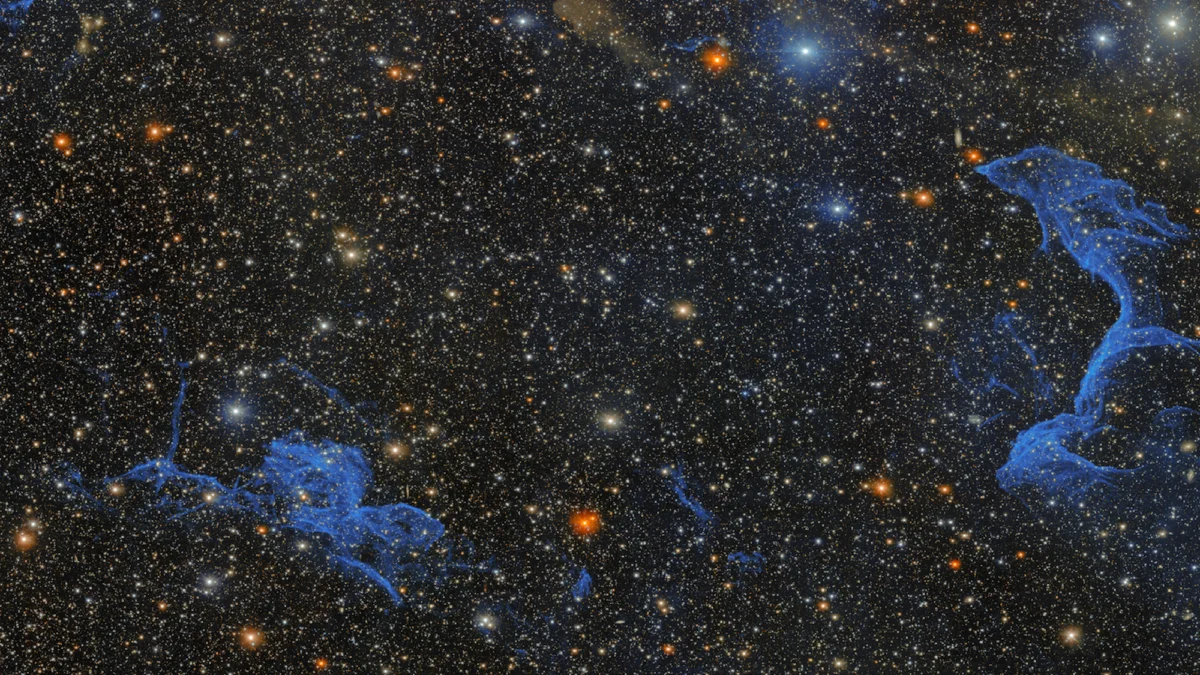
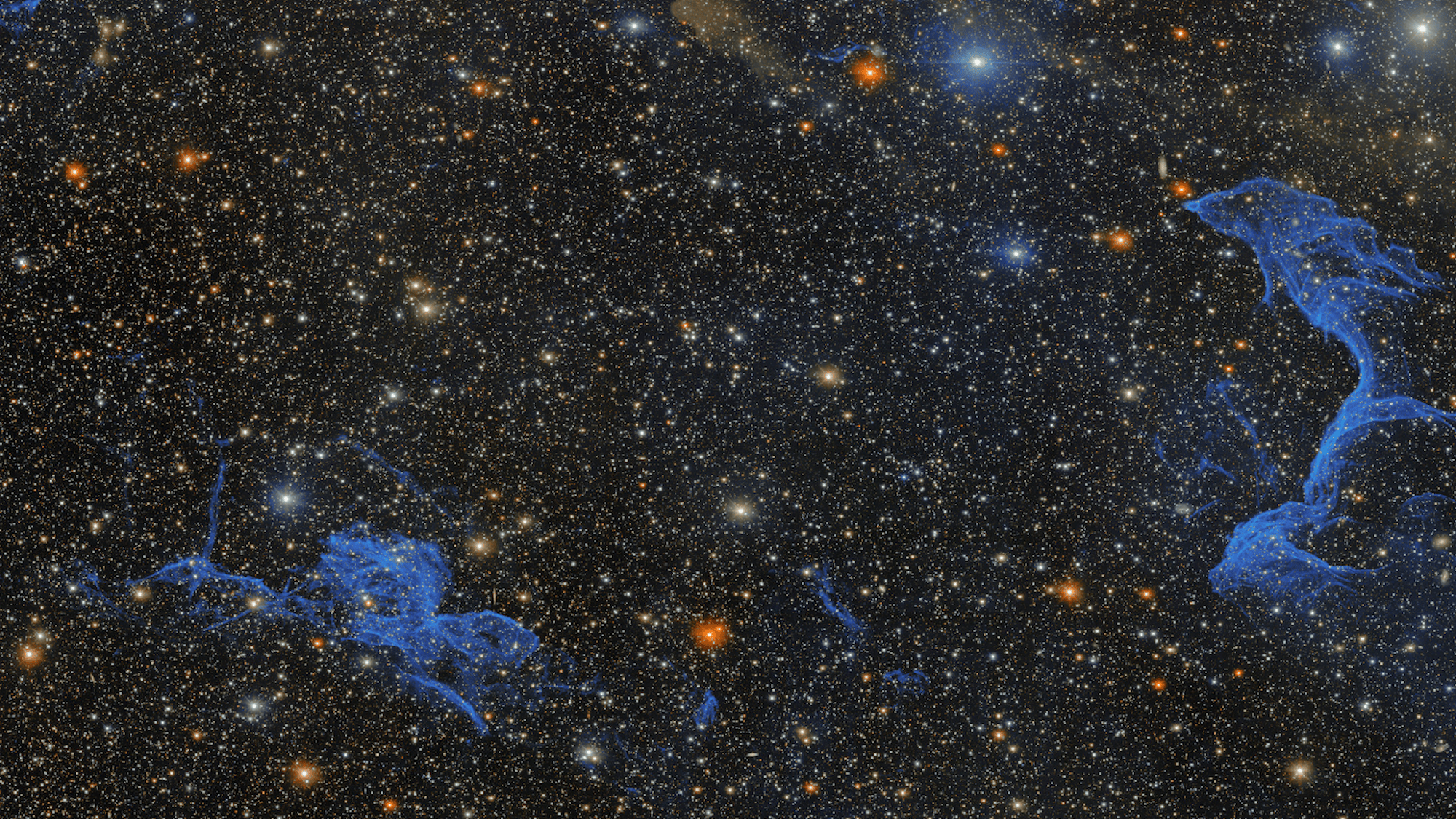
Floating silently in the vast expanse of the Centaurus constellation, approximately 6,800 light-years from Earth, lie the glowing, azure filaments of a cosmic graveyard known as SNR G295.5+09.7. Often referred to by astronomers and enthusiasts as the Betta Fish or Mermaid Nebula due to its fluid, tail-like appearance, this structure serves as a vivid reminder of a cataclysmic stellar death that occurred millennia ago. Recent high-resolution imagery captured by the Dark Energy Camera (DECam), mounted on the 4-meter Víctor M. Blanco Telescope at the Cerro Tololo Inter-American Observatory (CTIO) in Chile, has provided scientists with an unprecedented look at the intricate debris field left behind by a massive star’s final act of violence.
The nebula is categorized as a supernova remnant (SNR), a sprawling, complex structure composed of shock-heated gas and interstellar dust. This specific remnant offers a masterclass in the life cycle of stars, illustrating the transition from a stable, luminous body to a dense, compact object that challenges our understanding of physics.
A Chronology of Cosmic Demise
To understand the Betta Fish Nebula, one must look back between 6,000 and 10,000 years into the past. It was during this window that the progenitor star—a massive entity far larger than our own sun—exhausted its nuclear fuel. In the final moments of its life, the core of the star could no longer support its own immense gravitational weight against the outward pressure of fusion.
The resulting gravitational collapse happened in a fraction of a second. As the core imploded, the outer layers of the star were violently ejected into the surrounding interstellar medium at thousands of kilometers per second. This massive explosion, a supernova, sent shockwaves through the local galaxy, sweeping up surrounding gas and dust.
When these high-velocity shockwaves collided with the cold, relatively stationary interstellar material, they heated the gases to millions of degrees, causing them to ionize and glow. The image captured by the DECam highlights these specific interactions, revealing the blue wisps that give the nebula its aquatic moniker. The light from this explosion traveled through the vacuum of space for nearly seven millennia before finally reaching our telescopes, effectively providing us with a delayed transmission from a distant, ancient history.
The Physics of the Remnant
At the heart of this glowing debris field lies a remnant of the original star’s core: a neutron star. While the nebula itself spans many light-years, the neutron star is a miracle of extreme density. Astronomers estimate that this object contains roughly 1.4 times the mass of the Sun compressed into a sphere with a diameter of approximately 12 miles.
To visualize this, one would have to imagine stuffing the entire mass of the Sun into a space no larger than the city of Tucson, Arizona. The resulting density is so great that a single teaspoon of material from the surface of a neutron star would weigh billions of tons. This object serves as the "engine" of the nebula, though it is largely obscured by the chaotic, swirling clouds of gas it helped create.
The existence of a neutron star in this location is significant. Had the original star been slightly more massive, the gravitational collapse would not have stopped at the neutron star stage. Instead, the core would have continued to shrink until it formed a black hole. In such a scenario, the event horizon would have been so restrictive that the outward expansion of the stellar material might have been stunted, or the light from the resulting nebula would have been trapped, preventing us from ever observing this structure from Earth.
Technical Analysis and Imaging Significance
The imaging of SNR G295.5+09.7 was conducted by the National Science Foundation’s NOIRLab using the DECam, an instrument renowned for its 570-megapixel resolution. The DECam is primarily designed for the Dark Energy Survey, a project aimed at mapping the expansion of the universe, but its wide field of view and high sensitivity make it ideal for capturing the faint, diffuse light of supernova remnants.
The blue color observed in the nebula is not merely aesthetic; it provides critical data to researchers. By analyzing the light spectrum—specifically the emission from oxygen and other ionized elements—astronomers can determine the composition of the star that died. These remnants are the primary source of heavy elements in the universe. When a star explodes, it scatters carbon, oxygen, iron, and other elements forged in its core throughout the galaxy. These elements eventually become the building blocks for new stars, planets, and, in the case of our own solar system, the foundations for life.
The Role of Supernova Remnants in Galactic Evolution
The study of SNR G295.5+09.7 is not just an exercise in celestial photography; it is a vital component of galactic ecology. Supernovae act as the primary "recycling centers" of the galaxy. Without these explosions, the interstellar medium would remain relatively stagnant, lacking the enrichment of heavy elements necessary for the formation of rocky, terrestrial-like planets.

"These objects are the architects of the galaxy," says a representative associated with the NOIRLab research initiatives. "By mapping the remnants, we are effectively mapping the history of chemical enrichment in our neighborhood of the Milky Way."
The interaction between the shockwaves of the Betta Fish Nebula and the nearby interstellar clouds can also act as a trigger for new star formation. As the shockwave compresses cold, dense clouds of molecular hydrogen, it can force those clouds to collapse under their own gravity, birthing a new generation of stars. Thus, the death of one massive star often serves as the catalyst for the birth of hundreds of others.
Implications and Future Research
While the Betta Fish Nebula has been documented, it remains a subject of ongoing study. Researchers are particularly interested in the "kick" the neutron star received during the explosion. Often, supernova explosions are asymmetrical, which can launch the resulting neutron star across the galaxy at incredibly high velocities. Tracking the motion and cooling rate of the neutron star in SNR G295.5+09.7 could provide insights into the internal dynamics of these ultra-dense objects.
Furthermore, the study of such remnants allows for the testing of models regarding supernova nucleosynthesis. By comparing the amount of observed gas with the theoretical models of stellar death, astrophysicists can refine their understanding of how stars of different masses contribute to the chemical diversity of the cosmos.
As technology improves, specifically with the integration of multi-wavelength data from space-based observatories like the James Webb Space Telescope (JWST) and ground-based facilities like the Vera C. Rubin Observatory, we expect to see even greater detail within these remnants. The Betta Fish Nebula is a testament to the fact that while a star may cease its fusion-driven life, its influence on the structure and composition of the galaxy continues for millions of years.
In the broader context of astronomy, the Betta Fish Nebula remains a beacon of the violent, yet creative, nature of the universe. It serves as a reminder that the stars above are not static, unchanging lights, but dynamic, evolving, and ultimately mortal entities. Through the lens of the DECam, we are privileged to witness the afterglow of a cosmic event that occurred long before the rise of human civilization, yet remains a fundamental piece of the puzzle in understanding our origins among the stars.

