
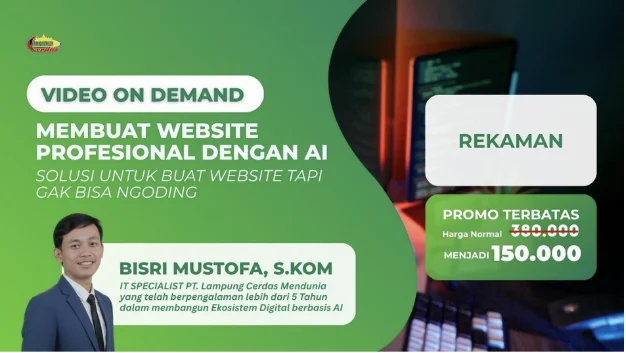
The landscape of software and web development is undergoing a profound structural transformation, driven by the rapid maturation of generative artificial intelligence. For decades, constructing a functional, aesthetically pleasing, and responsive website required a solid foundation in programming languages such as HTML, CSS, JavaScript, and various backend frameworks. Today, that barrier to entry is swiftly eroding. Modern artificial intelligence platforms allow individuals and enterprises to conceptualize, design, deploy, and manage professional websites purely through natural language instructions, bypassing traditional coding entirely.
This paradigm shift forms the core of the newly introduced Video-On-Demand (VOD) training program titled Website Mastery. Designed to bridge the digital skills gap for non-technical professionals, entrepreneurs, and students, the curriculum demystifies the integration of artificial intelligence into the web development lifecycle. Rather than focusing on syntax and manual debugging, participants are introduced to state-of-the-art AI-driven development ecosystems that interpret human prompts and translate them into production-ready code.
The democratization of web creation is no longer a futuristic concept confined to research laboratories; it is an active economic force reshaping the digital marketplace. As businesses increasingly rely on an agile online presence to remain competitive, the demand for rapid prototyping and deployment tools has skyrocketed. Industry analysts project that the adoption of low-code and no-code platforms, increasingly augmented by generative AI, will account for a significant majority of all web development applications over the next several years. By equipping a broader demographic with the ability to build sophisticated digital assets, initiatives like Website Mastery are poised to accelerate digital transformation across small and medium-sized enterprises.
The Evolution of Web Development: From Manual Coding to Natural Language Prompting
To understand the significance of current AI-driven web development platforms, one must examine the historical trajectory of how websites are built. In the early days of the internet, web creation was an artisanal craft demanding meticulous manual entry of hypertext markup. The introduction of Content Management Systems (CMS) such as WordPress, Joomla, and Drupal lowered this barrier by introducing graphical user interfaces and modular templates, allowing users to build blogs and simple business sites without writing raw code.
However, CMS platforms often present structural limitations regarding customization, performance optimization, and scalability, frequently requiring developers to intervene with custom code when unique features are needed. The subsequent rise of static site generators and modern frontend frameworks like React and Vue.js empowered developers to build highly dynamic applications, yet these technologies simultaneously widened the chasm between technical and non-technical users.
The advent of Large Language Models (LLMs) and specialized coding assistants has effectively bridged this chasm. Modern AI development tools do not merely generate static text snippets; they understand complex architectural requirements, manage component states, apply responsive styling, and troubleshoot errors in real-time. Platforms like Lovable, v0, and Bolt represent the vanguard of this movement, serving as collaborative partners that translate conversational instructions into fully realized digital interfaces.
Inside the Curriculum: Tools, Technologies, and Practical Workflows
The Website Mastery VOD program is structured to provide a comprehensive, end-to-end learning experience, moving participants seamlessly from conceptualization to global deployment. Rather than treating AI as a novelty, the curriculum integrates these tools into a standard, professional web development workflow.
Mastering the AI Toolkit: Lovable, v0, and Bolt
At the heart of the training are three prominent AI-driven development environments, each serving a distinct function in the creation pipeline:
- v0 by Vercel: Widely recognized for its generative user interface capabilities, v0 allows creators to prompt sophisticated UI components using Tailwind CSS and React. It excels at rapidly prototyping visual layouts and design systems based on descriptive text inputs.
- Bolt: Serving as a full-stack execution environment, Bolt enables users to build, run, and edit entire applications directly within the browser, leveraging AI to handle both frontend and backend logic.
- Lovable: This platform focuses on creating delightful, user-centric web applications through iterative prompting, allowing creators to refine functionality and visual appeal dynamically.
Participants are introduced to these platforms alongside essential supplementary tools, including Git and GitHub, which ensure version control and collaborative integrity. By mastering the setup and synchronization of GitHub repositories, students learn professional coding hygiene, ensuring their AI-generated projects remain organized, trackable, and scalable.
From Scratch to Deployment: The Practical Workflow
The educational methodology of Website Mastery rejects passive video consumption in favor of hands-on execution. The learning chronology guides participants through several distinct phases:
- Initial Conception and Prompt Engineering: Students learn how to formulate precise, context-rich prompts that guide AI tools toward desired structural and aesthetic outcomes. Understanding how to communicate intent clearly is framed as the primary technical skill of the modern developer.
- Generation and Visual Customization: Participants generate a baseline website from scratch, subsequently utilizing natural language instructions to modify layouts, adjust color palettes, integrate typography, and ensure mobile responsiveness.
- Version Control and Management: Projects are transitioned into local and remote environments, teaching participants how to manage updates, revert changes, and track project iterations using GitHub.
- Cloud Deployment via Vercel: The final phase demystifies the transition from a local workspace to the live internet. Participants utilize Vercel—a premier cloud platform for frontend frameworks—to build, host, and globally distribute their newly created websites, ensuring high availability and optimal performance.
Industry Implications and the Changing Role of Creators
The proliferation of AI-assisted web creation tools prompts important discussions regarding the future of traditional software engineering jobs and the broader digital economy. Industry observers generally agree that rather than replacing human developers, AI is elevating their role from manual coders to strategic architects and supervisors.
For non-technical entrepreneurs, freelancers, and small business owners, the implications are immediately empowering. Building a Minimum Viable Product (MVP) or launching a corporate landing page no longer requires substantial capital expenditure or months of coordination with external development agencies. A business owner can conceptualize a platform, iterate through designs via conversational AI, and deploy the asset within hours. This unprecedented speed to market fosters heightened competition and innovation, allowing creative concepts to be tested and refined with minimal friction.
Simultaneously, educational institutions and training providers must adapt their curricula to emphasize higher-level cognitive skills over rote technical execution. As demonstrated by the Website Mastery program, the core competencies of the future workforce will center on critical thinking, problem-solving, prompt architecture, and project management, rather than memorizing programming syntax.
Accessibility and Professional Growth
As digital infrastructure becomes increasingly central to global commerce, ensuring widespread access to these advanced capabilities is a paramount objective for tech educators. Programs designed for asynchronous consumption, such as Video-On-Demand masterclasses, offer the flexibility required by modern professionals seeking to upskill without disrupting their current employment schedules.
The structured approach of the Website Mastery curriculum ensures that participants do not merely acquire superficial familiarity with individual software packages, but rather develop a foundational understanding of modern web architecture. By demystifying the interplay between AI generation engines, version control systems, and cloud hosting providers, the initiative equips a new generation of digital creators with the autonomy needed to thrive in an automated economy.
For individuals seeking to harness the transformative potential of artificial intelligence and establish a professional online presence without the traditional constraints of learning to code, structured learning pathways represent a vital resource. Detailed information regarding enrollment, module breakdowns, and curriculum specifications for the Website Mastery VOD program can be accessed directly through designated educational portals such as detikevent. As the boundaries between technical and non-technical domains continue to blur, such initiatives will undoubtedly play a pivotal role in shaping the future of digital literacy and innovation.

