
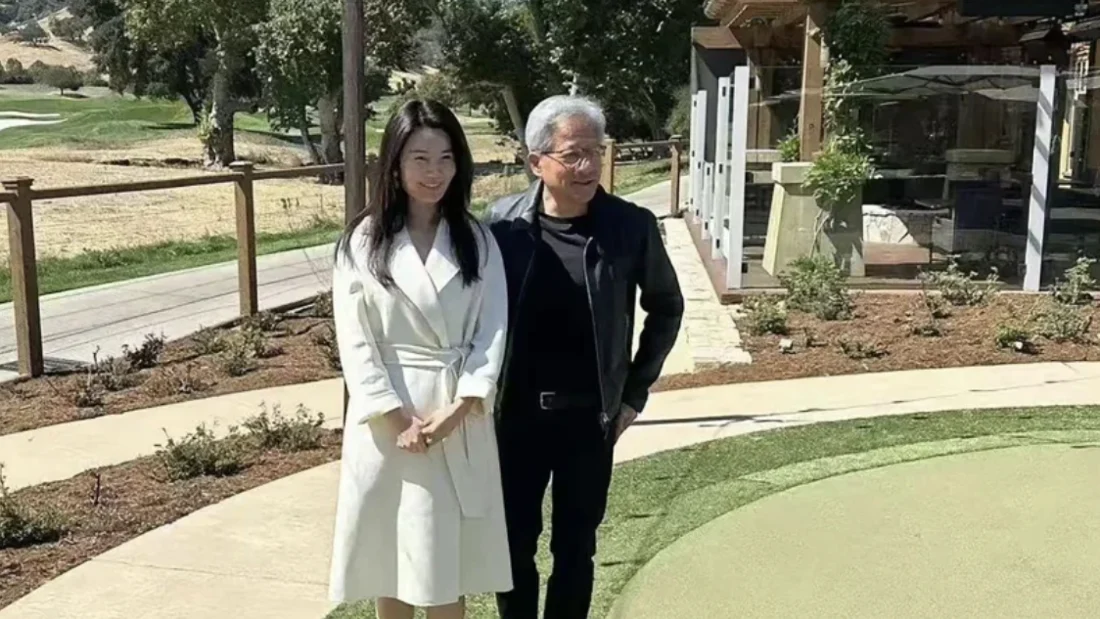
Nvidia Corporation has officially retained the services of Wachtell, Lipton, Rosen & Katz, one of the most prestigious law firms in the United States, to conduct an exhaustive and independent internal investigation into allegations of an extramarital affair between CEO Jensen Huang and a woman identified as Alice Huang, who is suspected of having ties to Chinese intelligence services. The move comes as the semiconductor giant faces intense scrutiny from federal regulators and mounting pressure from the U.S. Congress, threatening the stability of a company currently serving as the bedrock of the global artificial intelligence infrastructure.
The revelation, which surfaced late last week, has sent shockwaves through the financial markets. Nvidia, which has been the primary beneficiary of the generative AI boom, saw its market capitalization evaporate by approximately $500 billion in a matter of days. As of the latest market close, the company’s stock price hovered near its 52-week low, reflecting deep-seated investor anxiety regarding the intersection of corporate leadership, national security, and geopolitical tensions.
The Anatomy of the Investigation
The investigation is being led by Joon Kim, a partner at Wachtell and a former Acting United States Attorney for the Southern District of New York. Kim brings extensive experience in prosecuting complex fraud and white-collar crime, signaling that Nvidia’s board of directors is treating the matter with the highest level of legal rigor.
Nvidia’s board has formed a special committee consisting entirely of independent directors to oversee the probe. In a statement released to stakeholders, the company maintained that it currently has no evidence to suggest that proprietary technology, intellectual property, or sensitive data pertaining to U.S. national security has been compromised. However, the involvement of the Federal Bureau of Investigation (FBI) in a separate, parallel inquiry underscores the gravity of the situation.
Background and Chronology of Events
The controversy centers on Alice Huang—no relation to the Nvidia CEO—who previously served as an executive at Megaspeed, a Singapore-based firm that acted as a significant customer for Nvidia’s high-performance AI chips.
The timeline of concern stretches back to early this year, when Secretary of State Marco Rubio reportedly issued a classified memo to senior officials in Washington. The memo allegedly detailed intelligence suggesting that Jensen Huang had engaged in a personal relationship with Alice Huang, identifying her as a potential intelligence asset for Beijing.
- Early 2024: Intelligence reports regarding the association between Jensen Huang and Alice Huang are circulated within high-level government circles.
- Mid-2024: Initial queries regarding the business practices of Megaspeed are conducted by internal Nvidia compliance teams; the company maintains that these investigations found no evidence of illicit technology transfers.
- November 2024: The nature of the personal relationship becomes public knowledge, triggering a massive sell-off of Nvidia stock.
- Current Date: Nvidia formally retains Wachtell, Lipton, Rosen & Katz to conduct a deep-dive forensic audit of the CEO’s interactions and company records.
The Geopolitical Stakes: Chips as Security Assets
The central tension in this scandal lies in the nature of Nvidia’s product line. As the world’s second-most valuable company—trailing only Apple—Nvidia is the primary manufacturer of the Graphics Processing Units (GPUs) required to train large language models (LLMs). These chips are currently subject to stringent U.S. export controls aimed at preventing the People’s Republic of China from achieving military or technological parity in the field of AI.
Because Nvidia’s hardware is effectively classified as a dual-use technology, any suggestion that its leadership could be influenced or compromised by foreign actors is treated as a matter of urgent national security. Should investigators find that any influence was exerted through this relationship, the political fallout could lead to tighter export restrictions, further decoupling the U.S. and Chinese technology sectors.
Responses and Political Maneuvering
The reaction from the U.S. government has been swift and bifurcated. President Donald Trump, in a recent public acknowledgment, stated that he had spoken with Jensen Huang. Trump noted that Huang had claimed he was entirely unaware of Alice Huang’s alleged background as an intelligence operative. "He told me he had no idea, and I believe him," Trump remarked, though the sentiment has not pacified lawmakers on Capitol Hill.
The House Committee on Foreign Affairs has requested that Jensen Huang appear for a closed-door briefing next week. The committee is seeking answers regarding the extent of the relationship and whether any proprietary information was discussed or exposed. While Huang has not yet confirmed his attendance, the committee possesses the authority to issue a subpoena, which would legally compel his presence.
Meanwhile, the Chinese Foreign Ministry has vehemently denied the allegations, characterizing the reports as a smear campaign designed to disparage China and impede the progress of its domestic technology sector. Beijing has described the focus on Alice Huang as a "fabricated narrative" meant to justify further economic protectionism by the United States.
Financial and Operational Implications
The market volatility resulting from this scandal has put Nvidia’s valuation, which had soared to record highs on the back of AI optimism, under a microscope. Analysts suggest that the uncertainty regarding the CEO’s tenure and the potential for a regulatory overhaul of the company’s operations are the primary drivers of the current stock decline.
Nvidia’s reliance on a singular, highly visible figure like Jensen Huang creates a "key person risk" that the market is now aggressively pricing in. If the investigation concludes that the CEO’s judgment was compromised, the board may be forced to consider a leadership transition, a move that would represent a seismic shift in the semiconductor industry.
Furthermore, the investigation into Megaspeed and its past transactions with Nvidia is likely to be reopened. Although Nvidia has previously cleared the company of wrongdoing regarding the diversion of chips to China, the new context surrounding the CEO’s relationship provides a motive for federal investigators to scrutinize previous sales logs and end-user certificates with renewed intensity.
The Role of Wachtell and the Path Forward
The selection of Wachtell, Lipton, Rosen & Katz is a strategic choice. The firm is renowned for its handling of sensitive corporate crises and has a long history of working with major technology firms, including OpenAI and Salesforce. Joon Kim’s background as a federal prosecutor suggests that the board is preparing for a scenario where findings might need to be shared with the Department of Justice.
For the company, the primary goal is to restore investor confidence by demonstrating that the governance structure is robust enough to contain personal failures. However, the difficulty of the task cannot be overstated. Should investigators be unable to secure an interview with Alice Huang, the inquiry may remain inconclusive, leaving a lingering cloud over the company’s leadership.
As the investigation progresses, the tech industry remains in a state of suspense. The outcome will not only determine the future of Jensen Huang’s career but will also likely set a precedent for how American corporations navigate the increasingly perilous intersection of global geopolitics, high-stakes technology, and the private lives of their executive leadership. For now, Nvidia faces the dual challenge of satisfying an increasingly skeptical Congress while attempting to maintain its technological dominance in a rapidly evolving, hostile global market.

