
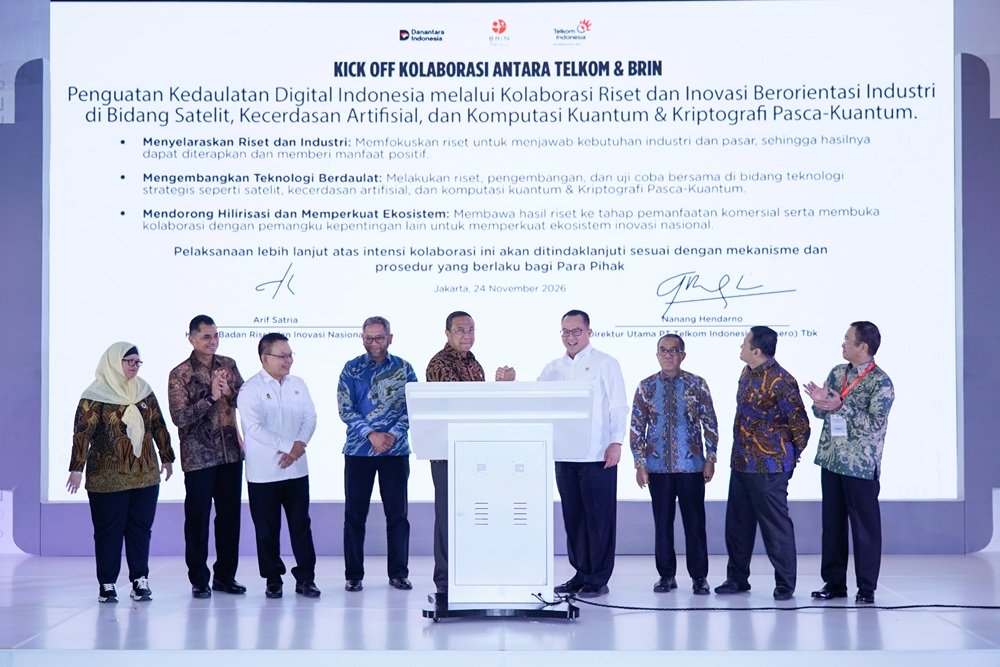
PT Telkom Indonesia (Persero) Tbk and the National Research and Innovation Agency (Badan Riset dan Inovasi Nasional, or BRIN) have officially established a high-level strategic partnership aimed at accelerating Indonesia’s technological self-reliance. Formally agreed upon in Jakarta, the collaboration focuses on three advanced technological pillars: artificial intelligence (AI), next-generation satellite infrastructure, and quantum computing. This landmark alliance is designed to bridge the gap between academic and institutional research and commercial market demands, cementing Indonesia’s position as a rising digital sovereign in Southeast Asia.
The agreement was officially signed by BRIN Head Arif Satria and Telkom President Director Nanang Hendarno. Operating under a joint innovation-to-commercialization framework, the partnership is structured to ensure that cutting-edge research does not remain confined to laboratory environments. Instead, it creates a robust pipeline for research outputs to undergo rigorous testing, iterative product development, and eventual commercial deployment across domestic industries and public sectors.
Background Context and Strategic Imperatives
In an era defined by rapid digital transformation, technological dependency on foreign software and hardware poses systemic vulnerabilities for emerging economies. Recognizing this, the Indonesian government has increasingly emphasized the need for domestic technological sovereignty—the capacity to conceptualize, design, build, and secure critical digital infrastructure from within national borders.
While Indonesia possesses a burgeoning digital economy and a massive consumer base, its foundational technology stacks—particularly in high-end artificial intelligence models, space-based communications, and advanced cryptography—have traditionally relied on foreign imports. BRIN, as the country’s premier research consolidation body, houses extensive scientific talent, advanced laboratories, and high-performance computing clusters. However, historically, a persistent chasm has existed between theoretical public sector research and practical industrial application. By partnering with TelkomGroup—Indonesia’s dominant telecommunications and digital infrastructure provider—this alliance seeks to operationalize BRIN’s intellectual property, turning scientific breakthroughs into market-ready commercial services.
Comprehensive Scope Across Three Technological Frontiers
The collaborative roadmap between Telkom and BRIN is systematically divided into three strategic domains, each addressing a critical pillar of modern national infrastructure.
1. Artificial Intelligence: Domestic LLMs, ModelHub, and Industry Use Cases
The artificial intelligence initiative centers heavily on linguistic and contextual localization. Telkom and BRIN are spearheading the development of Large Language Models (LLMs) and Small Language Models (SLM) natively trained in the Indonesian language and regional dialects via the ModelHub platform.
While global LLMs often lack nuanced cultural context and domestic linguistic depth, indigenous models ensure data security, cultural accuracy, and localized utility. Beyond general language models, the partnership has outlined four specialized use cases in collaboration with major state-owned enterprises (SOEs), including Danantara Indonesia, MIND ID, Pertamina, and Garuda Indonesia. These implementations are tailored to solve operational inefficiencies, streamline data analytics, and automate decision-making processes across critical sectors such as energy, mining, aviation, and agriculture. BRIN’s existing domain expertise in agriculture, fisheries, health, and mining will be integrated directly into these AI architectures, allowing Telkom to channel these innovations through its enterprise ecosystem.
2. Satellite Technology: From GEO Ground Segments to LEO Constellations
In the aerospace and telecommunications domain, the partnership leverages Telkom’s commercial subsidiary, Telkomsat, to overhaul national satellite capabilities. The immediate scope includes expanding Geostationary Earth Orbit (GEO) services, specifically focusing on the creation of more portable, cost-effective user terminals. These terminals are vital for bridging the digital divide, enabling high-speed connectivity in remote, archipelagic regions where terrestrial fiber-optic cables are unfeasible.
Looking toward the medium and long term, Telkom and BRIN are actively investigating the deployment of a national Low Earth Orbit (LEO) satellite constellation. Unlike GEO satellites stationed at fixed high altitudes, LEO constellations operate much closer to Earth, offering drastically reduced latency and broader coverage. This infrastructure will fundamentally support Positioning, Navigation, and Timing (PNT) systems, crucial for national defense, maritime navigation, and advanced geographic mapping.
3. Quantum Computing and Post-Quantum Cryptography (PQC)
As computing power scales exponentially, traditional cryptographic algorithms face an impending obsolescence timeline driven by the advent of quantum computing. Standard encryption methods used today could theoretically be cracked by quantum computers executing complex algorithms.
To preemptively safeguard national security, government communications, and corporate infrastructure, Telkom and BRIN are prioritizing the development of Post-Quantum Cryptography (PQC). The research initiative targets three foundational implementations: digital signatures for verifiable electronic documents, secure protocols for Internet of Things (IoT) ecosystems, and hardened Virtual Private Networks (VPNs). By deploying PQC frameworks now, Indonesia aims to future-proof its digital infrastructure against impending cryptographic threats posed by quantum supremacy.
Phase One Priorities: The Three Quick Win Initiatives
To ensure immediate momentum and measurable accountability, Telkom and BRIN have established three priority projects designated as "quick wins" for the initial phase of the collaboration:
- Ground Segment as a Service (GSaaS): Enhancing ground-station infrastructure to streamline satellite communications management and operational control.
- Indonesian LLM and SLM Development: Fast-tracking the rollout of sovereign AI language models through ModelHub for commercial and public sector integration.
- PQC for Digital Signatures: Implementing quantum-resistant cryptographic standards to secure high-value electronic documents and institutional transactions.
Leadership Insights and Institutional Roles
The division of labor within the partnership leverages the core competencies of both organizations. BRIN provides the foundational research capital, scientific personnel, and advanced laboratory equipment—most notably its High Performance Computing (HPC) facilities capable of handling massive machine learning and big data workloads. Meanwhile, TelkomGroup acts as the commercial engine, translating raw research into viable market products through rigorous customer validation, co-development, and go-to-market strategies.
Speaking on the strategic significance of the agreement, Telkom President Director Nanang Hendarno emphasized that technological independence requires active creation rather than passive consumption.
"Kedaulatan digital tidak cukup dibangun dengan mengadopsi teknologi, tetapi juga dengan kemampuan untuk mengembangkannya sendiri," Nanang stated, emphasizing that Indonesia must leverage its robust internal research capabilities to ensure technology directly serves the domestic market and industrial ecosystem. He added that the initial quick wins are designed to deliver tangible societal and economic value while laying the groundwork for long-term strategic resilience.
BRIN Head Arif Satria echoed these sentiments, highlighting the readiness of the agency’s infrastructure to support the ambitious partnership. "BRIN memiliki talenta, riset, and infrastruktur, mulai dari fasilitas HPC untuk AI, ML, dan Big Data, hingga infrastruktur satelit," Arif noted. By partnering with Telkom, these research assets gain a direct conduit to real-world deployment, significantly shortening the innovation lifecycle.
Implications and Future Outlook
The strategic alignment between Telkom and BRIN marks a pivotal shift in Indonesia’s technology policy. By combining the state’s scientific research apparatus with the nation’s leading telecommunications enterprise, the partnership mitigates the "valley of death" phenomenon—where promising academic research fails to reach commercialization due to a lack of industrial backing.
If successfully executed, this alliance could transform Indonesia from a passive consumer of foreign technologies into a regional exporter of sovereign AI solutions, resilient satellite services, and quantum-safe cryptographic standards. Furthermore, by embedding major state-owned enterprises into the AI development pipeline, the initiative ensures a ready-made market for domestic innovations, establishing a self-sustaining cycle of technological advancement, economic growth, and national security.

