
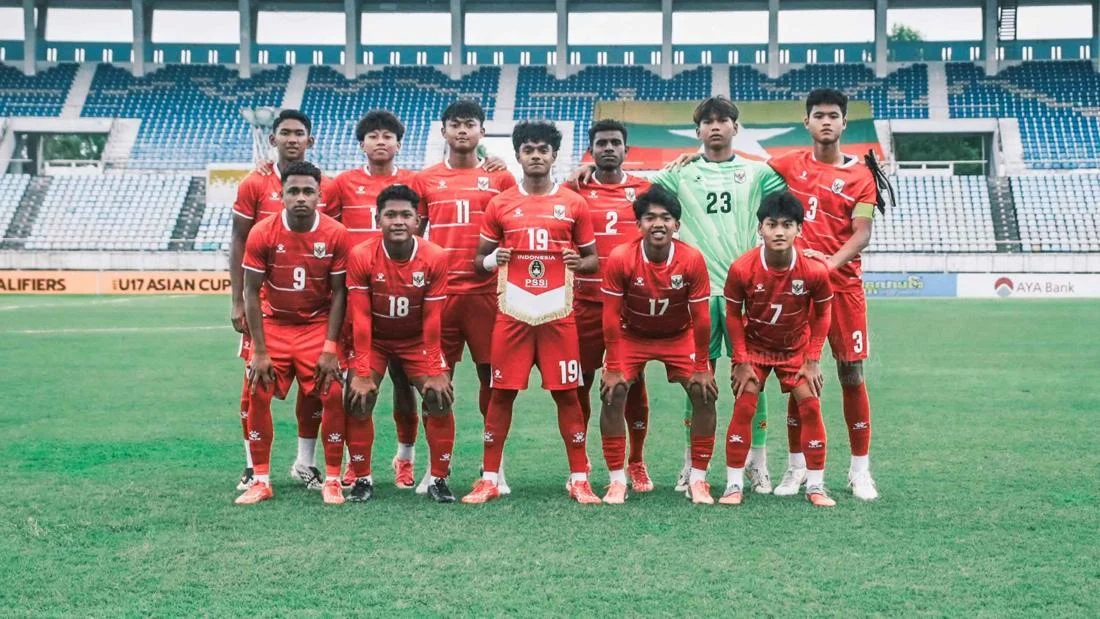
Muda Secures Compelling 3-0 Victory Over Philippines in U-17 Asian Cup 2027 Qualifiers Opener
The Indonesia U-17 national football team initiated their campaign in the qualification stage of the AFC U-17 Asian Cup 2027 with an emphatic and commanding performance, securing a 3-0 victory over their Southeast Asian rivals, the Philippines. The Group A opening fixture, hosted at the historic Thuwunna Stadium in Yangon, Myanmar, on Wednesday, November 11, 2026, showcased the structural growth, technical proficiency, and tactical discipline of the Indonesian youth setup under modern competitive conditions.
From the opening whistle, the Indonesian side, popularly known as Garuda Muda, asserted tactical dominance, dictating the rhythm of the match and creating numerous scoring opportunities. The result places Indonesia in an advantageous position at the top of Group A standings early in the qualification cycle, reinforcing their aspirations of securing a coveted spot in the continental tournament.
Tactical Setup and First-Half Dominance
As the match commenced under afternoon conditions in Yangon, the Indonesian coaching staff deployed a dynamic formation designed to press high up the pitch and disrupt the Filipino build-up play. The starting eleven featured Syahdan Caesar in goal, shielded by a defensive line composed of Allekay Ramadhan, Faiz Fathurahman, Ramadhan Putra, Pradipta Arya Zidano, and Haikal Ramadhan. The midfield engine room integrated Melki Alvando, I Dewa Gede Mahesta, and Chico Jericho, while the attacking responsibilities fell upon the shoulders of Dolvi Theofilus Solossa and Dhamar Try Kusuma.
The intent of the Garuda Muda squad was immediately evident. Barely a minute into the contest, Indonesia launched their first sustained offensive wave. A loose ball fell invitingly to I Dewa Gede Majesta inside the penalty area, whose sharp snapshot narrowly missed the target, sending a clear warning signal to the Philippine defensive line anchored by Nicko Buan, Joshua Engel, Lucas Alvarez, Djibril Henning, and Alejo Paredies.
Despite Indonesia’s early territorial advantage, the Philippines attempted to weather the storm through organized low-block defending and swift transitions. In the 16th minute, Indonesia threatened again when Dolvi Solossa unleashed a ferocious long-range effort from outside the box. The Filipino goalkeeper, Nicko Buan, displayed exceptional reflexes to parry the stinging shot away from danger.
The Philippine U-17 team, featuring international prospects such as Luke Sims, Clark Lisser, and Johan Rosten, gradually grew into the game and engineered a moment of brilliance in the 31st minute. Clark Lisser displayed remarkable individual skill, weaving past two Indonesian defenders with intricate footwork before releasing a low drive that drifted agonizingly close, missing the post by mere inches. That near-miss served as a wake-up call for the Indonesian backline.
The breakthrough for Indonesia materialized in the 36th minute. Dolvi Solossa delivered a precise, unselfish short pass to Dhamar Try Kusuma, who kept his composure inside a crowded penalty area. Dhamar drove a clean, low shot past the outstretched arms of Buan, breaking the deadlock and giving Indonesia a thoroughly deserved 1-0 lead.
Momentum firmly on their side, the Indonesian attack continued to press for a second goal before the interval. In the 41st minute, Dolvi Solossa rose high to meet a cross, directing a powerful header goalward that beat the goalkeeper only to agonizingly strike the woodwork. However, Indonesia’s persistence was rewarded deep into first-half injury time. Dhamar Try Kusuma struck again, completing a brace with a clinical, first-time finish from close range following a well-constructed team move inside the box. The referee’s whistle sounded shortly thereafter, sending Indonesia into the dressing room with a comfortable 2-0 advantage.
Second-Half Control and Tactical Management
Entering the second half with a comfortable two-goal cushion, the Indonesian technical staff instructed the players to manage the tempo, maintain defensive solidity, and exploit spaces left behind by a desperate Philippine side searching for a way back into the match.
The Philippines introduced tactical changes and fresh legs from the bench—including substitutes Jerimiah Antonio-Makinano and Kai Muller—in an effort to alter the dynamic of the midfield battle. They enjoyed brief spells of possession, yet struggled to penetrate a well-organized Indonesian defensive block marshaled effectively by Faiz Fathurahman and Ramadhan Putra.
As the match entered its final quarter, Indonesia capitalized on the opposition’s advancing defensive line. In the 76th minute, the Garuda Muda executed a textbook counter-attack. I Dewa Gede Majesta, who had been active throughout the match, utilized his pace to break through the midfield barrier, advanced toward the penalty area, and clinically dispatched the ball past the goalkeeper to make it 3-0.
With the scoreline reflecting a seemingly insurmountable deficit, the remainder of the fixture saw controlled possession play from Indonesia. The defensive unit absorbed late pressure with composure, ensuring that Syahdan Caesar kept a clean sheet. When the referee blew the final whistle, the scoreboard confirmed a flawless start for Indonesia with a 3-0 victory.
Background and Context of the AFC U-17 Asian Cup 2027 Qualifiers
The AFC U-17 Asian Cup 2027 qualification tournament represents a crucial milestone for youth football development across the Asian Football Confederation (AFC). For nations in Southeast Asia, these qualifiers serve as the ultimate litmus test for youth academies, grassroots development pipelines, and systematic coaching frameworks.
Group A matches hosted in Myanmar bring together competitive regional sides striving for continental recognition. The format requires teams to navigate a rigorous round-robin schedule, where goal difference, defensive discipline, and squad depth play decisive roles in determining qualification outcomes. For Indonesia, building momentum from the opening fixture is historically significant, as early victories alleviate psychological pressure and establish tactical confidence ahead of stiffer challenges against group opponents.
The modern structure of Indonesian youth football has experienced increased institutional support over recent cycles, emphasizing structured domestic competitions, international training camps, and sports science integration. Performances by talents like Dhamar Try Kusuma and Dolvi Solossa reflect the dividends of these long-term developmental investments.
Post-Match Analysis and Broader Implications
From a technical perspective, Indonesia’s victory over the Philippines highlighted several positive indicators alongside areas requiring refinement ahead of upcoming fixtures.
- Attacking Efficiency and Versatility: The ability of players like Dhamar Try Kusuma to exploit spaces in the box, combined with the creative playmaking of Dolvi Solossa and I Dewa Gede Majesta, demonstrates tactical fluidity in the final third. Generating multiple high-percentage scoring opportunities against a compact defensive structure validates the team’s offensive preparations.
- Defensive Resilience: Securing a clean sheet in an opening qualifier is vital for tournament success. The backline exhibited sound positional awareness and communication, successfully neutralizing the individual threats posed by Filipino attackers such as Clark Lisser.
- Squad Depth and Fitness Management: With a grueling schedule ahead in the qualification group, the ability to maintain high-intensity pressing throughout the 90 minutes without experiencing significant physical fatigue underlines the rigorous physical conditioning implemented by the coaching staff.
However, analysts note that as the competition progresses, Indonesian players must improve their clinical finishing in tight spaces. Several missed opportunities in the first half could prove decisive against higher-tier continental opponents who punish missed chances.
Looking Ahead in Group A
With three points and a positive goal difference secured, Indonesia sits at the summit of the Group A standings. The coaching staff will undoubtedly utilize the intervening days to evaluate player recovery, analyze upcoming opponents, and fine-tune tactical details.
For the Philippines, the defeat necessitates a thorough review of defensive transitions and mental resilience as they prepare for their subsequent fixtures in the qualification group. In tournament football, recovery and tactical adjustment are paramount, and the young Azkals retain mathematical opportunities to rebound in their remaining matches.
As the qualification tournament unfolds in Yangon, all eyes remain fixed on the Garuda Muda. If Indonesia can maintain the discipline, tactical cohesion, and offensive spark displayed in their opening fixture, they stand in a formidable position to secure qualification for the AFC U-17 Asian Cup 2027, taking another significant step forward on the regional and international stage.

