
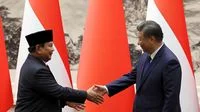
The Indonesian government is currently in the final stages of coordinating a high-stakes bilateral meeting between President Prabowo Subianto and Chinese President Xi Jinping on the sidelines of the upcoming Asia-Pacific Economic Cooperation (APEC) Summit. Scheduled to take place in Shenzhen, China, from November 18 to 19, the summit represents a pivotal moment for the new Indonesian administration to solidify its economic diplomacy and navigate the increasingly complex geopolitical landscape of the Asia-Pacific region.
While official confirmation of the exact time and agenda remains under review, the Ministry of Foreign Affairs (Kemlu) of the Republic of Indonesia has signaled that this potential summit is a top priority. Santo Darmosumarto, Director General for Asia-Pacific and African Affairs at the Indonesian Ministry of Foreign Affairs, confirmed on Wednesday (November 11) that diplomatic channels are working diligently to finalize the schedule. The meeting is anticipated to serve as a cornerstone for deepening the Comprehensive Strategic Partnership between the two nations, with a specific emphasis on bolstering investment and trade infrastructure.
The Significance of the APEC Summit
The APEC Summit in Shenzhen is one of the most critical multilateral gatherings of the year, bringing together leaders from 21 member economies. Under the Chinese chairmanship, the forum operates under the theme, "Building an Asia-Pacific Community to Prosper Together." This theme is underpinned by three core pillars: openness, innovation, and cooperation.
For President Prabowo, this summit marks a significant opportunity to engage directly with the global economic community. His schedule is packed with high-level engagements, most notably the APEC Economic Leaders’ Meeting (AELM) on November 19, and the APEC CEO Summit on November 18. The latter is particularly crucial, as it provides a platform for the Indonesian leader to dialogue with both public and private sector stakeholders regarding the future of sustainable economic growth, digital transformation, and the integration of artificial intelligence (AI) into regional value chains.
Strategic Objectives: Beyond Bilateral Ties
Indonesia’s agenda at APEC extends far beyond its individual relationship with China. The government views APEC as a vital mechanism for maintaining regional stability. In a climate characterized by intense power rivalries, Indonesia has explicitly stated its ambition to ensure that the forum remains a "bridge, not a battlefield."
"Indonesia wants APEC to be a region that is more open, equitable, and better prepared for the challenges of the future," stated Santo during the press briefing. This vision is supported by several strategic goals:
- Economic Resilience: Strengthening regional financial, energy, and human resource resilience to withstand global supply chain shocks.
- Technological Advancement: Advocating for the responsible use of AI and bridging the digital divide for developing nations within the APEC bloc.
- Stability and Peace: Emphasizing that long-term economic growth is contingent upon maintaining peace and security in the Asia-Pacific, a nod to the ongoing maritime and territorial tensions that frequently characterize regional discourse.
Contextualizing the Indonesia-China Relationship
The potential meeting between Prabowo and Xi Jinping follows a period of robust growth in bilateral relations. China has remained Indonesia’s largest trading partner for over a decade, and a top source of foreign direct investment (FDI). Key projects, such as the Jakarta-Bandung High-Speed Rail (Whoosh) and various nickel processing facilities in Sulawesi, underscore the deep integration of Chinese capital into Indonesia’s industrialization strategy.
However, the relationship is not without its complexities. Challenges regarding maritime boundaries in the North Natuna Sea and the environmental impact of large-scale Chinese-funded mining projects continue to be points of public and policy debate within Indonesia. A meeting between the two leaders would provide a venue to address these friction points while reinforcing the mutual benefits of a balanced, rule-based economic partnership.
Chronology of the Diplomatic Engagement
The road to the Shenzhen summit has been marked by a series of preparatory steps designed to ensure that Indonesia’s policy objectives are met:
- Early November 2024: Diplomatic staff and ministerial representatives initiate preliminary talks to set the agenda for the APEC summit.
- November 11, 2024: The Indonesian Ministry of Foreign Affairs publicly confirms that bilateral meetings, including a potential session with President Xi, are in the final stages of planning.
- November 18, 2024: President Prabowo is scheduled to attend the APEC CEO Summit, engaging with global industry leaders.
- November 19, 2024: The APEC Economic Leaders’ Meeting (AELM) takes place, serving as the primary forum for heads of state to discuss multilateral cooperation.
Data-Driven Economic Outlook
The focus on investment during the APEC meetings is supported by recent economic data. According to the Indonesian Investment Ministry, China consistently ranks as one of the top three investors in Indonesia, trailing only Singapore in terms of realized FDI. In 2023 alone, Chinese investment in Indonesia exceeded $7 billion, concentrated heavily in the downstream processing of critical minerals.
The Indonesian government’s emphasis on "innovation" aligns with China’s focus on the green energy transition. Jakarta is eager to position itself as a global hub for electric vehicle (EV) battery production. A high-level discussion between the two presidents is expected to touch upon how to further harmonize the "Global Development Initiative" (GDI) championed by China with Indonesia’s "Golden Indonesia 2045" vision.
Implications and Future Outlook
The outcome of the Prabowo-Xi meeting will likely serve as a barometer for the trajectory of Indonesia’s foreign policy under the new administration. President Prabowo has consistently advocated for a "good neighbor" policy and an independent, active stance on the global stage. By prioritizing the APEC forum, he is signaling that economic pragmatism will be the engine of his diplomatic efforts.
For the international community, the success of this meeting would offer a degree of reassurance that major regional powers are committed to maintaining open channels of communication. As protectionist sentiment rises globally, the efforts of Indonesia and China to promote an "open and equitable" trade environment may provide a necessary counterbalance to the trend of economic fragmentation.
Furthermore, by pushing for the inclusion of AI and digital infrastructure in the APEC agenda, Indonesia is signaling its intent to move up the global value chain. The Indonesian government hopes that the summit will result in concrete agreements or at least a firm framework for future cooperation on technology transfer and human capital development.
Conclusion
As the summit dates approach, the Indonesian delegation remains focused on the dual goal of securing national economic interests while playing a constructive role in regional governance. While the specifics of the Prabowo-Xi bilateral remain in flux, the underlying intent is clear: Indonesia is positioning itself as a central player in the future of the Asia-Pacific. Whether through trade liberalization, investment in sustainable energy, or diplomatic mediation, the upcoming APEC Summit in Shenzhen will undoubtedly be a defining chapter in the early days of the Prabowo administration’s foreign policy. The world will be watching to see if this meeting of minds can translate into the stability and prosperity that the region so urgently requires.

