
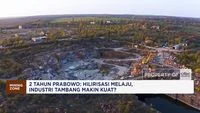
As the administration of President Prabowo Subianto reaches its two-year milestone, the government’s flagship policy of mineral downstreaming—or hilirisasi—stands at a critical juncture. Designed to shift Indonesia from a raw material exporter to a global hub for high-value industrial manufacturing, the policy has become the cornerstone of the nation’s economic transformation strategy. However, the ambition to capture greater value from domestic resources is currently navigating a complex landscape defined by regulatory hurdles, infrastructure gaps, and the urgent need for a more equitable distribution of economic benefits.
The Genesis and Evolution of Downstreaming
The roots of Indonesia’s downstreaming policy trace back to the 2009 Mining Law, which mandated the domestic processing of raw ores. Yet, it was under the previous administration that the policy gained significant momentum through the implementation of a total ban on nickel ore exports in January 2020. President Prabowo Subianto, upon assuming office in 2024, signaled a commitment to continuity, expanding the downstreaming mandate beyond nickel to include commodities such as copper, bauxite, tin, and coal.
The logic underpinning this strategy is rooted in the "Value-Added" theory. By forcing companies to build smelters within Indonesian borders, the government aims to catalyze the development of downstream industries—most notably the electric vehicle (EV) battery ecosystem. This is intended to leverage Indonesia’s status as the world’s largest nickel producer, which accounts for roughly 22% of global reserves, according to the United States Geological Survey (USGS).
Chronology of Policy Implementation
The trajectory of the downstreaming initiative over the past 24 months has been marked by several key legislative and operational developments:
- Late 2024: The Prabowo administration initiated a comprehensive review of mining permits (IUP) to ensure compliance with local processing requirements.
- Early 2025: The government introduced new fiscal incentives, including tax holidays for companies investing in high-tech battery precursor facilities, aiming to attract Western and Asian automotive manufacturers.
- Mid-2025: Operational challenges peaked as global commodity prices fluctuated, putting pressure on smaller smelter operators who struggled with high energy costs and capital expenditure requirements.
- November 2026: The administration convened a high-level summit to address the integration of downstream infrastructure with the national power grid, focusing specifically on transitioning smelters toward renewable energy sources.
Data-Driven Assessment of the Mining Sector
The economic impact of downstreaming is undeniable, though its distribution remains a subject of intense debate among economists and industry stakeholders. Data from the Central Statistics Agency (BPS) indicates that the export value of processed nickel products surged significantly compared to the era of raw ore exports. In 2025, the processed nickel sector contributed an estimated 3.8% to Indonesia’s GDP, a substantial increase from the sub-1% contribution observed a decade prior.
However, data also reveals a widening gap in investment distribution. Large-scale state-owned enterprises (SOEs) and major foreign-backed conglomerates have dominated the landscape, while small and medium-sized enterprises (SMEs) in the mining supply chain often find themselves excluded due to the high barrier to entry. Infrastructure readiness remains a critical bottleneck. While industrial estates in Morowali and Weda Bay have thrived, other regions designated for downstream development lack the necessary deep-sea ports, reliable electricity grids, and specialized human capital required to support sophisticated manufacturing.
Perspectives from Stakeholders
The business community presents a multifaceted view of the current policy environment. Large-scale mining corporations generally support the long-term vision of downstreaming, citing the stability provided by the government’s unwavering stance on export bans. "The policy has fundamentally changed the risk profile of investing in Indonesia," noted an executive from a leading mining firm during a recent industry forum. "We are no longer just extracting; we are building an industrial future."
Conversely, industry associations representing independent smelters have raised concerns regarding the "certainty of regulation." Frequent adjustments to export quotas and complex permitting processes have, at times, stifled operational continuity. "The regulatory framework must be more agile," says a spokesperson for the Indonesian Smelter Association. "If the goal is to make Indonesia a global manufacturing hub, the cost of doing business must be predictable, and the environmental compliance standards must be harmonized to meet international ESG (Environmental, Social, and Governance) requirements."
Addressing the Infrastructure and Regulatory Gap
For the downstreaming policy to reach its full potential, the administration must pivot from simple ore processing to the high-value end of the manufacturing spectrum. This requires a shift in focus toward:
- Energy Transition: Currently, many smelters rely heavily on coal-fired captive power plants, which conflicts with the government’s broader carbon neutrality goals. The government is now under pressure to expedite the integration of geothermal and hydro-power to fuel these facilities, thereby improving the marketability of "green" Indonesian nickel to global EV manufacturers.
- Regulatory Harmonization: There is an urgent need to streamline the bureaucratic overlap between central and regional governments. Investors often face conflicting directives regarding land acquisition and environmental permits, which can delay projects by months or even years.
- Human Capital Development: The specialized nature of battery cathode production requires a workforce with advanced technical skills. The government’s initiative to partner with local universities and vocational schools is a step in the right direction, but the pace of training currently lags behind the pace of industrial expansion.
The Broader Economic Implications
The implications of the downstreaming agenda extend far beyond the mining sector. By creating a domestic market for raw materials, the government is effectively insulating the national economy from the extreme volatility of global raw commodity price cycles. Furthermore, the development of the EV battery supply chain positions Indonesia as a critical player in the global energy transition.
However, the "resource curse" remains a looming risk. Analysts warn that if the wealth generated from downstreaming is not reinvested into education, public health, and sustainable infrastructure, the country risks creating an industrial enclave that benefits only a few while leaving the broader populace vulnerable to environmental degradation and economic inequality.
Looking Ahead: The Path Toward 2029
As the Prabowo administration looks toward the second half of its term, the success of the downstreaming policy will likely be measured by three indicators: the success of attracting major global EV manufacturers to establish assembly plants, the reduction of carbon emissions associated with smelter operations, and the ability to integrate local businesses into the high-tech supply chain.
The challenge ahead is not merely to produce more, but to produce better. Moving from "hilirisasi" (downstreaming) to "industrialisasi" (industrialization) will require the government to shift its role from a regulator of raw materials to a facilitator of high-tech innovation. Whether the administration can strike the delicate balance between maintaining state control over natural resources and creating an open, competitive environment for private investment will define the economic legacy of the next few years.
In the final analysis, the policy has successfully signaled that Indonesia is open for business, but on its own terms. The next two years will be critical in proving that these terms can lead to a sustainable, inclusive, and high-value economic future. The government’s ability to refine its regulatory framework and address the persistent infrastructure deficit will determine if Indonesia becomes a global manufacturing powerhouse or remains a captive of its own resource wealth. The progress made by the end of 2026 will serve as the final blueprint for the administration’s long-term economic vision, setting the tone for the nation’s industrial identity for the next decade.

