
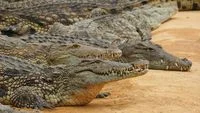
JERUSALEM (July 20, 2026) – Israel is reportedly advancing a highly controversial plan to enhance security at prisons holding Palestinian detainees by utilizing Nile crocodiles as part of its perimeter defense system. The proposal, which has drawn significant attention and is expected to provoke widespread condemnation from human rights and animal welfare organizations, involves surrounding correctional facilities with moats populated by these dangerous reptiles. This move follows a recent legal reclassification of Nile crocodiles in Israel, paving the way for their potential deployment in such unconventional security roles.
The concept, initially floated in late 2025 by Israel’s Minister of National Security, Itamar Ben-Gvir, a prominent figure from the far-right political spectrum, envisioned prison perimeters fortified with crocodile-filled trenches to deter escape attempts. At its inception, the idea faced immediate legal hurdles, primarily due to the classification of Nile crocodiles as protected wild animals, restricting their keeping to accredited zoos or designated conservation areas. However, recent developments suggest a significant shift in this legal landscape.
A Controversial Legal Reclassification
According to reports from Israeli media outlets, including Maariv, the Minister of Environmental Protection, Idit Silman, recently issued a decision that reclassifies Nile crocodiles from "wild animal" to "tended wild animal" (or "domesticated wild animal"). This administrative change is viewed by proponents of the plan as a critical step in removing the primary legal obstacle to implementing Ben-Gvir’s controversial proposal. The new classification ostensibly allows for the reptiles to be held and utilized in a broader range of facilities, including correctional complexes.
The swiftness and nature of this reclassification have not been without internal dissent. Legal advisors within the Ministry of Environmental Protection have reportedly voiced strong objections, questioning Minister Silman’s authority to unilaterally alter the legal status of a protected species, particularly when such a change carries profound implications for both animal welfare and public safety. These advisors have reportedly warned that the minister’s decision may exceed her legal mandate and could be challenged in court, potentially delaying or even derailing the crocodile moat project. The legal intricacies surrounding this reclassification are expected to be a focal point of future scrutiny, with potential challenges from environmental groups and legal experts.
Architect of the Plan: Minister Itamar Ben-Gvir
Minister Itamar Ben-Gvir, known for his hardline stance on security and justice issues, has been the primary advocate for this audacious prison security measure. As the Minister of National Security, his portfolio encompasses the Israeli Prison Service (IPS) and other law enforcement bodies. Ben-Gvir’s political ideology is rooted in ultranationalism and a strong emphasis on punitive measures, particularly concerning Palestinian prisoners. His tenure has been marked by a series of proposals aimed at tightening security, reducing privileges for detainees, and projecting an image of uncompromising strength. The crocodile moat proposal aligns with this broader agenda, seeking an extreme deterrent against escapes and a highly visible symbol of enhanced security.
His past actions and statements have frequently drawn criticism from human rights organizations, both domestically and internationally, who accuse him of inciting tensions and advocating for policies that infringe upon the rights of Palestinian detainees. The crocodile plan, if implemented, would undoubtedly add another layer to these ongoing controversies.
Target Location: Ketziot Prison
The initial facility slated for the implementation of the crocodile moat program is Ketziot Prison, located in the vast Negev Desert in southern Israel. Ketziot is one of Israel’s largest correctional facilities, primarily housing Palestinian security prisoners and administrative detainees. Its remote location and the challenging desert terrain already contribute to its high-security status. However, the prison, like others in the IPS system, has faced ongoing security challenges, including occasional escape attempts and concerns about overcrowding, which have fueled calls for more stringent measures.
The selection of Ketziot suggests a strategic decision to test the controversial program in a high-stakes environment. The desert climate, while challenging for crocodile maintenance, also offers a degree of isolation that might be perceived as beneficial for controlling the perimeter. The IPS’s internal review, initiated after Ben-Gvir’s proposal, reportedly gave a positive response to the idea, indicating a readiness within the prison service to explore such unconventional security enhancements.
Logistical and Financial Considerations
Beyond the legal and ethical debates, the practical implementation of a crocodile moat system presents significant logistical and financial challenges. The Israeli Prison Service has reportedly been proactive in assessing the feasibility of the plan. Since January, IPS officers have been dispatched to Hamat Gader, a well-known crocodile farm and tourist attraction in northern Israel, to undergo training and familiarize themselves with the characteristics and behavior of these reptiles. This hands-on experience is crucial for understanding the unique demands of caring for and managing large, dangerous animals in a security context.
Financial considerations also play a role in the IPS’s evaluation. While adult Nile crocodiles can command a price of approximately US$20,000 (around 326 million Indonesian Rupiah, assuming an exchange rate of Rp16,300/US$), the IPS is reportedly considering acquiring smaller, juvenile crocodiles, which are significantly cheaper at around US$8,000 (approximately Rp130 million) per animal. An unnamed IPS source quoted by Maariv indicated that these costs are considered relatively minor when compared to the substantial investments typically required for conventional prison security infrastructure, such as advanced surveillance systems, reinforced walls, and expanded guard patrols.
However, the cost analysis must extend far beyond the initial purchase price of the animals. Constructing and maintaining a suitable moat environment – including robust concrete structures, an adequate and consistent water supply in a desert region, filtration systems, feeding protocols, veterinary care, and specialized handlers – would entail substantial ongoing expenses. The long-term operational costs and the inherent risks associated with housing dangerous predators within a prison complex would likely far outweigh the initial investment in the animals themselves.
Ethical and Humanitarian Concerns
The prospect of using Nile crocodiles as prison guards has immediately triggered a storm of ethical and humanitarian concerns. Human rights organizations, both Israeli and international, are expected to vehemently condemn the plan. Organizations such as B’Tselem, Amnesty International, and Physicians for Human Rights-Israel, which routinely monitor conditions in Israeli prisons and advocate for the rights of Palestinian detainees, would likely view this proposal as a severe violation of international humanitarian law and human rights standards.
The use of live animals, especially dangerous predators, as a deterrent raises questions about the dehumanization of prisoners and the potential for cruel, inhuman, or degrading treatment. International conventions, such as the UN Standard Minimum Rules for the Treatment of Prisoners (known as the Nelson Mandela Rules), emphasize humane treatment and the protection of prisoners’ physical and mental health. While moats are not explicitly prohibited, the introduction of lethal animals would be unprecedented and could be seen as an unacceptable form of psychological torture or a direct threat to life, far exceeding legitimate security needs. Critics would argue that such a measure transforms a correctional facility into a medieval-style dungeon, stripping away any semblance of dignity from those incarcerated.
Palestinian prisoners’ rights groups, such as Addameer, would undoubtedly denounce the plan as a barbaric and punitive measure, further exacerbating the already tense relationship between detainees and the Israeli authorities. They would likely highlight the psychological impact of living under the constant threat of a deadly predator.
Animal Welfare Perspectives
Beyond human rights, the proposal also raises significant animal welfare concerns. Animal rights organizations globally would likely voice strong opposition to using wild animals in such a manner. Nile crocodiles are complex creatures with specific environmental and behavioral needs. Confining them to a prison moat, potentially in an unnatural desert environment, and using them as a living security system could constitute animal cruelty.
Concerns would include:
- Habitat Suitability: Ensuring the moat provides an adequate and suitable environment for the crocodiles’ long-term health and well-being, particularly in the harsh Negev climate.
- Diet and Care: Proper feeding, veterinary care, and enrichment to prevent stress, aggression, or disease among the animals.
- Ethical Treatment: The morality of intentionally placing animals in a role where they are expected to be a lethal threat, potentially leading to their own harm or death if escape attempts occur.
- Risk to Handlers: The inherent danger to prison staff tasked with managing and caring for these predators.
Such organizations would advocate for more humane and ethical security solutions that do not exploit animals for punitive purposes.
International Legal Frameworks and Broader Implications
The international community is also likely to scrutinize this proposal. While specific international laws directly prohibiting the use of crocodiles in prison security are non-existent, the spirit and principles of international humanitarian law and human rights law would be invoked. The Third and Fourth Geneva Conventions, which govern the treatment of prisoners of war and civilians in occupied territories, respectively, mandate humane treatment and prohibit measures that could cause physical suffering or moral pressure. The use of crocodiles could be interpreted as a violation of these principles.
The broader implications of implementing such a plan are multifaceted:
- International Reputation: It could severely damage Israel’s international standing, portraying it as resorting to extreme and inhumane measures.
- Diplomatic Fallout: It could strain diplomatic relations with allies and draw formal condemnations from international bodies.
- Precedent: It would set a dangerous precedent for prison security globally, potentially encouraging other nations to adopt similarly controversial methods.
- Effectiveness vs. Risk: The actual security benefits versus the enormous ethical, legal, and practical risks remain highly questionable. Alternative, technologically advanced security solutions are generally preferred in modern correctional systems.
Uncertain Future
As of now, no official announcement has been made by the Israeli government regarding the definitive implementation timeline or the final decision on the crocodile moat plan. The proposal remains a contentious "wacana" (discourse or idea) that has rapidly escalated from a fringe concept to a tangible possibility due to the recent legal reclassification. The internal legal objections within the Ministry of Environmental Protection, coupled with anticipated widespread opposition from human rights and animal welfare advocates, suggest that the path to actual implementation will be fraught with legal challenges, public debate, and international pressure.
The unfolding situation highlights the complex interplay between national security concerns, political agendas, legal frameworks, and ethical considerations in Israel. Whether the Nile crocodile will ultimately become a part of the Israeli prison security apparatus remains to be seen, but the discussion surrounding it has already cemented its place as one of the most unusual and controversial security proposals in the nation’s history.

