
Jakarta — In the fast-paced landscape of modern corporate finance, Microsoft Excel remains an indispensable tool, serving as the digital backbone for ledger management, budgeting, and financial reporting. However, a growing competency gap has emerged among professionals who assume that basic proficiency in creating simple tables or executing elementary arithmetic qualifies them to handle complex financial data ecosystems. Industry experts note that accounting and finance operations require a specialized suite of analytical functions, dynamic formulas, and structural frameworks that extend far beyond standard administrative spreadsheet usage.
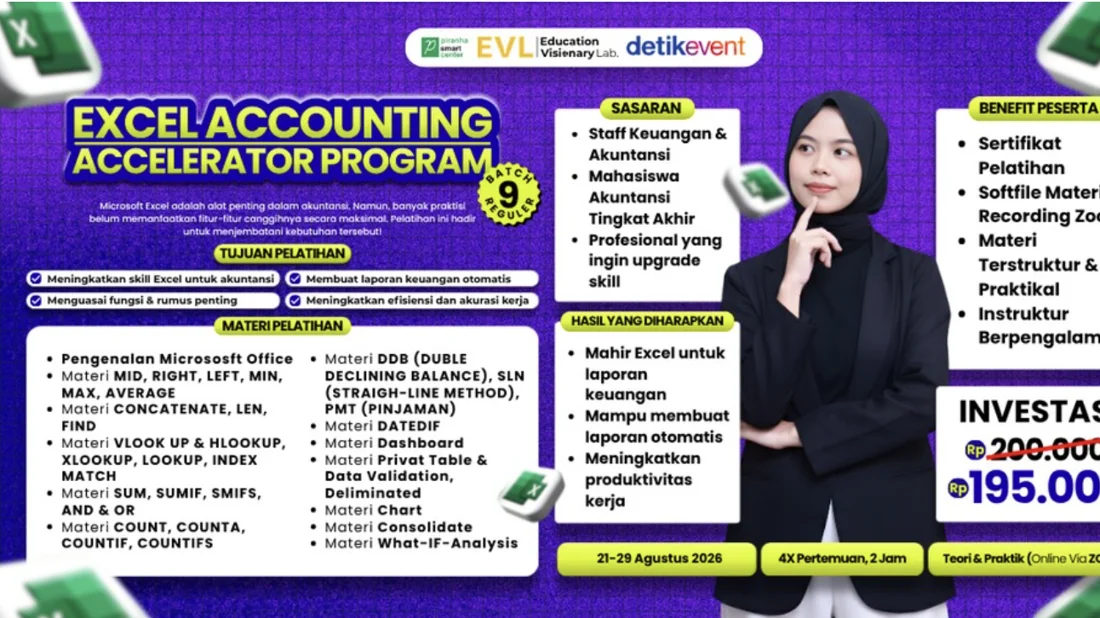
The inability to leverage advanced Excel capabilities often results in operational inefficiencies, where accounting professionals resort to manual data processing for tasks that could otherwise be automated through sophisticated formulas. To bridge this critical skills gap, targeted educational initiatives such as the upcoming Excel Accounting Accelerator Program Reguler Batch 10 have been established to equip professionals with industry-specific analytical competencies.
The Limitations of General Excel Proficiency in Corporate Finance
While corporate training programs frequently introduce basic spreadsheet functionalities—such as fundamental cell formatting, rudimentary sorting, and standard addition or subtraction formulas—they rarely address the intricate demands of accounting departments. Financial reporting, transaction auditing, and variance analysis require a deep understanding of logical operators, lookup functions, database management tools, and automated dashboard generation.
When finance professionals lack fluency in advanced functions, the margin for human error expands exponentially. Manual data entry and repetitive calculations increase the risk of discrepancies in financial statements, which can delay auditing processes and compromise strategic decision-making at the executive level. Furthermore, companies lose valuable man-hours when personnel spend hours compiling reports manually instead of utilizing dynamic tools like Pivot Tables, INDEX-MATCH arrays, or conditional aggregation formulas.
Recognizing this disconnect, industry trainers emphasize that learning Excel through the lens of general application is no longer sufficient. Professionals operating within accounting and financial sectors must contextualize their spreadsheet education around real-world financial scenarios, ensuring they can translate raw transactional data into actionable insights.
Curriculum Structure and Targeted Learning Outcomes
Designed specifically to address the nuances of financial data management, the Excel Accounting Accelerator Program Reguler Batch 10 aims to transition participants from basic users to proficient financial analysts. Rather than relying on abstract mathematical exercises, the curriculum integrates practical accounting frameworks into every module.
The program’s syllabus is structured to cover several core competency areas critical to modern financial operations:
- Advanced Mathematical and Logical Formulas: Moving beyond basic arithmetic to implement nested IF statements, SUMIFS, COUNTIFS, and error-handling functions that maintain data integrity across large ledgers.
- Advanced Lookup and Reference Functions: Mastering tools such as VLOOKUP, HLOOKUP, XLOOKUP, and the combination of INDEX and MATCH to retrieve, cross-reference, and reconcile financial records efficiently.
- Data Aggregation and Summarization: Utilizing Pivot Tables and Pivot Charts to distill thousands of line items into digestible summaries for management review.
- Financial Modeling and Analysis: Constructing dynamic financial models that project revenue, calculate depreciation schedules, and evaluate capital budgeting scenarios.
- Executive Dashboard Creation: Designing visual reporting interfaces that synthesize complex financial metrics into clear, real-time indicators for executive stakeholders.
By embedding case studies derived from actual corporate accounting challenges into the syllabus, organizers ensure that participants comprehend not only the mechanical execution of formulas but also the underlying financial logic.
Event Timeline and Operational Schedule
The Excel Accounting Accelerator Program Reguler Batch 10 has been structured to accommodate the demanding schedules of working professionals. The intensive training course will be conducted entirely online, allowing participants from various geographical locations to join without commuting constraints.
The chronological rollout of the program is scheduled across two consecutive weekends in September 2026:
- Session 1: Saturday, September 21, 2026, from 18:30 to 20:30 Western Indonesia Time (WIB).
- Session 2: Sunday, September 22, 2026, from 18:30 to 20:30 WIB.
- Session 3: Saturday, September 28, 2026, from 18:30 to 20:30 WIB.
- Session 4: Sunday, September 29, 2026, from 18:30 to 20:30 WIB.
This evening schedule allows accountants, financial analysts, corporate controllers, and business owners to upgrade their technical capabilities without disrupting their daytime professional responsibilities. Each two-hour session combines theoretical instruction with guided practical exercises, ensuring immediate application of the concepts taught.
Broader Economic Implications and Workforce Competitiveness
In an era characterized by rapid digital transformation, the automation of routine accounting tasks has redefined the role of the modern financial professional. Routine bookkeeping is increasingly handled by enterprise resource planning (ERP) systems and automated software, shifting the demand toward professionals who possess advanced data interpretation and synthesis skills.
Labor market analysts observe that employers across diverse industries—from multinational corporations to agile startups—prioritize candidates who demonstrate advanced spreadsheet proficiency. Mastery of tools like Excel serves as a foundational stepping stone toward higher-level business intelligence applications. Professionals who can navigate complex datasets with precision are better positioned to conduct variance analyses, assess financial risk, and contribute strategically to organizational growth.
Moreover, educational programs focused on practical skill acquisition play a vital role in addressing structural unemployment and underemployment. By upskilling the existing workforce, initiatives like the Excel Accounting Accelerator Program enhance overall labor productivity, driving higher standards of financial governance within the business sector.
Registration and Participation Details
Professionals seeking to eliminate inefficiencies in their daily workflows, resolve recurring data management challenges, and elevate their analytical credentials are encouraged to secure their enrollment ahead of the commencement date.
Registration for the Excel Accounting Accelerator Program Reguler Batch 10 is currently open. Interested candidates can access the official registration portal and review comprehensive syllabus details by visiting detikevent. Given the interactive nature of the online sessions and the focus on personalized instruction through practical casework, prospective participants are advised to register early to ensure placement in this milestone batch.

