
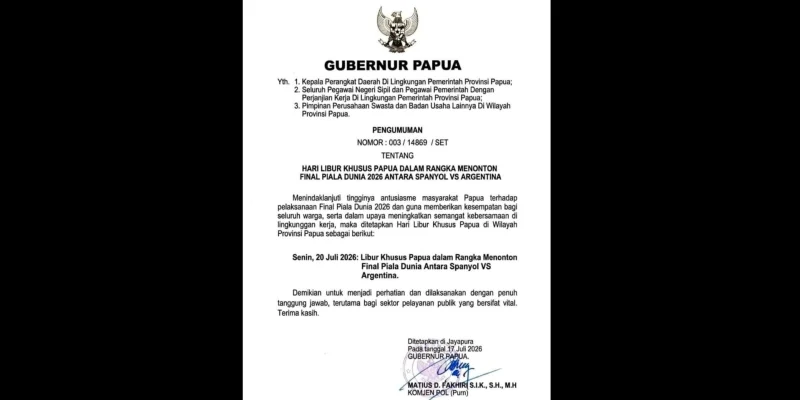
Jayapura, Papua – In an extraordinary move reflecting the profound global appeal of football, the Governor of Papua, Matius D. Fakhiri, has officially declared Monday, July 27, 2026, a special public holiday across the province. This decision aims to allow the entire population of Papua to fully immerse themselves in the highly anticipated FIFA World Cup 2026 Final, which is projected to feature a titanic clash between football powerhouses Spain and Argentina. The announcement, formalized through Governor’s Announcement Number 003/14869/SET, was issued in Jayapura on July 17, 2026, underscoring the regional government’s responsiveness to the fervent public enthusiasm surrounding the pinnacle of international football.
The decree specifies that the special holiday applies to all regional government apparatus, civil servants (ASN), and government employees with work agreements (PPPK). Furthermore, it extends as a strong recommendation and appeal to leaders of private companies and other business entities operating within the Papua region, encouraging them to grant similar concessions to their employees. This broad scope highlights the administration’s intent to ensure widespread participation in what is expected to be a unifying communal experience. Governor Fakhiri, a retired police commissioner general, emphasized that while the holiday is granted for celebration, vital public services must continue to operate without interruption, urging all parties to execute their responsibilities with diligence.
The Official Mandate and Its Scope
The official announcement, meticulously detailed in the Governor’s decree, leaves no ambiguity regarding the holiday’s purpose and application. "Monday, July 27, 2026: Special Holiday for Papua in order to watch the World Cup final between Spain Vs Argentina," reads the precise wording of the proclamation. This specific date is critical, taking into account the significant time difference between the North American host cities of the World Cup 2026 Final and Papua, which operates on Eastern Indonesia Time (WIT), GMT+9. A Sunday evening final in North America would translate to a Monday morning kick-off in Papua, necessitating the Monday holiday to facilitate live viewing.
The decision was explicitly framed as a direct response to the "high enthusiasm of the Papuan community for the climax of the 2026 World Cup." This level of public engagement, particularly for a global sporting event, is seen by the provincial administration as an opportunity to foster greater social cohesion and a shared sense of identity. The decree also serves as a testament to the autonomous powers vested in regional governments to make decisions that align with the cultural and social aspirations of their constituents. While the holiday is mandatory for all public sector employees, its advisory nature for the private sector aims to balance the economic impact with the social benefits, giving businesses the flexibility to adapt while encouraging participation.
The Global Spectacle: FIFA World Cup 2026
The FIFA World Cup 2026, co-hosted by the United States, Canada, and Mexico, represents a monumental shift in the tournament’s history. For the first time, 48 nations will compete across 16 cities, expanding the competition from its traditional 32-team format. This enlargement is set to bring an unprecedented number of matches—104 in total—and an even broader global reach, captivating billions worldwide. The tournament’s expanded format is designed to offer more opportunities for national teams to participate and to further globalize the sport, solidifying football’s status as the world’s most popular game.
The final match, pitting Spain against Argentina, as anticipated by the Papuan Governor’s announcement, would be a dream scenario for many football enthusiasts. Both nations boast rich footballing histories, multiple World Cup titles, and a legacy of producing some of the sport’s most iconic players. Spain, known for its elegant tiki-taka style, and Argentina, celebrated for its passionate flair and individual brilliance, represent contrasting yet equally compelling football philosophies. A final between these two giants would undoubtedly be a spectacle of skill, drama, and intense rivalry, justifying the extraordinary measures taken by the Papuan government to ensure its populace can witness it live. The mere anticipation of such a high-stakes encounter underscores the global emotional investment in the tournament.
Football Fever in Papua and Across Indonesia
Indonesia, a nation of over 270 million people, possesses an insatiable passion for football, and Papua is no exception. In fact, the easternmost province is widely regarded as a hotbed of Indonesian football talent, consistently producing some of the country’s most gifted players. The likes of Boaz Solossa, Eduard Ivakdalam, and many others have emerged from Papua, becoming national heroes and symbols of regional pride. This deep-rooted connection to the sport means that major international tournaments like the World Cup resonate profoundly within the community.
For many Papuans, football is more than just a game; it is a cultural phenomenon that transcends socio-economic divides, providing a common language and a source of collective joy and identity. Viewing parties, communal gatherings, and spirited discussions are commonplace during major tournaments, fostering a strong sense of camaraderie. The decision to declare a public holiday for the World Cup Final is, therefore, not merely an administrative act but a recognition and validation of this deep cultural attachment. It acknowledges that for a significant portion of the population, missing such a pivotal event due to work commitments would be a genuine loss of a shared national and global experience.
Balancing Enthusiasm with Responsibility: The Governance Challenge
While the excitement surrounding the World Cup Final is palpable, Governor Fakhiri’s announcement also contained a crucial caveat: the imperative to maintain essential public services. The decree explicitly reminds all government agencies and, by extension, private entities, to "pay attention and implement with full responsibility, especially for vital public service sectors." This directive reflects a careful balancing act between catering to public sentiment and ensuring the continuous functioning of critical infrastructure and services.
Sectors such as healthcare, security, transportation, and emergency services are typically deemed vital and cannot afford a complete shutdown. The government’s challenge lies in formulating contingency plans that allow a significant portion of the workforce to enjoy the holiday while maintaining skeleton crews or staggered shifts for essential personnel. This might involve additional incentives for those working on the holiday or pre-arranged schedules to minimize disruption. The governor’s background as a purnawirawan polisi (retired police commissioner general) suggests a practical understanding of operational demands and the necessity of maintaining order and service delivery, even amidst widespread festivity.
Economic and Social Implications of the Holiday
The declaration of a public holiday, particularly for an event like the World Cup Final, carries both economic and social implications. On the social front, the benefits are clear: it provides an unparalleled opportunity for community bonding. Families and friends can gather without the pressure of work, fostering stronger social ties and a shared sense of belonging. This collective experience of watching a global event can serve as a powerful unifier, transcending political or social differences. Governor Fakhiri himself underscored this aspect, noting that the moment could "strengthen the spirit of togetherness, both in the work environment and in the community."

Economically, the impact can be twofold. On one hand, a public holiday typically leads to a dip in productivity for formal sectors, as offices and factories operate at reduced capacity or close entirely. For the private sector, which is only advised to follow suit, there might be a calculation between lost work hours and potential gains from increased consumer spending related to the event. Local businesses, particularly those in the food and beverage industry, sports merchandise, and entertainment sectors, could experience a surge in demand as people gather to watch the match, purchase snacks, drinks, or even new viewing equipment. This localized boost could partially offset the broader economic slowdown. However, the overall net economic effect would require a more detailed analysis, weighing the value of productivity against the socio-cultural benefits and localized consumption spikes.
Precedent and Regional Autonomy in Action
The decision by Governor Fakhiri is not entirely unprecedented in the broader context of regional governance in Indonesia, where provinces often exercise their autonomy to declare local holidays for significant cultural or religious events. However, declaring a holiday specifically for a sporting event of this magnitude, especially one held internationally, highlights a specific responsiveness to modern global phenomena and public sentiment. It sets a precedent for how regional governments might engage with and harness the unifying power of major sporting events.
The Governor’s action also reflects the evolving role of regional leadership. In an increasingly connected world, leaders are expected not only to manage administrative affairs but also to understand and cater to the social and cultural aspirations of their populations. By responding to the "high enthusiasm" for the World Cup, Governor Fakhiri demonstrates a form of governance that is attuned to the emotional pulse of the community, leveraging a global event to foster local unity and spirit. His background as a former high-ranking police official also brings a unique perspective, combining strict adherence to public order with an understanding of social dynamics and popular appeal.
Anticipation Builds for a Historic Final
As the 2026 FIFA World Cup draws closer, the anticipation in Papua, now amplified by the gubernatorial decree, will undoubtedly reach fever pitch. The prospect of witnessing two footballing titans, Spain and Argentina, battle for ultimate glory, coupled with the freedom to do so without work commitments, promises an unforgettable experience for millions in the province. This blend of sports, culture, and responsive governance creates a unique scenario where an international spectacle becomes a catalyst for local celebration and unity.
The eyes of the world will be on the final match, but for Papua, July 27, 2026, will be more than just a date on the calendar; it will be a day dedicated to collective joy, shared passion, and a testament to the enduring power of football to unite people across continents and cultures. The decision by Governor Matius D. Fakhiri has not only granted a holiday but has also solidified the World Cup’s status as a truly global event with tangible local impacts, reinforcing the spirit of togetherness that he so ardently wishes to cultivate within the Papuan community.

