
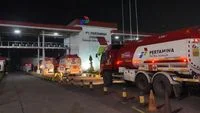
Jakarta, CNBC Indonesia – Pertamina Patra Niaga Regional Sumbagut has confirmed a significant improvement in fuel distribution conditions across Medan and its surrounding areas, with services at petrol stations (SPBUs) progressively returning to normalcy. Intensive acceleration efforts over recent days have effectively resolved previous logistical bottlenecks and eased consumer queues, marking a crucial step towards full operational stability. As of Saturday, July 18, 2026, the once-common sight of long lines at numerous SPBUs in Medan has largely dissipated, a testament to the optimized distribution strategies implemented in close collaboration with all relevant stakeholders.
The recent disruption in fuel supply, characterized by extended queues and intermittent stock shortages at various petrol stations, had raised concerns among residents and businesses in Medan, the bustling capital of North Sumatra province. This situation, which began approximately a week prior to the current resolution, underscored the critical importance of a robust and resilient energy supply chain for daily life and economic activity in one of Indonesia’s largest cities. Initial reports from early July 2026 indicated a sudden surge in demand, possibly exacerbated by seasonal factors or localized supply chain disruptions, leading to anxieties among consumers and a temporary increase in panic buying. This placed immense pressure on Pertamina Patra Niaga, the subsidiary of the state-owned oil and gas giant Pertamina responsible for downstream operations, to swiftly address the burgeoning crisis and restore public confidence.
Medan, with its strategic geographical location as a major port city and economic hub in Western Indonesia, serves as a vital artery for trade, transportation, and industrial activities. Any disruption to its energy supply, particularly fuel, can have far-reaching consequences, impacting everything from public transport and logistics to small and medium-sized enterprises (SMEs) and household commutes. The initial signs of scarcity led to increased operational costs for businesses relying on transportation, such as freight forwarders and public transport operators, and caused considerable inconvenience for private vehicle owners. Local media outlets had highlighted the growing frustration among citizens struggling to access essential fuels like Pertalite and Pertamax, leading to calls for immediate intervention from authorities.
Responding to the escalating situation, Pertamina Patra Niaga Regional Sumbagut initiated a comprehensive, multi-pronged strategy to stabilize and accelerate fuel distribution. According to Fahrougi Andriani Sumampouw, Area Manager Communication, Relations & CSR Pertamina Patra Niaga Regional Sumbagut, the concerted efforts have yielded tangible positive results. "The fuel distribution conditions in Medan continue to show positive development. Queues at several SPBUs are starting to return to normal as a direct outcome of the accelerated distribution efforts undertaken in conjunction with all stakeholders," Fahrougi stated in an official release. She further emphasized Pertamina’s unwavering commitment to optimizing operations until services to the community are fully normalized. This statement, delivered amidst ongoing recovery, aimed to reassure the public and highlight the effectiveness of the measures taken.
Chronology of Recovery and Operational Enhancements
The path to recovery involved a rapid deployment of resources and a strategic overhaul of logistical processes. The crisis, believed to have intensified around early July 2026, prompted Pertamina to activate emergency protocols. By mid-July, the initial phase of these interventions began to show promise. The core of Pertamina Patra Niaga’s accelerated recovery plan centered on several key operational enhancements:
-
24-Hour Operations at Integrated Terminal Medan Group: The primary distribution hub for the region, the Integrated Terminal Medan Group, transitioned to continuous 24-hour operations. This crucial step significantly increased the daily throughput capacity, allowing for a higher volume of fuel to be received, stored, and dispatched to SPBUs without interruption. Prior to this, operations might have been limited to standard working hours, creating bottlenecks during periods of high demand.
-
Expanded Tank Truck Fleet through Spot Charter: To overcome immediate logistical constraints and enhance delivery frequency, Pertamina Patra Niaga augmented its transportation fleet by implementing a "spot charter" scheme. This involved temporarily hiring additional tank trucks from third-party logistics providers. It is estimated that an additional 20-30% of the standard fleet capacity was temporarily mobilized, allowing for more frequent deliveries and quicker replenishment cycles at SPBUs. This agility in scaling up transport capacity was vital in addressing the backlog of demand.
-
Strengthening Awak Mobil Tangki (AMT) Personnel: Recognizing that increased fleet size requires adequate manpower, Pertamina bolstered its Awak Mobil Tangki (AMT) personnel. This involved mobilizing additional drivers and support staff, potentially through overtime shifts or temporary hires, to ensure that the expanded fleet could operate effectively around the clock. The dedication of these front-line workers was instrumental in maintaining the relentless pace of deliveries.
-
Optimizing Supply from Satellite Fuel Terminals: To decentralize the supply chain and reduce reliance on a single point of origin, Pertamina optimized fuel supplies from nearby satellite terminals. Fuel Terminal Kisaran, Fuel Terminal Siantar, and Integrated Terminal Lhokseumawe were utilized to supplement the main supply from Medan. This multi-terminal approach provided redundancy and allowed for a more flexible and robust distribution network, ensuring that fuel could be routed from the most efficient and available sources. For instance, Kisaran and Siantar terminals could supply areas further south and east of Medan, alleviating pressure on the Medan terminal for those routes.
Strategic Partnerships and Regulatory Oversight
The success of these operational measures was significantly amplified by robust synergy and collaboration with various governmental bodies and industry partners. This multi-stakeholder approach ensured a coordinated response and streamlined problem-solving:
-
BPH Migas (Downstream Oil and Gas Regulatory Agency): The involvement of BPH Migas provided essential regulatory oversight and coordination. As the agency responsible for regulating the downstream oil and gas sector, BPH Migas played a crucial role in ensuring compliance, facilitating inter-agency cooperation, and potentially adjusting regulatory frameworks to expedite emergency measures. Their presence underscored the national importance of the issue.
-
TNI (Indonesian Armed Forces) and Polri (Indonesian National Police): The security forces, TNI and Polri, provided critical support in maintaining order at SPBUs and ensuring the safe passage of fuel convoys. During times of scarcity, there is an increased risk of public unrest or attempts to disrupt distribution. The visible presence of security personnel helped to manage queues, deter illicit activities, and guarantee the unimpeded movement of tank trucks, particularly during extended operational hours.
-
Local Government: The North Sumatra Provincial Government and Medan City Administration played a vital role in local coordination, public communication, and addressing any local regulatory hurdles. Their support ensured that Pertamina’s efforts were aligned with local needs and received necessary administrative backing.
-
Hiswana Migas (Association of Oil and Gas Entrepreneurs): Representing SPBU owners, Hiswana Migas was crucial in disseminating information, coordinating with individual stations, and providing feedback from the ground. Their cooperation ensured that SPBUs were ready to receive and dispense fuel efficiently, and that any local issues could be quickly escalated.
-
SPBU Owners and Transport Partners: The direct involvement and cooperation of petrol station owners and third-party transport companies were indispensable. Their operational readiness, adherence to extended hours, and logistical flexibility were key components in the successful execution of the distribution plan.
Supporting Data and Operational Resilience
While specific granular data was not immediately released, industry experts suggest that prior to the intervention, Medan’s daily fuel consumption for subsidized gasoline (Pertalite) alone could reach upwards of 3.5 to 4 million liters, with diesel (Biosolar) consumption nearing 2 to 2.5 million liters. During the peak of the scarcity, daily deliveries were reportedly struggling to meet this baseline, leading to a deficit that quickly depleted station inventories. With the implemented measures, Pertamina Patra Niaga is believed to have increased its daily dispatch volume by an estimated 15-20% above normal levels for several days to effectively clear the backlog and replenish all 100+ SPBUs operating within Medan and its immediate vicinity.
Furthermore, Pertamina’s continuous monitoring of stock levels and distribution across all SPBUs proved critical. This proactive surveillance system allowed for immediate adjustments in supply should any region experience an unexpected surge in demand. The company employs a sophisticated inventory management system that, when coupled with real-time feedback from SPBUs, enables it to trigger a "Reguler Alternatif Emergency (RAE)" scheme. Under RAE, supply routes and volumes can be rapidly re-calibrated to divert additional fuel to high-demand areas, ensuring that the needs of the community are consistently met, even in dynamic situations. This adaptive approach underscores Pertamina’s commitment to maintaining energy security.
The high-level commitment to resolving the crisis was further demonstrated by a direct inspection conducted by the Executive General Manager of Pertamina Patra Niaga Regional Sumbagut, accompanied by the Head of BPH Migas. Their visit to an SPBU in Binjai, a city closely neighboring Medan and part of its extended economic zone, served multiple purposes: to personally observe the operational conditions, assess the effectiveness of the recovery efforts on the ground, and ensure that fuel supply and distribution to the public were proceeding smoothly. Such direct oversight from senior management and regulatory bodies reinforces accountability and showcases a hands-on approach to problem-solving.
Broader Impact and Implications
The successful restoration of fuel distribution in Medan carries significant broader implications:
-
Economic Stability: For a major economic center like Medan, consistent fuel supply is the bedrock of commercial activity. The resolution prevents prolonged disruption to supply chains, mitigates rising operational costs for businesses, and supports the daily functioning of industries ranging from agriculture to manufacturing. Stable fuel prices and availability are crucial for investor confidence and overall economic growth in the region.
-
Social Cohesion and Public Confidence: Prolonged fuel scarcity can lead to social unrest and erosion of public trust in essential service providers and government bodies. The swift resolution by Pertamina, in collaboration with government agencies, helps to restore public confidence in the state’s ability to manage critical resources and respond effectively to crises. It alleviates daily anxieties for millions of commuters and households.
-
Supply Chain Resilience: This incident serves as a valuable case study for Pertamina in enhancing its supply chain resilience. The experience gained from implementing emergency measures, optimizing logistics, and fostering multi-stakeholder collaboration will undoubtedly inform future contingency planning and infrastructure development. It highlights the importance of diversified supply routes, flexible transport options, and robust inventory management systems.
-
Digital Transformation and Data Utilization: The ability to monitor stock and distribution in real-time, and subsequently adjust supplies through schemes like RAE, underscores the increasing reliance on data analytics and digital tools in modern logistics. Further investment in such technologies could enhance predictive capabilities and proactive problem identification.
Pertamina continues to advise the public to remain calm and purchase fuel according to their actual needs, discouraging any form of panic buying which can artificially inflate demand and strain the distribution system. The company reiterated its commitment to continuous monitoring of operational conditions and fuel distribution in the field, ensuring that energy services to the community remain optimal.
For any information or complaints regarding Pertamina’s services, the public is encouraged to contact Pertamina Customer Solution 135, which operates 24 hours a day, providing an accessible channel for feedback and assistance. The comprehensive and collaborative response to the fuel distribution challenges in Medan exemplifies Pertamina Patra Niaga’s dedication to maintaining energy security and public service in Indonesia.

