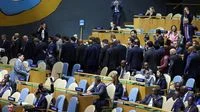
The 79th session of the United Nations General Assembly (UNGA) in New York became the stage for a profound display of diplomatic discord on Thursday, September 25, as a significant number of international delegates staged a coordinated walkout during the address by Israeli Prime Minister Benjamin Netanyahu. The protest, which occurred as the Israeli leader ascended the podium, served as a stark visual representation of the deep global divisions concerning Israel’s ongoing military operations in Gaza and its broader regional security policies.
As Netanyahu approached the microphone, the chamber erupted in a mixture of vocal disapproval and scattered applause from the Israeli delegation. The atmosphere quickly deteriorated into a scene of chaotic departure, leaving the plenary hall visibly thinned. The demonstration forced Philemon Yang, the President of the 79th session of the UN General Assembly, to repeatedly intercede to restore order, urging delegates to maintain decorum amidst the mass exit.
A Scene of Diplomatic Defiance
The walkout was not a singular event but a cascading sequence of departures. As row after row of diplomats stood and exited the hall, the silence in the room became punctuated by the sound of shuffling footsteps and closing doors. Netanyahu, remaining composed at the lectern, paused briefly, observing the exodus with a stoic expression before addressing the remaining assembly.
"Please, order in the hall," President Yang declared, his voice echoing through the sparsely populated chamber. "I order order in the hall," he repeated as the commotion persisted.
Upon regaining a semblance of control, Netanyahu did not shy away from the confrontation. Turning to the remaining audience, he directed a sharp rebuke at those who had left, characterizing the protest as a manifestation of moral deficiency. "If there are any moral cowards who have not yet left this room, please do so now," he stated, following his remarks with a pointed expression of gratitude toward the presiding officer for the attempt to restore order.
Contextualizing the Global Backlash
The protest at the UNGA is the culmination of months of mounting international pressure on the Israeli government. The military campaign in Gaza, initiated following the October 7, 2023, attacks by Hamas, has resulted in a humanitarian crisis that has drawn condemnation from various international bodies, human rights organizations, and individual governments.
Data provided by the Gaza Health Ministry indicates that the death toll has exceeded 41,000, with over 75,000 individuals injured. The conflict has caused the systemic collapse of civilian infrastructure, including schools, hospitals, and water sanitation systems. The United Nations and other international humanitarian agencies have repeatedly warned that the scale of destruction is unprecedented, with millions of Palestinians displaced, facing acute food insecurity and a lack of medical supplies.
The accusations of "genocide" mentioned by various international actors stem from the scale of civilian casualties and the restriction of humanitarian aid entering the territory. While Israel maintains that it acts in self-defense and accuses Hamas of using civilian infrastructure as shields, the international legal community—including proceedings at the International Court of Justice (ICJ)—continues to deliberate on the legal ramifications of the conflict.
Chronology of Escalation
The tensions surrounding the current UNGA session are deeply rooted in a series of escalations that have defined the past year of Middle Eastern geopolitics:
- October 7, 2023: Hamas launches a large-scale attack on southern Israel, resulting in approximately 1,200 deaths and the taking of over 240 hostages. Israel declares war, initiating a comprehensive aerial bombardment and subsequent ground invasion of the Gaza Strip.
- Late 2023 – Early 2024: Global outcry intensifies as the humanitarian situation in Gaza worsens. South Africa initiates proceedings at the ICJ, accusing Israel of violating the Genocide Convention.
- February 2024: Regional tensions spike as Israel and the United States conduct significant military strikes against targets linked to Iranian-backed entities. The broadening scope of the conflict leads to increased criticism of Israeli security policies from countries that previously maintained a more neutral stance.
- September 2024: As leaders gather in New York for the annual UN General Assembly, the focus shifts heavily toward the lack of a ceasefire agreement in Gaza and the rising fear of a wider regional conflict involving Lebanon and Iran.
Analysis: The Erosion of Diplomatic Norms
The act of walking out during a world leader’s address is a rare and powerful diplomatic instrument. In the context of the UN, where the foundational principle is dialogue and the peaceful resolution of conflict, such a move signals that the protesting nations no longer see common ground for diplomatic engagement under the current circumstances.
From a geopolitical perspective, this mass walkout underscores the growing isolation of the current Israeli administration on the global stage. While Israel continues to rely on its strategic partnership with the United States, the support from other Western allies has become increasingly conditional and vocal in its critique of military conduct. The walkout suggests that for many nations, the perceived moral cost of the Gaza war has eclipsed traditional diplomatic protocol.
Furthermore, the tension in the General Assembly highlights the fragility of the United Nations as a mediator. When the institution’s floor becomes a site of protest rather than negotiation, it reflects the limitations of the UN Security Council and the General Assembly in influencing the behavior of member states when national security interests are perceived to be at stake.
Responses and Official Stances
While official statements from the countries involved in the walkout were not immediately issued in a collective format, individual delegations have previously expressed their positions through various channels. Many of the nations participating in the exit have historically been vocal supporters of the Palestinian right to self-determination and have frequently criticized the expansion of settlements in the West Bank.
The Israeli government, through its UN representatives, has consistently framed such protests as evidence of institutional bias within the United Nations. In the aftermath of the speech, Israeli officials argued that the focus on their military actions ignores the existential threats posed by Hamas and regional proxies such as Hezbollah and the Iranian state. The narrative presented by the Israeli delegation remains one of an embattled nation fighting for its survival against entities committed to its destruction.
Future Implications for International Relations
The incident at the UNGA serves as a harbinger for a shift in the international order. As the world observes the ongoing humanitarian catastrophe in Gaza, the traditional alliances that have stabilized the Middle East for decades are being tested. The walkout is not merely a symbolic gesture; it is a manifestation of a deepening rift that could lead to:
- Increased Multilateral Pressure: The possibility of further sanctions, arms embargoes, or diplomatic downgrades from individual countries that feel the international system has failed to protect civilians.
- Shift in Diplomatic Alliances: The emergence of a more unified "Global South" bloc that prioritizes the Palestinian cause in its international relations, potentially creating a counter-weight to Western-led initiatives.
- Institutional Crisis: The growing frustration with the UN’s inability to enforce its own resolutions regarding the conflict could lead to a decline in the organization’s perceived legitimacy, prompting nations to seek alternative frameworks for international dispute resolution.
As Benjamin Netanyahu concluded his speech, the contrast between the applause from his supporters and the empty seats of his critics served as a definitive image of his current tenure. The session at the UNGA on September 25 will likely be remembered as a pivotal moment where the norms of diplomacy were set aside in favor of a visceral, public rejection of the status quo in the Middle East. The long-term impact on Israel’s standing in the international community remains to be seen, but the clear message from the chamber was that the current trajectory of the conflict is no longer acceptable to a significant majority of the world’s nations.