
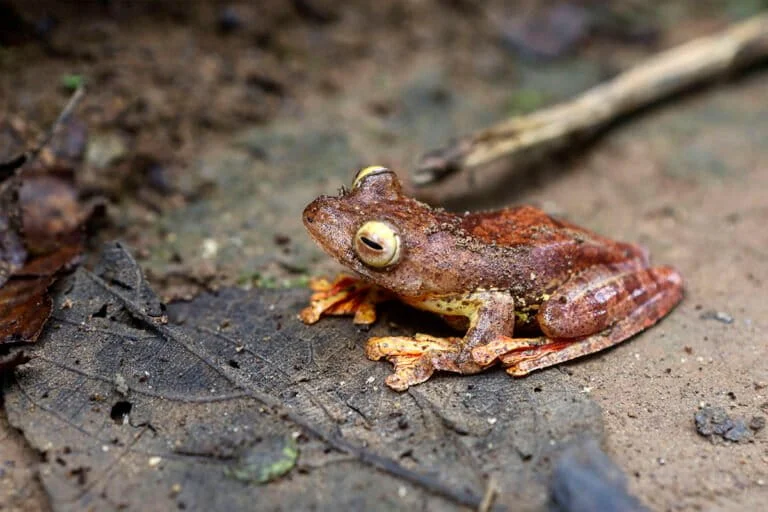
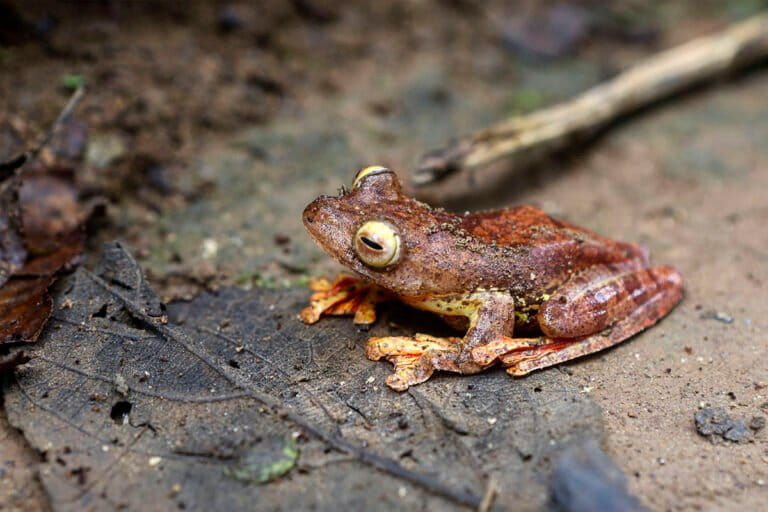
In the dense, humid canopy of the Jantho Forest Nature Reserve in Aceh Besar, Indonesia, a subtle display of evolutionary brilliance occurs under the shroud of darkness. The Harlequin Tree Frog, scientifically identified as Rhacophorus pardalis, possesses a striking aesthetic—a brownish-red dorsal surface punctuated by vibrant yellow markings that shimmer when caught in artificial light. Despite its visual flair, this elusive amphibian remains one of the most enigmatic inhabitants of the Sumatran rainforest, frequently evading both the casual observer and the systematic researcher. Its presence in the Jantho region serves as a biological indicator of the complex, fragile interplay between forest integrity, hydrological stability, and the survival of small-scale endemic fauna.
Unmasking the Rhacophorus pardalis
The Harlequin Tree Frog is a testament to the specialized adaptations required for life in the tropical Asian rainforests. According to Mistar, a prominent herpetologist associated with the Yayasan Ekosistem Lestari, the species is distributed across various regions of Sumatra, though its sightings are statistically infrequent. Adult males typically measure between 4 and 5.5 centimeters from snout to vent, making them small enough to navigate the intricate labyrinth of leaves and branches with ease.
The species is characterized by its vivid color palette. Beyond the dorsal brownish-red hues, the lateral sides of the body exhibit a yellowish tint mottled with dark spots. Perhaps most striking is the ventral region and the inner thighs, which can display shades ranging from vibrant orange to deep red. These physiological features are not merely ornamental; in many amphibian species, such colorations can serve as a warning to potential predators or as a mechanism for mate recognition in the low-light conditions of the forest floor and canopy.
Evolutionary Mechanics and Aerial Navigation
The locomotion of Rhacophorus pardalis is highly specialized. Equipped with long, powerful hind legs, the frog is an adept jumper. However, its most fascinating attribute is the extensive webbing between its digits. While common among tree-dwelling frogs, this feature in the genus Rhacophorus serves an aerodynamic purpose. When the frog leaps from high branches, this webbing increases its surface area, allowing the animal to glide or slow its descent, effectively maneuvering through the air to land on distant foliage. This "parachuting" ability is a crucial survival mechanism, allowing the frog to evade ground-based predators and traverse large gaps in the canopy without ever descending to the forest floor.
The Paradox of the Tree Frog
While colloquially known as "tree frogs," their life cycle is inherently tied to aquatic environments, creating a unique ecological requirement. Dr. Amir Hamidy, a senior herpetologist with the National Research and Innovation Agency (BRIN) of Indonesia, notes that despite their arboreal nature, the Harlequin Tree Frog is strictly dependent on water for reproduction.
"Even though they live in the trees, they require standing water for oviposition, and they typically remain near these sources for a day or two," Dr. Hamidy explained. The reproductive strategy of the genus Rhacophorus is remarkably sophisticated. Females often deposit eggs into foam nests that are carefully attached to vegetation hanging directly above water bodies. This strategy ensures that when the eggs hatch, the tadpoles drop directly into the water, where they continue their development and eventually undergo metamorphosis.
This reliance on standing water—whether it be permanent pools, slow-moving streams, or even temporary rain-filled depressions—highlights the species’ vulnerability. The survival of Rhacophorus pardalis is not solely dependent on the preservation of the trees themselves, but on the micro-habitats that provide the necessary moisture and aquatic nurseries for their offspring.
Ecological Implications of Forest Degradation
The current state of Sumatran forests, which have faced decades of pressure from logging, agricultural expansion, and infrastructure development, presents a significant threat to such specialized species. The degradation of forest cover results in a "cascading effect" on amphibian populations. When canopy trees are removed, the forest floor loses the protection of shade, leading to increased evaporation and the loss of critical humidity.
Dr. Hamidy emphasizes that the loss of forest cover does not just remove a nesting site; it destroys the connectivity of the entire landscape. "If the forest is damaged, their life cycle is severely disrupted. Logging and changes in forest cover can eliminate the places where these frogs seek shelter, migrate, and breed," he stated. Because these frogs rely on specific micro-climates, the fragmentation of the habitat often leads to local extinctions, even if parts of the forest remain standing. The disappearance of small, ephemeral pools, often ignored in broader conservation assessments, can be catastrophic for the reproductive success of the Harlequin Tree Frog.
Data and Observation Challenges
One of the primary difficulties in managing the population of Rhacophorus pardalis is the "detection gap." Low frequency of observation in the field does not necessarily equate to a low population density. In the field of herpetology, the probability of sighting is heavily influenced by variables such as survey timing, meteorological conditions, and the intensity of nocturnal monitoring.
Historical records from the Jantho Forest Nature Reserve suggest that the region remains a vital corridor for biodiversity. However, scientific surveys in such regions are often limited by budget constraints, the rugged nature of the terrain, and the cryptic behavior of the animals. Consequently, researchers rely on a combination of visual encounter surveys and acoustic monitoring—listening for the unique calls of the males during breeding seasons—to gauge the presence of these frogs.
Broader Context: The Sumatran Jigsaw
The Harlequin Tree Frog serves as a quintessential example of the "unseen" biodiversity that constitutes the health of the Sumatran ecosystem. While conservation efforts often focus on "flagship" or "charismatic" megafauna such as the Sumatran tiger or the orangutan, the persistence of these small amphibians is just as vital.
Amphibians occupy a central position in the food web. They serve as predators of insects and other small invertebrates, helping to regulate pest populations that might otherwise damage forest vegetation. Simultaneously, they are a primary food source for a variety of reptiles, birds, and small mammals. The loss of a single amphibian species can trigger a ripple effect throughout the local ecosystem, potentially leading to an imbalance in the predator-prey dynamics of the forest.
The Path Toward Holistic Conservation
The survival of the Harlequin Tree Frog requires a conservation approach that transcends the mere protection of tree stands. It necessitates a holistic management strategy that preserves:
- Hydrological Integrity: Protecting the natural drainage patterns of the forest to ensure that ephemeral pools and breeding sites remain available.
- Micro-habitat Connectivity: Maintaining corridors of dense vegetation to allow for the movement of frogs between foraging and breeding sites.
- Climate Stability: Ensuring that forest cover is sufficient to maintain the high-humidity micro-climates required for the species’ delicate skin, which is susceptible to desiccation.
As Indonesia continues to grapple with the demands of economic development and the necessity of environmental protection, the case of the Harlequin Tree Frog stands as a silent appeal for caution. The preservation of the Sumatran rainforest is not only about saving the giants of the canopy but also about safeguarding the tiny, vibrant inhabitants that define the forest’s complexity.
Future Research Directions
Looking ahead, the scientific community is advocating for more rigorous, long-term monitoring programs in Aceh and other parts of Sumatra. Future studies should focus on:
- Genetic diversity analysis: To determine if populations in fragmented forest patches are becoming isolated and potentially suffering from inbreeding.
- Impact of climate change: Researching how shifting rainfall patterns in Sumatra may affect the availability of ephemeral breeding pools, which are critical for the survival of Rhacophorus pardalis.
- Citizen Science initiatives: Engaging local communities in the Jantho region to document sightings, thereby increasing the volume of data available to conservationists without the prohibitive costs of permanent research stations.
Ultimately, the Harlequin Tree Frog is a poignant reminder that every species, regardless of its size, holds a place in the ecological architecture of the earth. Its continued existence in the Jantho Forest Nature Reserve is a victory for conservation, but it is one that requires constant vigilance. As researchers continue to peel back the layers of the Sumatran rainforest, the lessons learned from the life of this small, shimmering amphibian will undoubtedly prove invaluable in the broader quest to protect the world’s most vulnerable habitats. The forest is a mosaic of lives, and the Harlequin Tree Frog is one of its most delicate, yet resilient, pieces.
