
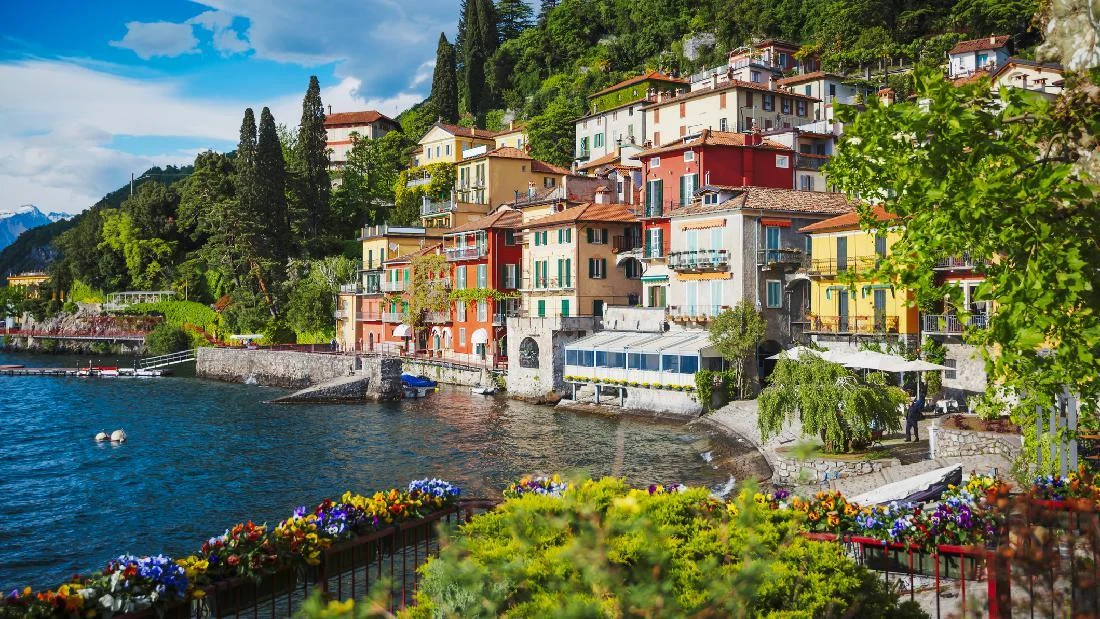
The picturesque village of Varenna, situated on the eastern shore of Italy’s iconic Lake Como, has officially introduced a series of stringent regulations aimed at curbing the negative impacts of mass tourism and maintaining public order. Among the most notable measures is a strict ban on appearing shirtless or in swimwear in public areas, a move designed to preserve the aesthetic and cultural integrity of the historic commune. Under the new mandate, visitors found wandering through the village’s narrow cobblestone streets or public squares without a shirt or in revealing beachwear face immediate financial penalties, signaling a shift toward more disciplined tourism management in one of Italy’s most sought-after destinations.
According to official documentation released by the local government and reported by international news outlets including the Washington Post, the restrictions are not limited to attire. The Varenna administration has also targeted the logistical challenges posed by large tour groups and the increasing issue of noise pollution. These measures, which officially came into effect on June 27, 2024, represent a significant amendment to the municipal police regulations. The village, often referred to as the "Pearl of Lake Como," joins a growing list of European destinations taking a stand against "overtourism" by prioritizing the quality of life for permanent residents and the preservation of local traditions over unrestricted visitor access.
Detailed Regulations and Financial Penalties
The new "urban decorum" laws distinguish clearly between recreational zones and public transit or residential areas. While tourists are still permitted to wear bikinis, swim trunks, or remain shirtless within the confines of designated beaches, docks, and boat landing areas, the same attire is strictly forbidden once they step into the village proper. Local authorities have established a sliding scale for fines to enforce compliance. Individuals found in violation of the dress code—specifically those walking the streets with exposed torsos or in minimal swimwear—will be subject to fines ranging from 50 to 200 euros. Based on current exchange rates, this equates to approximately Rp895,000 to Rp3,580,000, a substantial penalty intended to act as a deterrent for the millions of visitors who flock to the region annually.
In addition to the dress code, the Varenna authorities have addressed the congestion caused by organized travel. The new regulations cap the size of guided tour groups at a maximum of 25 participants. This specific number is intended to ensure that groups do not completely obstruct the village’s notoriously narrow alleys, known as contrade, or the "Walk of Lovers" (Passerella degli Innamorati), a thin promenade that skirts the lake’s edge. Furthermore, the use of megaphones, microphones, or any form of amplified loudspeaker by tour guides is now strictly prohibited. This measure aims to mitigate the "acoustic impact" of tourism, ensuring that the tranquil atmosphere of the lakeside village is not shattered by constant announcements.
The penalties for professional guides who fail to adhere to these new operational standards are even more severe than those for individual tourists. Guides caught leading oversized groups or using prohibited audio equipment face fines between 100 and 400 euros (approximately Rp1,790,000 to Rp7,160,000). Persistent offenders or those who commit multiple infractions also risk a temporary ban, which could prevent them from operating within the commune for several months.
Contextualizing the Surge in Lake Como Tourism
The decision to implement these laws does not exist in a vacuum but is a direct response to the unprecedented surge in tourism that has gripped Lake Como over the last decade. Historically a retreat for the European aristocracy and later a haven for Hollywood elites—most notably George Clooney, whose residence in nearby Laglio brought global attention to the area—Lake Como has transitioned from an exclusive enclave to a mass-market "bucket list" destination.
Varenna, with its population of only about 700 permanent residents, is particularly vulnerable to the pressures of high-volume tourism. During the peak summer months, the village can see thousands of day-trippers arriving via the ferry system from Bellagio and Menaggio or by train from Milan. The infrastructure of a medieval village, built long before the advent of modern tourism, is simply not equipped to handle the physical volume of these crowds. The "Instagrammability" of Varenna’s colorful houses and steep staircases has further accelerated this trend, leading to "bottlenecks" where tourists stop to take photographs, inadvertently blocking the movement of locals attempting to go about their daily lives.
The new regulations specifically forbid groups from loitering or stopping in a manner that obstructs public thoroughfares, bridges, or squares. This "anti-loitering" stance is a direct effort to keep the village’s circulatory system moving, preventing the kind of gridlock that has become common in other Italian hotspots like Venice or the Cinque Terre.
A Growing Trend Across the European Continent
Varenna’s move is part of a broader "decorum movement" sweeping through Italy and other Mediterranean tourist hubs. The concept of decoro urbano (urban decorum) has become a centerpiece of local governance in Italy. For instance, the city of Sorrento, overlooking the Bay of Naples, implemented similar fines for shirtless walking and swimwear in 2022, with Mayor Massimo Coppola citing the "discomfort and unease" such behavior caused among the local population. Similarly, the town of Portofino on the Italian Riviera introduced "no-waiting zones" to prevent tourists from clogging the harbor area for selfies, with fines reaching up to 275 euros.
Beyond Italy’s borders, the French city of Narbonne has long maintained regulations against inappropriate attire in its historic center. In Spain, cities like Barcelona and Palma de Mallorca have also introduced ordinances to keep swimwear confined to the beaches. These regulations reflect a changing philosophy in European tourism management: a shift from quantity to quality. Local governments are increasingly realizing that the economic benefits of tourism can be offset by the "social costs"—the degradation of public spaces, the displacement of local shops by souvenir stalls, and the erosion of the very charm that attracted tourists in the first place.
Chronology of the Legislative Change
The path to these new regulations began in early 2024 as local council members and residents voiced increasing frustration over the "disrespectful" behavior of summer visitors. While tourism is the lifeblood of the local economy, the consensus among Varenna’s leadership was that the village was reaching a breaking point.
- Early Spring 2024: Preliminary discussions held by the Varenna municipal council regarding the revision of police and public order regulations.
- May 2024: Draft proposals for group size limits and dress codes were circulated among local business owners and stakeholders.
- June 2024: The municipal council officially voted on the amendments to the "Regolamento di Polizia Urbana."
- June 27, 2024: The laws officially went into effect, with local police (Polizia Locale) beginning patrols to inform and, where necessary, cite violators.
- July 2024: Signs were posted at key entry points, including the Varenna-Esino train station and the ferry terminal, to warn arriving travelers of the new rules.
Analysis of Implications for the Travel Industry
The implementation of these rules in Varenna serves as a case study for the future of sustainable tourism in fragile environments. For travel agencies and tour operators, the 25-person limit necessitates a restructuring of itineraries. Large bus tours that previously offloaded 50 or 60 people at once must now split their groups, potentially increasing operational costs but arguably providing a better, more intimate experience for the traveler.
From a sociological perspective, the ban on bare chests and swimwear represents a pushback against the "resortification" of historic towns. By enforcing a dress code, Varenna is asserting its identity as a living community with its own standards of etiquette, rather than merely a backdrop for vacation photos. This reinforces the idea that tourists are guests in a private home and must behave accordingly.
Critics of such measures often argue that they are "anti-tourist" or difficult to enforce. However, supporters point out that without these interventions, the "tourist trap" phenomenon becomes inevitable, leading to a decline in the destination’s long-term value. For Varenna, the goal is to find a middle ground—a "sustainable equilibrium" where the village remains profitable for businesses but livable for its residents.
Official Responses and Local Sentiment
While the Mayor of Varenna, Mauro Manzoni, has historically championed the preservation of the village’s character, the local administration emphasizes that these rules are about safety and mutual respect rather than hostility toward visitors. Local residents have largely welcomed the move, particularly the restrictions on noise and group sizes. Many have noted that the use of megaphones by multiple guides simultaneously created a "cacophony" that made it impossible to enjoy the peace of their own homes.
"It is not about excluding people," one local business owner commented during the proposal phase. "It is about making sure that the person who comes here understands they are in a place with a thousand years of history, not a water park."
As the summer season progresses, the eyes of other Lake Como communes—such as Bellagio and Tremezzina—will likely be on Varenna. If these measures prove successful in reducing congestion and improving the village’s atmosphere, it is highly probable that similar ordinances will be adopted across the entire Lake Como region, creating a unified standard for "responsible tourism" in Northern Italy. For now, visitors to Varenna are advised to pack a light shirt and keep their voices down, or be prepared to pay a high price for their breach of etiquette.

