
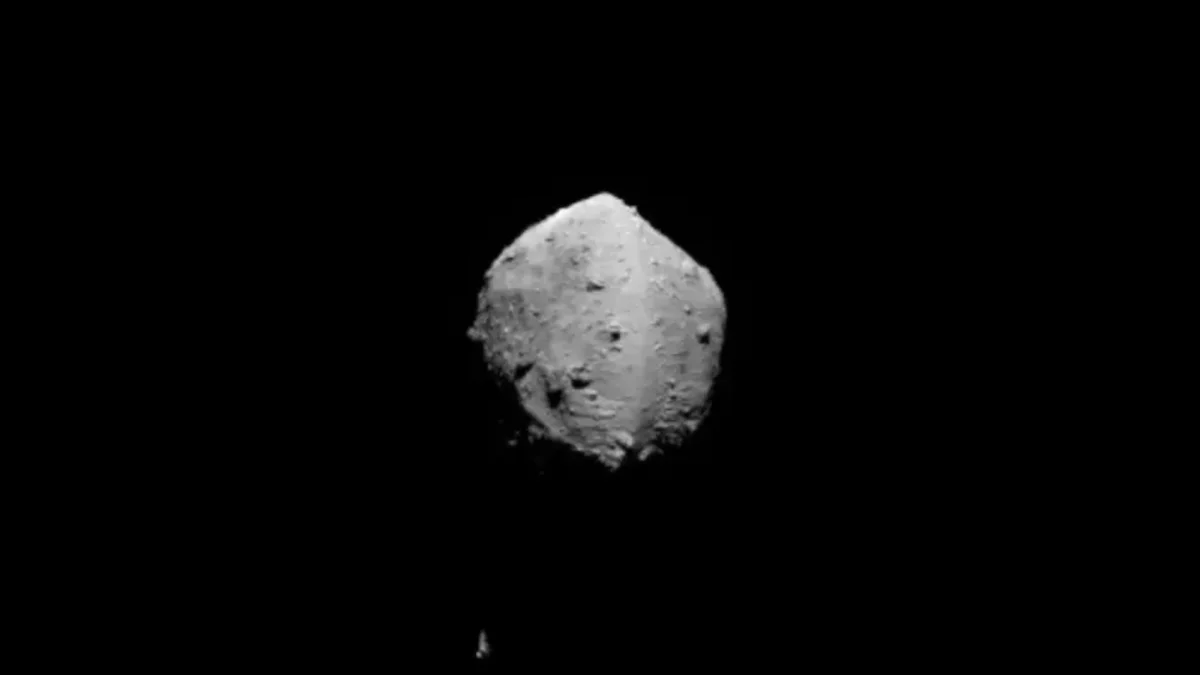
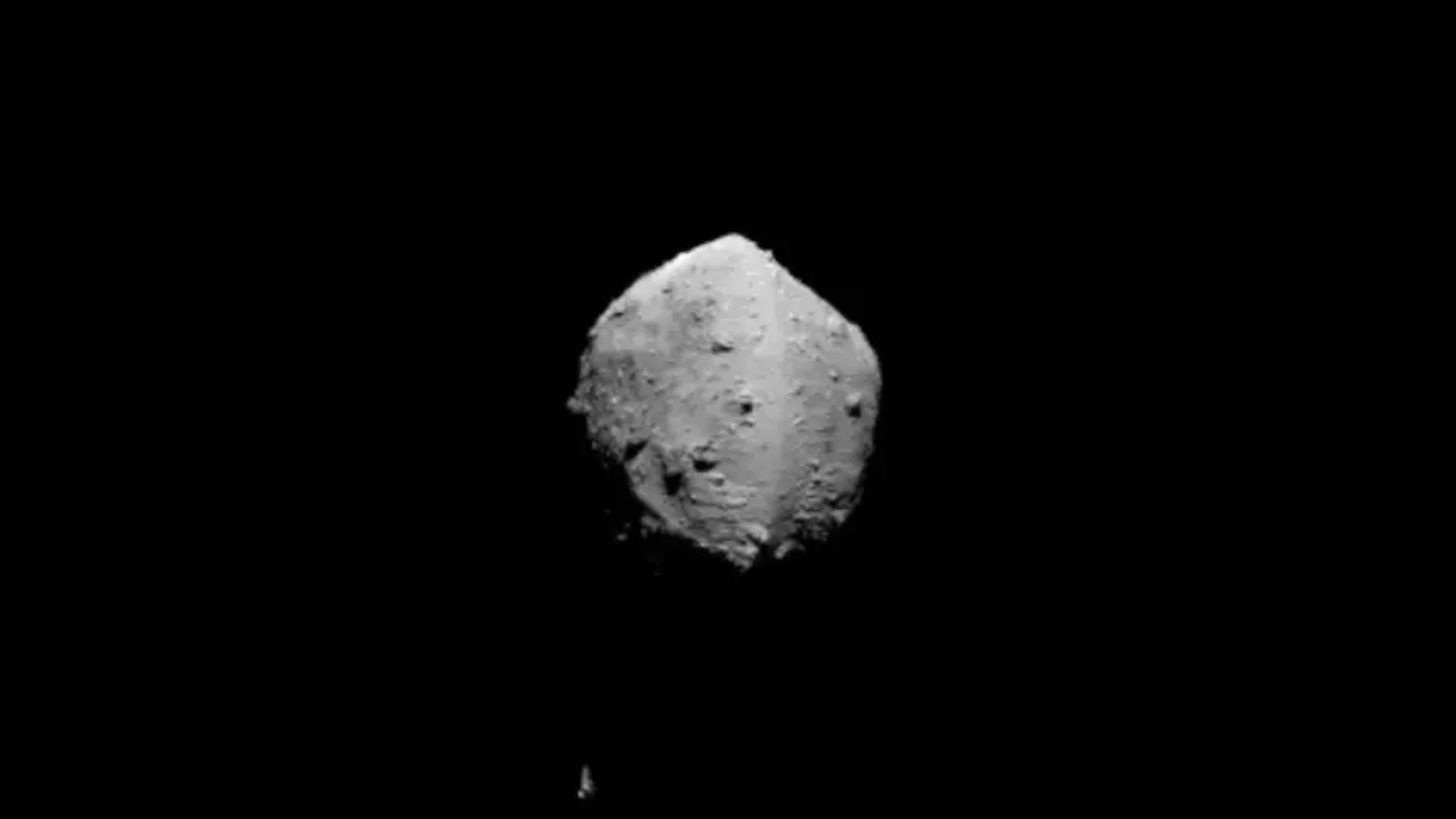
The European Space Agency’s (ESA) Hera spacecraft has officially arrived at the binary asteroid system Didymos, marking a critical new phase in the ongoing international investigation into planetary defense. On November 5, the mission team released the first high-resolution images captured by the spacecraft as it maneuvered to within 37 miles of the primary asteroid, Didymos. This visual data provides researchers with their first detailed look at the celestial body since NASA’s Double Asteroid Redirection Test (DART) mission executed a high-velocity kinetic impact against the system’s smaller moonlet, Dimorphos, in September 2022.
The arrival of Hera signifies the transition from a demonstration of deflection capability to a comprehensive post-impact forensic analysis. By examining the structural integrity, surface composition, and geological aftermath of the collision, scientists aim to refine the predictive models used to protect Earth from potential near-Earth object (NEO) threats.
A Chronology of the DART-Hera Campaign
The narrative of this mission began long before the spacecraft reached its destination. In November 2021, NASA launched the DART mission, a $325 million project designed to test the feasibility of kinetic impact as a planetary defense strategy. The target was the Didymos system, a binary pair consisting of a primary asteroid, Didymos (approximately 2,559 feet in diameter), and its smaller orbiting moonlet, Dimorphos (approximately 525 feet in diameter).
On September 26, 2022, the DART spacecraft achieved a successful intercept, striking Dimorphos at roughly 14,000 miles per hour. The primary goal was not to destroy the asteroid, but to alter its orbital period around its parent body. Observational data from terrestrial telescopes later confirmed that the impact shortened the moonlet’s orbit by approximately 32 minutes—a significant deviation that proved the viability of kinetic impactors for asteroid deflection.
Following the success of the impact, the ESA greenlit the Hera mission, which launched in October 2024. After a two-year journey across the inner solar system, Hera reached the Didymos system in November 2026. The mission is tasked with conducting a "crime scene investigation," providing the granular data that ground-based telescopes could not capture from millions of miles away.
Technical Objectives and Scientific Instrumentation
Hera is equipped with a sophisticated suite of instruments designed to characterize the asteroids with unprecedented precision. The spacecraft carries the Asteroid Framing Camera (AFC), which was responsible for the initial imagery transmitted on November 5. Beyond simple photography, the mission utilizes laser altimetry, hyperspectral imaging, and thermal sensors to map the topography of both Didymos and Dimorphos.
A key objective for the Hera team is to understand the "rubble pile" nature of these objects. Preliminary data suggests that Dimorphos is not a solid, monolithic rock, but rather a loose collection of boulders and debris held together by weak gravity. The impact of the DART spacecraft created a massive plume of dust and boulders, which likely dispersed across the system. Scientists are particularly interested in determining if this debris settled on the surface of the primary asteroid, Didymos, potentially altering its geological characteristics.
"This is the other side of Didymos from the one that DART’s camera showed us shortly before impact, so this feels like looking at a whole new world," stated Patrick Michel, the mission’s principal investigator. The imagery confirms that while the iconic equatorial ridge—a feature common to many binary asteroids—remains visible, the surface environment has been fundamentally altered by the interaction between the two bodies.
Data Analysis and Planetary Defense Implications
The implications of the Hera mission extend far beyond the study of a single binary system. The primary goal of planetary defense is to be prepared for an incoming threat. If a hazardous asteroid were discovered on a collision course with Earth, the choice of mitigation strategy would depend entirely on the asteroid’s density, porosity, and structural cohesion.
By measuring the mass and composition of Dimorphos, Hera will allow scientists to calculate the "momentum enhancement factor" (often denoted as beta). This factor represents the additional force provided by the ejecta—the mass thrown off the asteroid during the impact—which effectively acts as a secondary rocket engine, pushing the asteroid further than the spacecraft’s mass alone would allow.
"We have exciting work ahead of us to sort it out," said Michael Kueppers, a mission scientist with the ESA. "We look forward to seeing much more of both bodies and systemically mapping all the changes we identify."
The ESA has scheduled the release of a more comprehensive data set and higher-resolution imagery for November 25, 2026. This data will be integrated into the existing library of planetary defense information, helping to refine the criteria used by the International Asteroid Warning Network (IAWN) and the UN-mandated Space Mission Planning Advisory Group (SMPAG).
Global Collaboration in Space Safety
The Didymos project serves as a model for international cooperation in space exploration. While NASA provided the kinetic impactor, the European Space Agency provided the diagnostic mission, and researchers from universities and space agencies across the globe are contributing to the analysis of the data.
This multi-faceted approach acknowledges that the threat of an asteroid impact is a global concern that transcends national boundaries. The mission has also provided invaluable training for mission control teams and deep-space navigation experts, who must manage the complex orbital mechanics involved in maneuvering a spacecraft around a binary system where gravity is non-uniform and highly dynamic.
Future Horizons for Asteroid Exploration
As Hera continues its mission, it will deploy two CubeSats—small, secondary satellites named Juventas and Milani—to conduct even closer observations. These units will perform gravity field mapping and surface composition analysis, allowing researchers to peer beneath the dusty veneer of the asteroids.
The study of Didymos is effectively a precursor to future missions that may involve more complex maneuvers, such as gravity tractors (using a spacecraft’s mass to slowly pull an asteroid off course) or ion beam shepherds. The knowledge gained from Hera ensures that when humanity next identifies a legitimate threat, the response will be informed by the definitive physics of the DART-Hera campaign.
As the mission progresses, the scientific community remains focused on the long-term changes within the Didymos system. The interaction between the debris field, the primary asteroid, and the moonlet will continue to provide insights into the formation and evolution of binary systems in the early solar system. By understanding how these bodies behave, humans are not only learning about the history of the universe but also actively securing the future of the planet against the unpredictable nature of the cosmos.
The upcoming data release on November 25 is expected to provide further clarity on the surface composition of Didymos, with researchers particularly focused on identifying signs of recent impact-related scarring or mineralogical shifts. Until then, the international space community continues to process the images provided by Hera, serving as a reminder of the delicate and dynamic balance of the solar system.

