
The Federal Aviation Administration (FAA) issued a nationwide ground stop for all departing flights across the United States today, citing a critical failure in internal communications infrastructure that rippled through the nation’s airspace. This extraordinary measure, which effectively paralyzed one of the world’s most complex transportation networks, prompted an immediate emergency response from federal authorities and triggered widespread confusion among millions of travelers. While the situation remains fluid, officials from the Department of Homeland Security have moved quickly to reassure the public, emphasizing that current evidence points to a technical malfunction rather than a malicious cyberattack or external threat.
The directive, which applied to all commercial and private departures from U.S. airports, marks a rare and significant disruption in American aviation history. As the agency scrambled to isolate the root cause of the communications breakdown, the ripple effects were felt globally, impacting international carriers scheduled to enter U.S. airspace and forcing a massive logistical overhaul for major airlines.
Chronology of the Operational Paralysis
The sequence of events began early in the morning when the FAA identified an internal glitch affecting the communication pathways within the Air Route Traffic Control Centers (ARTCC). These centers serve as the backbone of the U.S. National Airspace System (NAS), managing high-altitude traffic and ensuring safe separation between aircraft flying across the country.
According to preliminary reports, the first anomalies were detected during the early morning shift change. By approximately 7:00 a.m. EST, the FAA issued an advisory to air traffic controllers regarding a degradation in the integrity of real-time data feeds. Within thirty minutes, the situation escalated as the agency determined that the degradation could jeopardize the safety of active flights. The FAA then issued a "Ground Stop" order, a safety protocol that prohibits aircraft from taking off from any airport within the agency’s jurisdiction.
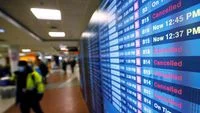
Throughout the morning, airports across the country became centers of confusion. Travelers reported a disconnect between the reality on the ground and the information displayed on terminal monitors, which initially continued to show departures as "on time." However, as the ground stop solidified, the boarding process ceased entirely, leaving passengers stranded in departure lounges and sitting in aircraft on the tarmac.
Technical Assessment and Homeland Security Response
The Department of Homeland Security (DHS), working in conjunction with the Cybersecurity and Infrastructure Security Agency (CISA), initiated an immediate assessment to determine the nature of the outage. Secretary of Homeland Security Alejandro Mayorkas and other administration officials remained in constant contact with the FAA throughout the morning.
In a televised statement aimed at calming public anxiety, Senator Markwayne Mullin clarified the nature of the incident. "This is not an event akin to the September 11 attacks," Mullin stated, addressing concerns that the massive failure could have been the result of a coordinated terror strike. "This is a pure telecommunications disruption. We have seen no evidence to suggest a malicious actor is behind this, though we are maintaining a rigorous stance of investigation to ensure no possibilities are ignored."
The FAA described the incident as a "temporary telecommunications failure" and noted that the measure was taken as a "precautionary step." The agency’s technical teams are currently conducting a forensic analysis of the communication pathways to understand why a local failure cascaded into a national outage. Engineers are examining the integrity of the data transmission hardware that links the regional control centers to the FAA’s central command.
The Complexity of the National Airspace System
To understand the severity of this event, one must consider the sheer volume of the U.S. aviation sector. Under normal operating conditions, the FAA manages more than 45,000 flights per day. The National Airspace System encompasses over 29 million square miles of airspace, including the United States and large portions of the Atlantic and Pacific oceans.
The system relies on a delicate balance of legacy infrastructure and modern digital technology. While the FAA has been in the midst of a multi-year effort to modernize its systems—specifically through the transition to NextGen (Next Generation Air Transportation System)—the backbone of the current infrastructure still relies on interconnected telecommunications networks. Even a minor latency issue in these networks can force a complete halt in operations, as air traffic controllers require split-second, verified data to maintain aircraft separation.
The financial implications of a national ground stop are profound. Airline industry analysts estimate that even a four-hour delay costs the aviation sector millions of dollars in direct operational losses, including crew duty time violations, fuel burn, and passenger compensation. Furthermore, the downstream effects are cumulative; because the U.S. system is a hub-and-spoke model, a delay in Chicago or Atlanta rapidly cascades into secondary and tertiary delays across the entire country.
Broader Implications and Institutional Resilience
The incident has reignited a debate regarding the resilience of critical national infrastructure. While the FAA maintains a high safety record, critics have long pointed to the age of the underlying computer systems used to manage air traffic. In recent years, the FAA has faced criticism for funding shortages and the challenge of integrating new technologies with systems that date back several decades.
Cybersecurity experts have also weighed in on the incident, noting that while this appears to be a technical glitch, the reliance on centralized communication hubs creates a single point of failure. "The issue isn’t necessarily that the system failed; it’s that the system’s architecture allows for a single point of failure to ground the entire nation," said a cybersecurity analyst familiar with aviation logistics. "The industry must now pivot toward a more decentralized, redundant communication model to ensure that a local issue does not result in a systemic collapse."
Public Impact and Airline Protocols
As the ground stop dragged into the afternoon, major airlines, including United, American, Delta, and Southwest, began issuing waivers for passengers. These waivers allow travelers to change their itineraries without the usual fees, acknowledging that the delay was entirely out of the airlines’ control.
The impact was not limited to domestic travel. International flights destined for the U.S. were either held at their points of origin or forced to enter holding patterns over the Atlantic. In airports like London Heathrow, Frankfurt, and Tokyo Narita, the uncertainty regarding the U.S. ground stop caused significant congestion at gate areas.
For passengers, the experience was one of frustration and uncertainty. Airport staff, often lacking real-time updates from the FAA, were left to manage increasingly agitated crowds. Many travelers expressed concern over the lack of transparency, noting that the information provided to the public was significantly delayed compared to the information available to flight crews.
The Path Forward: Restoring Confidence
As of the latest briefing, the FAA has begun the process of a phased restart. The agency is carefully monitoring the stability of its communication lines as it allows flights to resume. However, the return to normal operations is expected to be slow, with residual delays likely to persist for several days.
The incident serves as a stark reminder of the fragile nature of modern travel infrastructure. As the Department of Transportation launches a formal investigation into the outage, the public will be looking for clear answers regarding how such a systemic failure occurred and what concrete steps will be taken to prevent a recurrence.
For the FAA, the priority remains the safety of the flying public. While the economic cost and the inconvenience to millions of people are substantial, officials maintain that the ground stop was the only responsible course of action. In an industry where the margin for error is effectively zero, the decision to prioritize safety over operational continuity remains the foundational principle of the agency’s mandate.
Moving forward, the federal government is expected to face increased scrutiny from congressional committees. Lawmakers have already signaled their intent to hold hearings to examine the FAA’s budget, its modernization timeline, and the robustness of its disaster recovery protocols. The outcome of these inquiries will likely dictate the future of investment in the nation’s air traffic control infrastructure for the next decade.
In the immediate term, the aviation industry faces the arduous task of "re-sequencing" thousands of flights, ensuring that aircrews remain within legal duty-time limits and that aircraft are properly positioned to resume service. The ordeal underscores the inherent interconnectedness of the modern world, where a single malfunctioning component in a computer server can bring the entire American sky to a standstill.

