
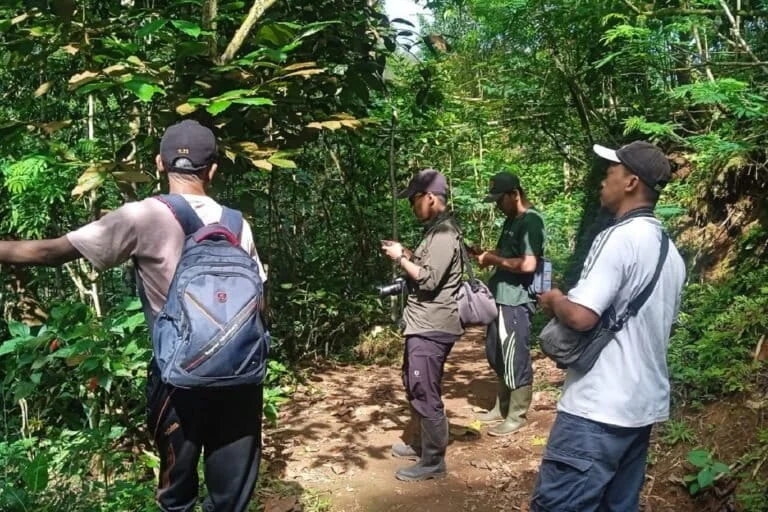
The Menoreh Hills, a rugged limestone range stretching across the borders of Central Java and Yogyakarta, have long been a sanctuary for Indonesia’s rich avian biodiversity. However, for decades, this ecological treasure trove faced a silent crisis as the melodic calls of its inhabitants were replaced by the quiet of a forest stripped by poaching. Today, a transformative movement is taking root in the villages of Purworejo and Kulonprogo, led by an unlikely group of conservationists: former bird hunters who have traded their nets for binoculars and mapping tools. This shift from exploitation to preservation is not merely a matter of sentiment but a strategic response to a collapsing ecosystem that threatens both the wildlife and the livelihoods of the human communities that depend on it.
The catalyst for this change can be seen in the story of Parman, a resident of Donorejo Village in the Purworejo Regency of Central Java. For years, Parman made a living by harvesting the Hill Blue Flycatcher (Cyornis banyumas), known locally as Sikatan Cacing. The bird is highly prized in the Indonesian songbird trade, a massive domestic market where the quality of a bird’s "kicau" (chirping) can command high prices in cities like Yogyakarta and Magelang. By his own admission, Parman’s methods were destructive; he targeted fledglings that were still unable to fly, raising them in captivity to be sold once they reached maturity.
However, approximately five years ago, the supply began to dry up. The once-abundant flycatchers became increasingly difficult to find in the wild. This scarcity forced a moment of reckoning for Parman, leading him to abandon poaching and pivot to goat farming. Yet, his withdrawal from the trade did not lead to an immediate recovery of the bird population. While Parman had stopped, hunters from outside the village continued to infiltrate the area, driven by the high demand and the dwindling numbers of the species. It became clear that individual "repentance" was insufficient; a systemic, community-led intervention was required to save the Menoreh ecosystem.
The Status of the Hill Blue Flycatcher and the Silent Forest Syndrome
The Hill Blue Flycatcher is currently listed as Endangered on the International Union for Conservation of Nature (IUCN) Red List. Endemic to the islands of Java and Bali, its population has plummeted due to relentless trapping for the cage-bird trade and habitat loss. The Menoreh Hills represent one of the last viable habitats for this species, making the conservation efforts in Donorejo and surrounding villages globally significant.
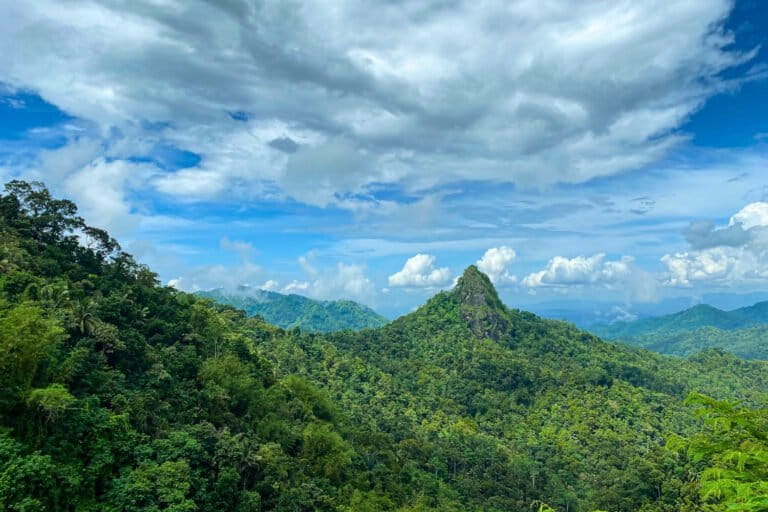
The decline of the flycatcher is a symptom of a broader "silent forest syndrome" affecting many parts of Indonesia. In this phenomenon, forests remain structurally intact, but their avian populations are hollowed out by over-harvesting. Because birds play critical roles in seed dispersal, pollination, and insect control, their absence triggers a cascade of negative effects on forest regeneration and agricultural productivity. Parman and his neighbors began to realize that the loss of the birds was inextricably linked to the degradation of their own environment, specifically the health of their water sources.
Institutionalizing Conservation: The Girimukti Group and Mapping Corridors
In response to the persistent threat of outside poachers and the visible decline in biodiversity, Parman and a dozen other residents formed the Girimukti Group. This community organization was established to transition from passive observation to active management of their natural resources. Over the last two years, the village of Donorejo has implemented a strict ban on all forms of bird trapping. While this provided a necessary reprieve, the Girimukti Group recognized that protection required data.
The group began an ambitious project to map the "bird corridors" within the Menoreh Hills. These corridors are essential pathways that allow birds to move between different habitat patches for feeding and breeding. Parman explains that the data collected—which includes nesting sites, feeding grounds, and flight paths—is used to identify critical areas that require absolute protection. "We realized that these birds do not stay exclusively in Donorejo," Parman noted. "They are connected to various surrounding areas, particularly Jatimulyo in Kulonprogo. If we protect our side but the other side is destroyed, the population will still fail."
This landscape-level thinking is supported by the Yayasan Kanopi Indonesia, an NGO that has spent over a decade mentoring communities in the Menoreh region. Arif Rudiyanto, an Associate Programme Implementation officer at the foundation, emphasizes that local knowledge is the most potent tool in conservation. "The residents have a deep understanding of the terrain. For example, landowners with cliffs on their property now know that these are nesting sites for the Hill Blue Flycatcher. Instead of clearing the land or modifying the cliffs, they leave them undisturbed," Rudiyanto said.
The Intersection of Water Conservation and Avian Habitats
One of the most significant findings of the Girimukti Group’s mapping efforts is the direct correlation between bird habitats and the health of local springs, or sendang. In Donorejo, the group identified five critical water points where the flow had decreased drastically, with some drying up entirely during the dry season. These springs serve as vital hydration and bathing stations for birds, while also providing the primary water supply for the villagers.
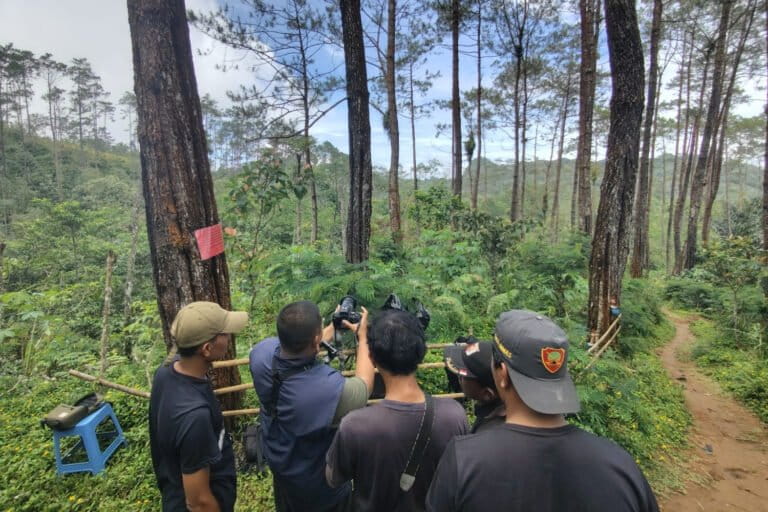
In the neighboring village of Pandanrejo, the youth have also joined the cause. Adhita Virya Akmilius Lala, a young activist, noted that their surveys revealed the sendang as hotspots for various species, including kingfishers (raja udang), egrets (kuntul), and the Javan Sunbird (madu jawa). "The degradation of the habitat was as much a threat as the hunters," Adhita explained. "By restoring the vegetation around the springs, we are ensuring that the birds have a reason to stay, while simultaneously securing our own water future."
This holistic approach transforms conservation from a restrictive "keep out" policy into a proactive "restoration" strategy. The community has begun planting specific flora to support different avian diets. For fruit-eaters, they plant papaya, cherry (kersen), and mango. For nectar-feeders, they cultivate flowering plants like butterfly pea (telang), frangipani (kamboja), and cape jasmine (kaca piring). For seed-eaters, the birds are encouraged to forage in the villagers’ coffee, sorghum, and corn fields.
Scientific Validation: Agroforestry and the Power of Tumpangsari
The community’s efforts are backed by academic research. A study by Gadjah Mada University (UGM) found that the traditional farming patterns used by Menoreh farmers are uniquely suited to bird conservation. Specifically, the "sub-canopy" vegetation layer—typically consisting of coffee trees ranging from 4.1 to 8 meters in height—provides an ideal structural environment for birds. These trees offer a complex network of branches and twigs that serve as substrates for perching, communicating, and hiding from predators.
Furthermore, data from the Food and Agriculture Organization (FAO) suggests that in fragmented landscapes like the Menoreh Hills, the survival of bird species depends less on the total area of "virgin" forest and more on the connectivity provided by agroforestry, community forests, and riverbanks. The Menoreh farmers utilize a system known as tumpangsari (intercropping), which avoids monoculture and creates a complex, multi-layered habitat.
Tegar Cahaya Putra, the initiator of the Lestari Purwosari Group in Kulonprogo, has seen firsthand how this system benefits both nature and the economy. Since 2020, his group has integrated bird habitat protection into the village’s official development plan. "By protecting the birds, we’ve actually revitalized our coffee cultivation," Tegar said. "The birds assist in pollination and pest control, and the ‘bird-friendly’ label has added value to our agricultural products."
Challenges and the Path Forward
Despite these successes, significant challenges remain. Much of the critical habitat in the Menoreh Hills is located on privately owned land. While education and local wisdom have so far encouraged landowners to cooperate, there is a constant pressure from development and infrastructure projects. The Menoreh region is also highly susceptible to landslides, making the maintenance of deep-rooted forest cover a matter of public safety as much as ecological health.
Arif Rudiyanto of Yayasan Kanopi Indonesia argues that the grassroots efforts of the villages must be met halfway by regional and provincial governments. "The local regulations (Perdes) created by these villages are a great start, but they need to be integrated into the broader spatial planning of the regency and province," he stated. "We cannot allow large-scale development projects to bypass the local wisdom that has kept this ecosystem functioning for generations."
The transformation of the Menoreh Hills serves as a powerful case study in community-led conservation. It demonstrates that when local communities are empowered with data and supported by scientific research, they can reverse the tide of extinction. For Parman and the residents of Donorejo, the return of the Hill Blue Flycatcher’s song is more than just a victory for a single species; it is a signal that their landscape is healing. By protecting the bird corridors, they are safeguarding the springs, the soil, and the cultural heritage of the Menoreh Hills for the generations that will follow.

