
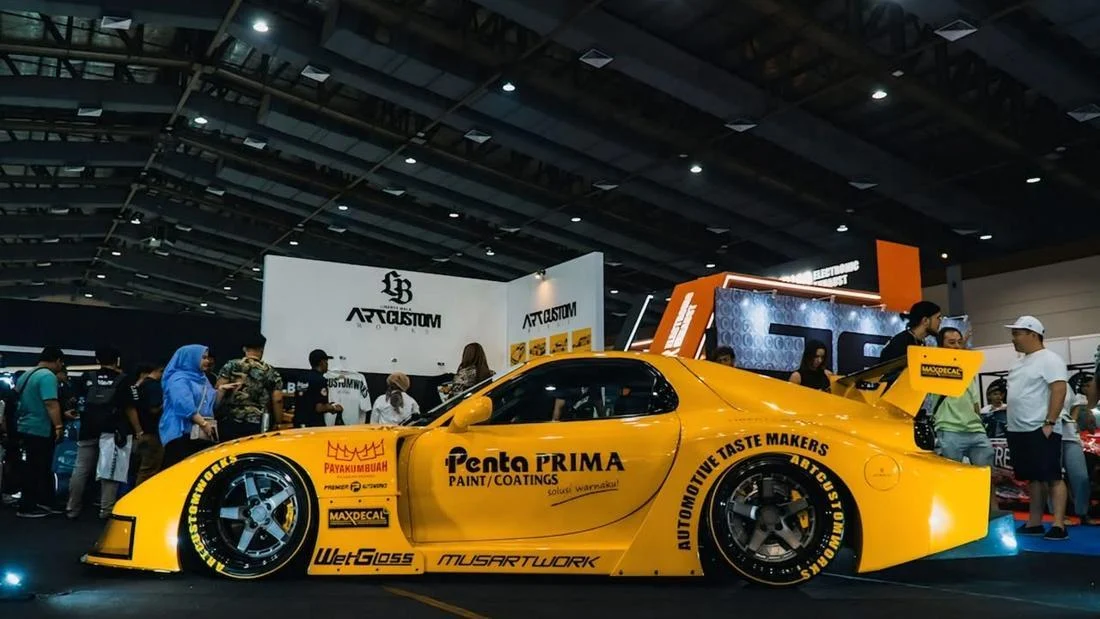
The landscape of the Indonesian automotive industry is undergoing a significant transformation, moving beyond the mere assembly and sale of new vehicles to the cultivation of a robust aftermarket ecosystem. As the population of vehicles on Indonesian roads continues to expand, the demand for high-quality body repair, refinishing, and aesthetic modification has surged. Standing at the forefront of this industrial shift is Penta Prima, a domestic brand under the umbrella of PT Bina Adidaya, which is aggressively positioning its automotive refinish line, Penta Oto, to challenge the long-standing dominance of international paint manufacturers.
The Evolution of the Domestic Automotive Refinish Market
For decades, the Indonesian automotive refinish market—comprising base coats, clear coats, and specialized primers—was almost exclusively dominated by established global brands from Japan, Germany, and the United States. These brands set the benchmark for quality, color consistency, and durability. However, the paradigm is shifting. With the rise of a sophisticated local modification culture and an increasingly demanding consumer base, domestic players are now leveraging decades of manufacturing experience to bridge the gap between "local products" and "premium quality."
Penta Prima, a subsidiary of PT Bina Adidaya, has been a quiet giant in the Indonesian paint industry for over 30 years. Recognizing that the market was ripe for a home-grown solution that could match imported quality while offering superior distribution and localized support, the company consolidated its efforts under the Penta Oto brand. This strategic pivot represents a move toward vertical integration, supported by the company’s transition under the stewardship of PT Singa Investindo Development.
A Strategic Corporate Restructuring
The integration of PT Bina Adidaya into the PT Singa Investindo Development ecosystem marks a pivotal chapter in the company’s history. This transition is not merely administrative; it is a calculated effort to inject capital, foster research and development (R&D), and expand capacity. In the volatile and highly competitive chemical coating industry, scale is essential. By consolidating resources, Penta Prima has been able to accelerate its R&D cycle, allowing for faster response times to changing automotive trends, such as the emergence of complex pearl and metallic paint finishes required by modern vehicle designs.
Boediono Tjiptodihardjo, President Director of PT Singa Investindo Development, emphasized that the company’s vision transcends national boundaries. "We view Indonesia not only as a massive consumer market but as a manufacturing hub capable of producing goods that stand up to international scrutiny. Our goal is to build a brand with deep roots in Indonesia that possesses the technical rigor to compete head-to-head with foreign brands that have historically enjoyed a first-mover advantage here," he stated.
Building Credibility Through Industry Engagement
A critical component of Penta Prima’s strategy since 2023 has been its deliberate integration into the Indonesian automotive lifestyle ecosystem. Rather than relying solely on traditional B2B sales channels, the company has actively participated in high-profile events such as the Indonesia Modification & Lifestyle Expo (IMX), HIN IAM, and Kustomfest Jogja.
These events serve a dual purpose. First, they provide a platform for brand visibility, showcasing the Penta Oto Series and Super Gloss Series to the most discerning critics in the industry: professional painters and custom car builders. Second, these gatherings function as a real-time feedback loop. By engaging directly with the community, Penta Prima gains critical insights into the technical challenges faced by workshops, such as drying times in Indonesia’s humid climate, color matching accuracy, and the ease of application for complex multi-layer paint jobs.
The participation in The Elite Showcase 2026 served as a milestone for the brand. As a primary sponsor, Penta Prima moved beyond being a mere vendor; it became a partner in the creative process. By providing the finishing materials for a diverse array of customized vehicles, the brand demonstrated its capability to handle everything from classic restoration paint jobs to high-gloss, high-durability coatings for modern performance cars.
Addressing the Human Capital Gap
Industry analysts often point out that the quality of an automotive paint job is only 50% material and 50% application technique. A premium paint product will fail if the applicator lacks the necessary training. Recognizing this, Penta Prima has invested heavily in the Penta Prima Training Centre.
This initiative is designed to professionalize the role of the "tinter" and the "painter." By training local talent in the nuances of modern automotive refinish systems, the company is effectively building its own support network. This focus on human capital is a sophisticated play to ensure that their products consistently deliver the intended results, thereby building long-term brand loyalty among workshop owners who value predictability and technical support.
Market Implications and Future Outlook
The entry of Penta Oto into the middle-up market segment is a significant development for the Indonesian economy. The import of high-end automotive coatings has historically contributed to the trade deficit in the automotive sector. By providing a local alternative that meets international standards, Penta Prima is contributing to the localization of the automotive supply chain.
Agus Santosa, Director of PT Bina Adidaya / Penta Prima, acknowledges the difficulty of the challenge. "The market has been accustomed to foreign brands for a very long time. Our challenge is not just pricing—it is proving that a domestic product can match the technology, performance, and color consistency of global giants. We are building trust, one car at a time," he noted.
The roadmap for Penta Prima is clear: to establish a "complete auto-refinish system." This involves expanding their portfolio to cover the entire spectrum of the painting process—from primers and fillers to the final protective clear coats. As the company continues to refine its R&D processes, the potential for expansion into regional markets within Southeast Asia remains a logical long-term trajectory.
Data-Driven Growth and Competitive Analysis
The automotive aftermarket in Indonesia is projected to continue its upward trajectory as the secondary car market remains robust. With more than 20 million passenger cars currently on Indonesian roads, the frequency of "repaint" and "touch-up" services is statistically tied to the average age of the fleet, which continues to rise.
As Penta Prima continues to scale, it faces competition from global chemical conglomerates that benefit from global economies of scale. However, Penta Prima’s competitive advantage lies in its "hyper-localization." By having a deep understanding of local logistics, climate-specific chemical requirements, and a direct line to the preferences of local modifiers, the brand is carving out a niche that is difficult for foreign competitors to replicate without significant local investment.
Conclusion: A New Era for Domestic Manufacturing
The trajectory of Penta Prima is a testament to the maturation of Indonesia’s industrial capabilities. By moving away from low-value manufacturing and toward high-tech chemical engineering, the company is positioning itself as a leader in the nation’s effort to increase domestic content (TKDN) in the automotive industry.
As the brand continues to refine its "complete system" approach, the implications for the Indonesian automotive ecosystem are profound. Not only does it provide professional body shops with a reliable, locally sourced supply chain, but it also elevates the standards of the local modification industry. For consumers, this means higher quality refinishing options that are more accessible and supported by local expertise.
In the coming years, the success of Penta Oto will likely serve as a case study for other domestic manufacturing sectors. If a local brand can successfully displace or compete with global leaders in a sector as technically demanding as automotive coatings, it signals a broader shift in the competitive landscape of Indonesian industry—a shift defined by innovation, quality, and a confident push toward international standards. As the automotive industry moves toward electrification and new design languages, the role of the refinish industry will continue to evolve, and Penta Prima appears ready to paint that future.

