
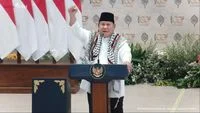
President Prabowo Subianto marked a significant milestone in Indonesia’s educational and religious landscape on Saturday, September 19, 2026, by attending the centennial anniversary of the Pondok Modern Darussalam Gontor in Ponorogo, East Java. The event, which celebrated a century of the institution’s contribution to Islamic education and character building in Indonesia, served as a platform for the President to address both the internal imperative of national resilience and the external urgency of the humanitarian crisis in Palestine.
The presence of President Prabowo at this historic institution highlighted the deep-rooted connection between Indonesia’s Islamic boarding schools—or pesantren—and the state’s developmental goals. As Gontor enters its second century, the discourse shifted from pedagogical achievements to the geopolitical realities facing the global community, with a specific focus on the Palestinian struggle.
A Symbolic Display of Solidarity
The atmosphere at the ceremony reached an emotional crescendo when President Prabowo formally acknowledged the presence of the Palestinian Ambassador to Indonesia, Abdulfattah A.K. Al-Sattari. Upon the mention of the Ambassador’s name, the assembly erupted in applause and cheers. In an unscripted moment of diplomatic solidarity, the Ambassador approached the podium, where he presented President Prabowo with a traditional Palestinian keffiyeh, which the President accepted and wore throughout the remainder of his address.
Prompted by the visible support from the crowd, President Prabowo led the assembly in chanting "Free Palestine" three times. This public declaration served as a reaffirmation of Indonesia’s long-standing foreign policy stance, which remains firmly committed to the independence and sovereignty of Palestine.
In his address, President Prabowo offered a sobering reflection on the current state of the Palestinian people. "I remember our brothers and sisters in Palestine. They are being massacred, bombed, and subjected to continuous attacks, while we often feel helpless in our attempts to assist them," the President stated. This acknowledgment underscored the frustration felt by many in the international community regarding the limitations of diplomatic intervention in the ongoing conflict.
Historical Context: The Legacy of Gontor
Pondok Modern Darussalam Gontor, founded on September 20, 1926, by the Trimurti—KH Ahmad Sahal, KH Zainudin Fanani, and KH Imam Zarkasyi—has evolved from a humble village school into a cornerstone of Indonesian intellectualism. Over the past 100 years, the institution has played a pivotal role in shaping the nation’s socio-political fabric by producing thousands of graduates who have gone on to serve in government, academia, and civil society.
The centennial celebration is not merely a commemoration of age but an assessment of the institution’s role in the national vision of Indonesia Emas 2045 (Golden Indonesia 2045). Gontor’s methodology, which integrates classical Islamic scholarship with modern curricula, has been widely recognized as a model for holistic education in a rapidly globalizing world.
The Imperative of National Strength
Transitioning from the global stage to domestic priorities, President Prabowo used the Palestinian situation as a cautionary tale for the Indonesian public. He argued that the vulnerability of nations lacking internal strength and unity is a historical reality that Indonesia must diligently avoid.
"This situation should serve as a trigger for a resolute will—a will to learn diligently and a will to build a strong Indonesian nation," President Prabowo asserted. "Because a nation that is not strong will be trampled upon by other nations. We must learn from history."
The President’s message was directed specifically at the religious scholars, educators, and students present. He posited that the path to preventing such national crises lies in the cultivation of human capital. By emphasizing education, scientific advancement, and economic independence, Indonesia can secure its sovereignty against external pressures. The President framed the development of educational institutions like Gontor as a vital component of national security, suggesting that a well-educated, unified population is the ultimate deterrent against foreign intervention and domestic decay.
Geopolitical Implications and Foreign Policy
The imagery of the President of Indonesia embracing the Palestinian cause at a major national event serves as a clear signal of the administration’s foreign policy trajectory. Indonesia, as the world’s most populous Muslim-majority nation, has historically leveraged its position in the Organization of Islamic Cooperation (OIC) and the United Nations to advocate for a two-state solution.
Analysts suggest that President Prabowo’s rhetoric signals a continuity in Indonesia’s foreign policy, which balances pragmatic economic diplomacy with moral posturing on humanitarian issues. By linking the Palestinian plight to the necessity of a strong Indonesian state, the President is also framing his internal development agenda as a prerequisite for Indonesia to play a more effective role on the world stage.
"To help others, one must first be capable," is the subtext of the President’s argument. By prioritizing the strengthening of Indonesia’s domestic institutions, the administration seeks to gain the leverage required to influence regional and global affairs more effectively.
Chronology of the Centennial Celebration
The centennial celebration was the culmination of a year-long series of events held across the Gontor network. Key milestones leading up to the September 19 event included:
- Early 2026: Launch of the "Gontor 100 Years" educational initiative, focusing on digital transformation and curriculum updates.
- June 2026: A series of international seminars involving alumni from across the globe, focusing on the role of Islamic boarding schools in the 21st century.
- September 15–18, 2026: Preliminary cultural and religious ceremonies, including the unveiling of the centennial monument.
- September 19, 2026: The Grand Ceremony featuring the President of Indonesia, government ministers, and international dignitaries.
Economic and Educational Policy Intersections
The President’s focus on "learning diligently" aligns with the current administration’s budgetary priorities, which have seen an increased allocation for the "Golden Indonesia 2045" roadmap. This policy emphasizes STEM (Science, Technology, Engineering, and Mathematics) education integrated with character development—a philosophy that mirrors the Gontor model.
From a sociological perspective, the support for institutions like Gontor is part of a broader strategy to engage the "pesantren" demographic in the national modernization project. There are approximately 39,000 Islamic boarding schools across Indonesia, catering to millions of students. Harnessing the potential of this network is essential for any administration aiming to boost national productivity and social stability.
The Response from Stakeholders
The leadership of Pondok Modern Darussalam Gontor expressed their gratitude for the President’s attendance, noting that it served as a morale booster for the thousands of students currently enrolled. The institution’s administrators emphasized that the partnership between the state and Islamic boarding schools is vital for maintaining the moderate, inclusive version of Islam that has historically defined the Indonesian archipelago.
Furthermore, the presence of the Palestinian Ambassador and his active participation in the event were viewed by diplomatic observers as a significant endorsement of the bilateral ties between Jakarta and Ramallah. The Ambassador’s gesture of gifting the keffiyeh to President Prabowo was widely interpreted as an acknowledgment of Indonesia’s consistent support for Palestinian statehood.
Conclusion: A Vision for the Future
As the sun set on the centennial festivities in Ponorogo, the message left by President Prabowo was one of sober optimism. He challenged the nation to move beyond mere empathy toward a proactive pursuit of strength. For the students of Gontor and the broader Indonesian public, the event served as a reminder that the defense of national interests and the support for global humanitarian causes are not mutually exclusive; rather, they are two sides of the same coin.
In the years to come, the success of Indonesia’s journey toward becoming a global power will be measured by its ability to translate these ideals into tangible policy outcomes. If the events of September 19 are any indication, the administration intends to build a future defined by a robust domestic foundation and an unwavering moral compass on the international stage. The centennial of Gontor, therefore, serves as both a celebration of a storied past and a clarion call for a future that is as resilient as it is compassionate.

