
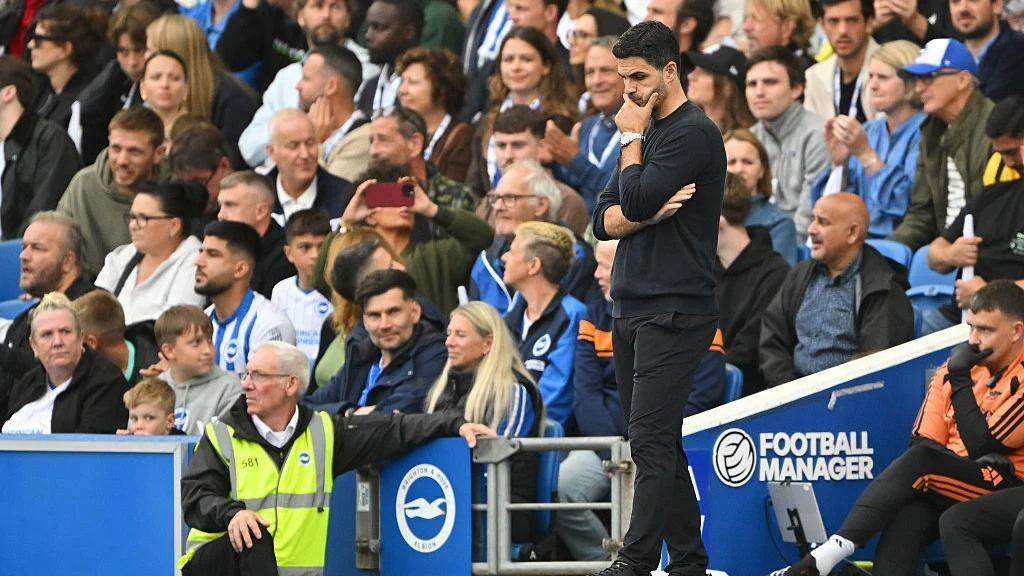
The early-season momentum that had propelled Arsenal to the summit of the Premier League suffered a definitive and jarring halt on Saturday, September 19, 2026, as Mikel Arteta’s side was comprehensively beaten 3-0 by Brighton and Hove Albion at the Amex Stadium. Entering the fixture on the back of a pristine seven-match winning streak across all competitions, the North London club produced a performance that their manager candidly described as significantly below the required standard of elite English football.
From the opening whistle to the final blow of the referee’s flute, Brighton outplayed, out-fought, and out-thought their visitors. The hosts executed a high-intensity tactical blueprint that exposed structural vulnerabilities in Arsenal’s usually robust defense, while simultaneously neutralizing the creative outlets that had characterized the Gunners’ faultless start to the campaign. The defeat not only halts Arsenal’s immaculate run but also serves as an early-season wake-up call regarding the relentless competitiveness of the Premier League.
A First-Half Masterclass by the Seagulls
The tone for the afternoon was set in the opening exchanges, with Brighton pressing aggressively and forcing Arsenal into uncharacteristic errors in possession. The Amex Stadium was in full voice as the home side established territorial dominance, refusing to grant Arsenal’s midfield the time and space required to dictate the tempo of the match.
The breakthrough arrived in the 31st minute through veteran midfielder Pascal Gross. Capitalizing on a loose clearance following sustained pressure in the final third, Gross unleashed a precise, venomous strike from outside the box that left the Arsenal goalkeeper with no chance, nestling neatly into the bottom corner. The goal punctured whatever composure Arsenal had managed to retain up to that point.
As the first half drew to a close, Brighton doubled their advantage. In the 44th minute, young forward Charalampos Kostoulas seized upon defensive indecision. Receiving the ball in a pocket of space just outside the penalty area, Kostoulas shifted it onto his preferred foot and fired another brilliant long-range effort past the sprawling dive of the custodian. A scoreline of 2-0 at halftime accurately reflected the balance of play, leaving Arteta and his coaching staff with massive tactical dilemmas to resolve during the interval.
Defensive Fragility and Set-Piece Irony
Hoping to spark a revival, Arsenal attempted to assert more control over the game in the second half. However, any aspirations of an improbable comeback were definitively extinguished shortly after the hour mark.
Brighton extended their lead in the 68th minute through a source that must have felt particularly galling for the visiting bench. Central defender Chema Andres rose highest inside the penalty area to meet an out-swinging corner kick, powering a header past the goalkeeper. Conceding from a set-piece scenario was a bitter irony for Arsenal, a team that built much of their defensive resilience and attacking potency on the execution of dead-ball routines during their previous title-contending campaigns. The breakdown in marking highlighted a rare lapse in concentration from a defensive unit that had previously conceded only a handful of goals all season.
Statistical Dominance by Brighton
The match statistics paint a stark picture of Brighton’s comprehensive superiority. Over the course of the 90 minutes, the hosts registered 17 attempts on goal, compared to just 11 from an unusually toothless Arsenal attack.
Brighton’s defensive discipline was equally instrumental in securing the clean sheet. The Seagulls outperformed Arsenal in key defensive metrics, recording 18 successful tackles to the visitors’ 13, 20 clearances compared to 14, and 11 interceptions to 6. This defensive efficiency successfully stifled Arsenal’s frontline, rendering key attacking players largely anonymous and preventing the Gunners from establishing any sustained rhythm in the final third.
Arteta’s Candid Post-Match Assessment
Speaking to the media in his post-match press conference and subsequent interviews with broadcast partners such as BBC Radio 5 Live, Mikel Arteta made no excuses for his team’s performance, immediately conceding that Brighton was thoroughly deserving of the three points.
"Brighton deserved to win this game," Arteta stated firmly. "We did not execute the basic fundamentals correctly for a sufficient duration of the match, particularly during the first half. We failed to win enough duels, we lost the second balls, and that instantly created spaces and stretched our defensive structure."
The Spanish manager elaborated on the systemic issues that plagued his side, pointing specifically to their inability to cope with Brighton’s aggressive tactical press. "When you combine those lost duels with unforced errors and a failure to implement our basic positional principles against a team that excels at pressing, you find yourself under constant pressure. We failed to escape that pressure in the manner we usually do."
While clearly disappointed, Arteta balanced his critique of his own squad with praise for the opposition’s tactical execution and collective work rate. "There are two elements to analyze here. First, we must give full credit to Brighton, to their style of play, and to their absolute commitment in every duel across the pitch. Second, our own performance fell well below our internal standards and the standards required in the Premier League."
Arteta concluded by framing the defeat as an essential learning curve for a squad that had grown accustomed to victory. "If you squander moments and fail to compete at the required intensity, winning becomes impossible. This is a valuable lesson for us. If you look at how this team has played and competed over the last six or seven weeks, the trajectory has been extraordinary, but today serves as a stark reality check."
Context, Chronology, and the Broader Implications
This fixture marked the eighth match of the Premier League season for Arsenal. Up until this afternoon, the club boasted a 100% win record, establishing themselves as early favorites to claim domestic supremacy. The loss to Brighton leaves their lead at the top of the table vulnerable, pending the results of their nearest title rivals over the weekend.
For Brighton, the victory represents a continuation of their impressive tactical evolution under their coaching staff, demonstrating their capability to dismantle established elite clubs through disciplined structure, athletic intensity, and clinical finishing from distance.
The timing of the fixture introduces a distinct operational dynamic for Arsenal. Saturday’s match represents their final competitive outing before the scheduled international break. This fortnight-long hiatus provides Arteta and his technical staff with a crucial window to conduct a forensic review of the tactical lapses witnessed at the Amex Stadium, heal minor physical ailments, and recalibrate the squad’s mental focus.
Looking Ahead to the Return to Action
Arsenal will not return to competitive action until October 10, when they host Leeds United at the Emirates Stadium. The fixture against the Yorkshire club will serve as the immediate litmus test for how effectively the squad has internalized the lessons learned on the south coast.
In elite sports, early-season defeats often serve as necessary catalysts for long-term success, exposing latent vulnerabilities before they can metastasize into terminal flaws during the business end of the season. How Arsenal responds to this adversity—starting with their return to home turf against Leeds—will ultimately define whether the setback at Brighton was merely a temporary anomaly in an otherwise championship-caliber campaign, or the beginning of a more concerning trend.

