

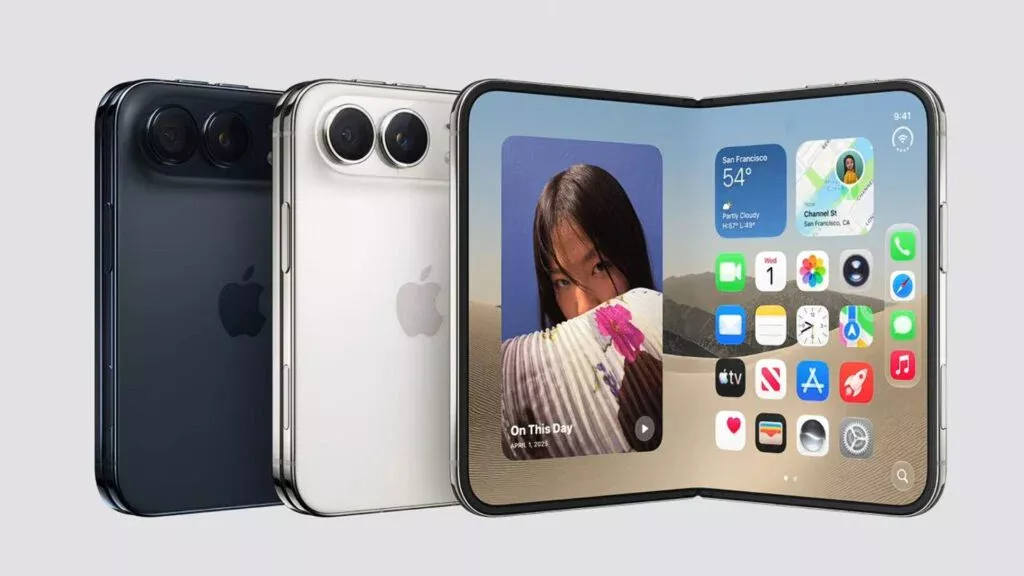
The global smartphone industry is undergoing a structural transformation following Apple Inc.’s official entry into the foldable device segment with the introduction of the iPhone Duo. Unveiled during a highly anticipated hardware showcase, the device not only marks Apple’s long-awaited debut in the flexible screen category but also introduces a proprietary software paradigm designed to solve longstanding ergonomic and functional challenges inherent in foldable hardware. Central to this launch is an advanced iteration of StandBy Mode, a feature engineered specifically to maximize the utility of both the external cover display and the primary internal flexible screen when the device is configured in a stationary or tent-mode orientation.
By bridging the gap between passive display utility and active productivity, Apple has engineered a contextual interface that allows the iPhone Duo to function as an interactive desk clock, a dynamic digital photo frame, and a customizable widget hub. Industry analysts note that this implementation significantly diverges from existing foldable offerings within the Android ecosystem. While competing original equipment manufacturers (OEMs) have spent years refining hardware folding mechanisms—such as minimizing the crease and enhancing hinge durability—Apple has historically taken a measured approach, waiting for component maturity before pairing its hardware with deeply integrated, context-aware software. The result is a device that establishes a new benchmark for how foldable displays can add tangible value to everyday consumer workflows.
Evolution of the Foldable Concept and Background Context
The journey toward Apple’s first foldable device spans nearly a decade of research and development, characterized by aggressive patent filings, supply chain acquisitions, and rigorous stress-testing of ultra-thin flexible glass (UTG). For years, the foldable smartphone market was pioneered primarily by Android manufacturers such as Samsung, Huawei, Motorola, and Google. These brands successfully normalized book-style and clamshell form factors, transforming foldable devices from experimental luxury novelties into viable premium alternatives for enterprise users and technology enthusiasts alike.
However, despite impressive hardware engineering, the Android foldable ecosystem frequently faced criticism regarding software optimization. Many third-party applications struggled to scale seamlessly when transitioning from a compact outer cover screen to an expansive unfolded tablet-sized display. Furthermore, while several Android devices incorporated ambient display features or desktop modes, none achieved the seamless, hardware-agnostic ambient utility that Apple has introduced with the iPhone Duo.
Apple’s entry into this competitive landscape changes the market dynamics entirely. By leveraging its vertically integrated ecosystem—encompassing custom silicon, proprietary operating system architecture, and deep developer support—Apple has positioned the iPhone Duo not merely as a novelty folding phone, but as a transitional computing device. The inclusion of StandBy Mode as a core architectural feature addresses a fundamental critique of foldable devices: that they spend a significant portion of their operational lifespan folded and idle on a desk or bedside table. By transforming an idle folded device into an active, glanceable information hub, Apple has redefined the utility quotient of the modern smartphone.
Technical Mechanics of StandBy Mode on the iPhone Duo
One of the most technically significant aspects of StandBy Mode on the iPhone Duo is its operational independence from external power sources. In standard, non-foldable iOS devices, StandBy Mode is strictly restricted to situations where the iPhone is connected to a charger and resting in a landscape orientation. This limitation was established primarily to preserve battery life on traditional lithium-ion cells subjected to continuous, all-day ambient display rendering.
For the iPhone Duo, Apple’s engineering teams bypassed this constraint through a combination of high-efficiency OLED panel architecture, advanced power management integrated within the next-generation Apple Silicon processor, and a high-density, dual-cell battery configuration. Consequently, StandBy Mode on the iPhone Duo activates automatically and natively, whether the device is connected to a MagSafe charger, resting on a wireless charging pad, or sitting completely unpowered on a flat surface.
The functionality relies heavily on spatial awareness sensors, advanced gyroscopes, and the continuous monitoring of the device’s hinge angle. When the iPhone Duo is partially opened in a horizontal "tent mode" or resting on its cover screen, the operating system instantly recognizes the physical orientation and scales the interface accordingly. Users are greeted by a glanceable UI that can be personalized with a vast array of interactive widgets. These include real-time meteorological tracking, calendar agendas, interactive to-do lists, and localized news briefings, alongside a continuously rotating gallery of high-resolution personal photographs managed by on-device machine learning algorithms.
Moreover, Apple has prioritized ocular ergonomics for nocturnal use. When ambient light sensors embedded within the display bezel detect low-light conditions—such as a dark bedroom at night—the interface automatically shifts its chromatic spectrum. The system suppresses blue light emissions, dimming the display luminescence and transitioning all active elements to a monochromatic red color profile. This engineering choice is designed to minimize sleep disruption while maintaining high visibility for nighttime checks, underscoring Apple’s meticulous attention to user health metrics.
Market Implications and Industry Reactions
The introduction of the iPhone Duo and its specialized software features has triggered immediate ripples across the global technology sector. Competitors and market analysts alike are closely examining how Apple’s software-first approach to hardware innovation will influence consumer purchasing behavior.
Financial markets responded positively to the announcement, with Apple shares seeing an upward tick following the keynote presentation. Supply chain partners responsible for manufacturing ultra-thin glass, precision hinges, and advanced OLED panels also reported increased investor interest. Tech economists suggest that Apple’s validation of the foldable form factor will serve as a powerful catalyst for mainstream market adoption, pulling foldable devices out of the niche tech enthusiast category and firmly into the mass-market consumer mainstream.
Prominent technology analysts have highlighted the potential ripple effect on rival ecosystems. "For years, Android manufacturers have competed aggressively on hardware specifications—thinner profiles, larger cover screens, and more complex multi-camera arrays on foldables," noted a senior tech industry researcher. "Apple’s strategy demonstrates that hardware form factor alone is insufficient. By introducing an ambient intelligence feature like StandBy Mode that functions independently of a power source, Apple has shifted the competitive battleground back to software integration and ecosystem cohesion. It is highly probable that major Android OEMs will accelerate their own software optimization efforts to replicate or counter this functionality in their next-generation foldable releases."
Furthermore, enterprise analysts point out that the tent-mode utility of the iPhone Duo opens up new avenues for mobile productivity. Business professionals attending conferences or working remotely can utilize the device as a secondary, standalone information display during presentations or meetings, reducing the reliance on auxiliary hardware for quick reference tasks.
User Experience and Long-Term Ecosystem Synergy
Beyond the immediate technical specifications, the iPhone Duo represents a masterclass in ecosystem synergy. The device operates seamlessly alongside other Apple hardware, integrating with iPadOS, macOS, and watchOS via continuous continuity protocols. When StandBy Mode is active on the iPhone Duo, it can mirror or sync with localized smart-home data managed via Apple HomeKit, transforming the foldable phone into an interactive command center for residential automation.
Accessibility features have also been deeply woven into the iPhone Duo’s interface design. VoiceOver integration, dynamic text scaling, and adaptive touch targets ensure that users with diverse accessibility needs can fully utilize the expanded screen real estate and the contextual StandBy UI without friction. Apple’s commitment to maintaining software support and security updates across its hardware lineup further solidifies the consumer value proposition, reassuring buyers making a substantial financial investment in a first-generation premium form factor.
Outlook and Future Trajectory
As the iPhone Duo prepares for its commercial release, the broader implications for the smartphone industry are becoming increasingly clear. Apple has demonstrated that entering a mature product category does not require starting from scratch; rather, it demands identifying the pain points of existing implementations and solving them through superior hardware-software integration.
The successful adaptation of StandBy Mode for untethered foldable usage highlights Apple’s capacity for iterative innovation. By turning an idle mechanical state into an interactive visual experience, the company has established a functional precedent that will likely govern foldable device design for years to come. As consumers and developers begin hands-on testing with the device, the true test will lie in how third-party application ecosystems adapt to this new paradigm, paving the way for an even more versatile mobile computing future.

