
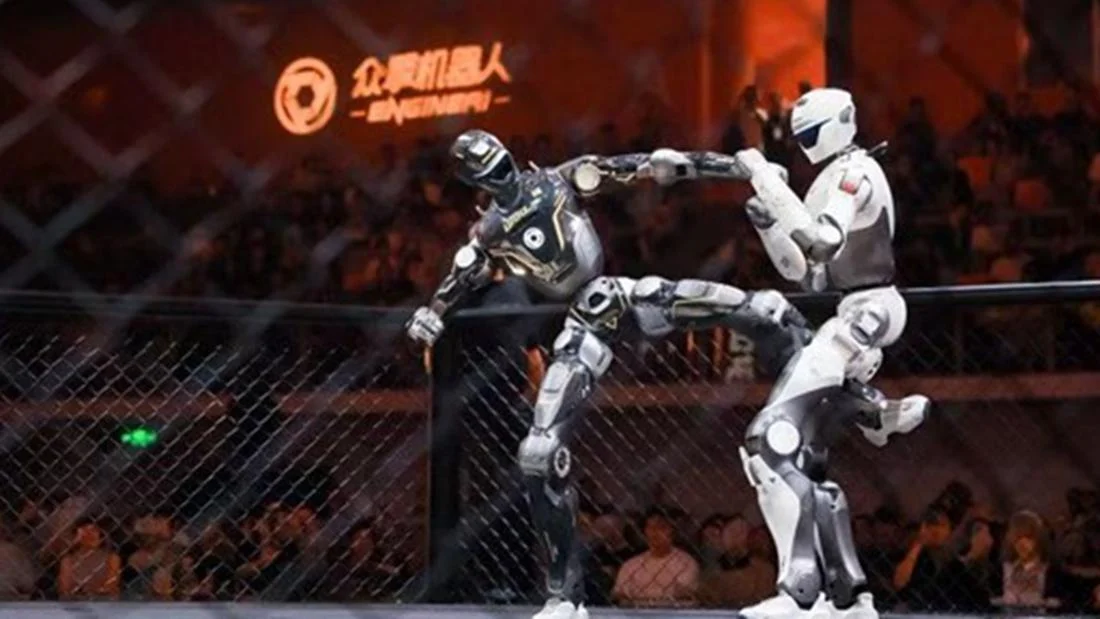
Shenzhen, China – A decade ago, the notion of bipedal robots clashing in an arena, controlled by human operators, existed primarily within the realm of cinematic fantasy, popularized by films like the 2011 sci-fi hit Real Steel. Today, that futuristic vision has materialized into a tangible, high-stakes sport in China, marking a significant leap in both robotics technology and entertainment. The city of Shenzhen, a global epicenter for technological innovation, recently hosted the inaugural Ultimate Robot Knock-out Legend (URKL) competition, an event that has captivated audiences and underscored China’s ambitions in the burgeoning field of advanced robotics.
The grand debut of URKL took place at the Shenzhen Nanshan Cultural and Sports Center, opening its doors on a Thursday evening in mid-July 2026. This landmark event, organized by EngineAI, a leading robotics firm based in Shenzhen, showcased the raw power and sophisticated agility of humanoid combat robots in a professional fighting league setting. The atmosphere was charged with anticipation as spectators witnessed a spectacle previously confined to the silver screen, signaling the dawn of a new era in sports entertainment and technological demonstration.
From Cinematic Dream to Arena Reality
The inspiration drawn from Real Steel, where actor Hugh Jackman navigates the gritty world of robot boxing, is undeniable. That film, released in 2011, depicted a future where human boxers had been replaced by colossal robots, controlled by their human handlers in a brutal yet thrilling sport. Fast forward fifteen years, and EngineAI has transformed this cinematic premise into a reality, albeit on a slightly different scale and with distinct technological underpinnings. The URKL competition features advanced humanoid robots engaging in unscripted, high-intensity combat, a testament to rapid advancements in artificial intelligence, engineering, and materials science.
The opening bout set a dramatic tone for the league, pitting the sleek, white humanoid robot known as "White Eagle" against its formidable black counterpart, "Matador." The clash was fierce and drew enthusiastic cheers from the crowd as the two mechanical gladiators exchanged powerful blows. The intensity culminated in a decisive victory for White Eagle, whose precise strikes led to the dramatic decapitation of Matador, a moment that underscored both the realism and the destructive potential inherent in this new form of combat sport. Such moments, while perhaps unsettling to some, are precisely what EngineAI hopes will generate widespread appeal and drive the commercial viability of robot fighting.
The Engineering Marvel: EngineAI T800
Central to the URKL competition is the standardized combat platform: the EngineAI T800 humanoid robot. Standing at an imposing height of 1.73 meters, roughly the average height of a human adult, the T800 is a marvel of modern robotics. Its design allows for an impressive repertoire of combat maneuvers that mimic human martial arts, including powerful uppercuts, agile spinning kicks, and the crucial ability to quickly recover and stand up after being knocked down.
EngineAI boasts that the T800 incorporates several cutting-edge technologies crucial for high-intensity combat. These include:
- Advanced Posture Control: This system enables the robot to maintain balance and stability even when subjected to significant impacts, allowing for precise movements and rapid defensive actions. It relies on sophisticated sensor arrays (gyroscopes, accelerometers, force sensors) and real-time processing to adjust joint angles and weight distribution instantly.
- Dynamic Perception: Equipped with an array of cameras, lidar, and other environmental sensors, the T800 can perceive its surroundings and the movements of its opponent in real-time. This dynamic perception allows it to anticipate attacks, identify vulnerabilities, and execute counter-maneuvers with remarkable speed and accuracy.
- Impact Absorption Capabilities: Given the destructive nature of the sport, the T800 is engineered with specialized materials and structural designs that can absorb and dissipate significant impact forces. This not only protects vital internal components but also allows the robot to withstand sustained punishment and continue fighting, a critical aspect of durability in combat.
These features collectively position the T800 not merely as a remote-controlled toy but as a sophisticated robotic athlete, capable of complex physical interactions and strategic decision-making, albeit under human supervision.
Industry Acclaim and Strategic Vision
The launch of URKL has not gone unnoticed by prominent figures. Celebrated Hong Kong actor and martial artist Donnie Yen, renowned globally for his roles in action films like Ip Man, was present at the inaugural event and offered an enthusiastic endorsement. "Today is the first time I have witnessed real robots fighting," Yen remarked, clearly impressed. "To personally witness this historical breakthrough feels truly different. The precision of the machines and their movements is absolutely extraordinary." Yen’s presence lends significant star power and cultural validation to the nascent sport, bridging the gap between traditional martial arts and futuristic combat.
Zhao Tongyang, CEO of EngineAI, articulated the broader strategic vision behind URKL. Beyond mere entertainment, the competition is designed to serve as a powerful catalyst for the commercialization of robot combat and, more significantly, to accelerate research and development (R&D) and industrialization within the robotics sector. "We aim to use this competition to drive research and development within the industry," Tongyang stated. "This event provides input for technology, and technology will in turn drive the industry."
This statement highlights a common strategy in the tech world: create a high-profile application or "killer app" that pushes the boundaries of existing technology, thereby generating further innovation and attracting investment. Just as motor racing has historically driven advancements in automotive engineering, EngineAI envisions URKL as a crucible for robotics, where the demands of combat will force breakthroughs in areas such as motor efficiency, battery life, structural integrity, sensor fusion, and AI-driven movement algorithms.
Global Participation and Judging Criteria
The URKL competition has attracted significant international interest, with 32 teams from around the world vying for supremacy. Notably, all participating teams are mandated to utilize the standard EngineAI T800 robot, ensuring a level playing field where victory hinges on the ingenuity of the pilots, their programming strategies, and their understanding of the robot’s capabilities rather than on disparities in hardware. This standardization promotes competitive balance and encourages innovation in software and control systems.
The judging criteria for URKL are comprehensive, designed to evaluate various facets of a robot’s combat performance:
- Effective Attack: This category assesses the power, precision, and strategic placement of strikes, evaluating how well a robot can inflict damage and disrupt its opponent.
- Body Stability: Crucial for maintaining offensive and defensive postures, this measures the robot’s ability to remain upright and stable even after receiving blows or executing powerful maneuvers.
- Defense and Evasion Capability: This evaluates a robot’s ability to block, parry, or dodge incoming attacks, minimizing damage and preserving its structural integrity.
- Overall Durability: A testament to the robot’s construction and resilience, this category considers how well the robot withstands prolonged combat and sustains functionality despite wear and tear.
These criteria ensure that URKL is not merely a slugfest but a nuanced competition demanding a blend of offensive prowess, defensive strategy, and robust engineering.
Broader Context: China’s Robotics Ambitions and Shenzhen’s Role
The emergence of URKL is not an isolated event but rather a significant manifestation of China’s aggressive push to become a global leader in robotics and artificial intelligence. The Chinese government has long identified robotics as a strategic industry, integral to its "Made in China 2025" initiative, which aims to transform China from the "world’s factory" into an innovation powerhouse. Massive investments in R&D, coupled with supportive policies, have fostered a thriving ecosystem for robotics companies across the nation.
Shenzhen, in particular, stands at the forefront of this revolution. Known as China’s Silicon Valley, the city boasts an unparalleled concentration of manufacturing infrastructure, supply chains, and technological talent. Its proximity to component suppliers, rapid prototyping capabilities, and a culture of innovation make it an ideal breeding ground for companies like EngineAI. The city’s government actively promotes technological advancement through incubators, accelerators, and preferential policies, creating an environment where ambitious projects like URKL can flourish. The commercialization of robot combat, therefore, serves a dual purpose: it provides entertainment and acts as a powerful public relations tool, showcasing China’s technological prowess on a global stage.
Furthermore, the humanoid robot market itself is projected for substantial growth. While industrial robots have dominated the sector for decades, humanoid robots, with their ability to navigate and interact with human-centric environments, are poised to revolutionize service industries, elder care, hazardous operations, and even space exploration. The development of advanced humanoid combat robots, with their emphasis on dynamic balance, precise motor control, and robust design, directly contributes to the technological foundations required for these future applications. The "stress test" of combat pushes the limits of current technology, leading to innovations that can eventually trickle down to more mundane, but equally critical, applications.
Implications and Future Outlook
The Ultimate Robot Knock-out Legend holds profound implications across several domains:
- Technological Advancement: The immediate and most direct impact is on robotics R&D. The competitive pressure to build better, stronger, and smarter robots will accelerate innovations in materials science (e.g., lighter, stronger alloys, impact-absorbing composites), actuator design (more powerful and precise motors), sensor technology, and especially artificial intelligence and machine learning for real-time decision-making and control.
- Economic Opportunities: URKL represents the genesis of a potentially massive new sports entertainment industry. This includes revenue streams from live event tickets, broadcasting rights (streaming and television), sponsorships, merchandise, and even video game adaptations. The league could create new jobs in robot design, engineering, maintenance, piloting, and event management. Furthermore, the development of sophisticated robots for entertainment could lead to spin-off technologies applicable in other commercial sectors.
- Public Engagement and STEM Education: The spectacle of robot combat has a unique ability to capture public imagination, particularly among younger generations. This can serve as a powerful tool to popularize science, technology, engineering, and mathematics (STEM) fields, inspiring students to pursue careers in robotics and AI. The "Real Steel" effect, now a reality, can make complex technological concepts tangible and exciting.
- Ethical Considerations (Future): While current robot combat is overseen by human pilots, the long-term trajectory towards increasingly autonomous robots in combat raises future ethical questions regarding AI decision-making, responsibility, and the nature of violence in sports. For now, the focus remains on human-controlled or semi-autonomous systems, but the debate will undoubtedly evolve as technology progresses.
- Global Expansion: If URKL proves successful in China, it is highly likely that similar leagues will emerge globally, or URKL itself will expand internationally. This could foster international collaboration and competition in robotics, creating a global platform for showcasing technological prowess.
In conclusion, the Ultimate Robot Knock-out Legend is far more than just a novelty act. It is a calculated strategic move by EngineAI, supported by China’s broader national agenda, to push the boundaries of robotics. By transforming a beloved sci-fi trope into a thrilling reality, Shenzhen has not only launched a new entertainment genre but has also established a dynamic new proving ground for the next generation of humanoid robotics. The roaring crowds in Shenzhen are not just witnessing a fight; they are witnessing the future of technology and entertainment unfold before their very eyes, a future where the line between imagination and reality continues to blur at an astonishing pace.

