
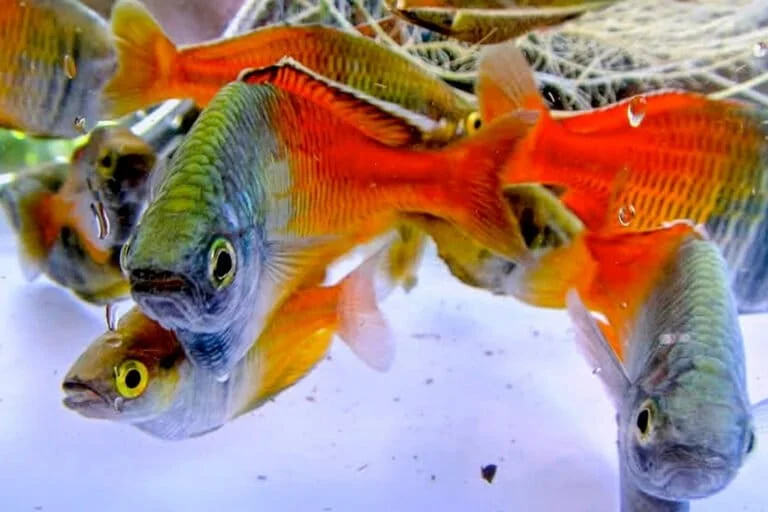
The Boeseman’s rainbowfish (Melanotaenia boesemani) stands as a biological marvel, a living mosaic of deep blues and vibrant, fiery oranges that divide its body with surgical precision. This striking color contrast, particularly prominent in adult males, has made it one of the most sought-after species in the global aquarium trade. Measuring rarely more than ten centimeters in length, the species possesses an aesthetic allure that transcends borders, yet its existence is tethered to a singular, fragile geography: the Ayamaru Lakes in the Maybrat Regency of Southwest Papua, Indonesia. While its image graces home aquariums across Europe, Asia, and the Americas, its status in the wild has shifted from abundant to alarmingly scarce, prompting a critical reassessment of how this species is managed, traded, and protected.
A Discovery and the Dawn of Global Popularity
The species was first documented by Western science through the efforts of Dutch biologist Marinus Boeseman, who collected specimens in 1955. At that time, the fish was already well-known to the indigenous people of the Maybrat region, who referred to it as "sekiak." It was not until 1980 that ichthyologist Gerald Allen formally described the species, naming it in honor of Boeseman.
The turning point for the species occurred in 1982, when Allen and noted aquarist Heiko Bleher successfully collected live specimens from the Ayamaru region. These fish were transported to breeding facilities abroad, initiating a global proliferation. The 1980s marked the "gold rush" era for the species; according to reports from Australian environmental authorities in 2023, the exploitation was immense. At the height of the international demand in the mid-1980s, estimates suggest that approximately 60,000 male specimens were being harvested from the wild every month to satisfy the growing aquarium market. This intensive, unregulated extraction laid the foundation for a silent crisis that would not be fully realized for decades.
The Ecological Decline of a Karst Sanctuary
The Ayamaru Lakes are not merely a backdrop for a colorful fish; they are a complex, interconnected karst ecosystem. The lakes are fed by a series of subterranean rivers and surface streams, making them highly sensitive to the ecological health of the surrounding terrestrial landscape. Research conducted by Hidayah et al. in 2021 highlights a sobering reality: the wild population of the Boeseman’s rainbowfish has plummeted to such an extent that finding them in their native habitat has become an arduous task for researchers.
The decline is attributed to a "triple threat" of environmental pressures: overfishing, the introduction of invasive non-native species, and the degradation of the watershed. Deforestation around the catchment area has led to increased sedimentation, which clouds the water and alters the substrate of the lake bottom. As the volume of water fluctuates due to changing land-use patterns, the narrow niches required for the fish to spawn and thrive are shrinking. This creates a dangerous feedback loop where the habitat can no longer support the population densities that existed before the international trade boom.
Chronology of Exploitation and Awareness
1955: First biological specimen of the "sekiak" collected by Marinus Boeseman in the Ayamaru region.
1980: Formal scientific description by Gerald Allen; species officially named Melanotaenia boesemani.
1982: Successful collection and exportation of live specimens to international markets by Gerald Allen and Heiko Bleher.
1985–1989: Peak intensity of wild harvesting; reports suggest up to 60,000 fish extracted monthly.
2021: Scientific publication by Hidayah et al. confirms the extreme rarity of the species in the Ayamaru Lakes.
2023: Australian government reports detail the historical impact of the 1980s trade, highlighting the long-term damage to wild populations.
2026: Studies by Kambu et al. emphasize the role of indigenous "sasi" practices in modern conservation efforts.
The Shift Toward Commercial Aquaculture
The modern aquarium trade has largely transitioned away from wild harvesting, relying instead on large-scale commercial breeding operations in countries like Singapore, the Czech Republic, and the United States. While this shift has theoretically reduced the pressure of direct capture on the Ayamaru population, it has introduced a "conservation paradox."
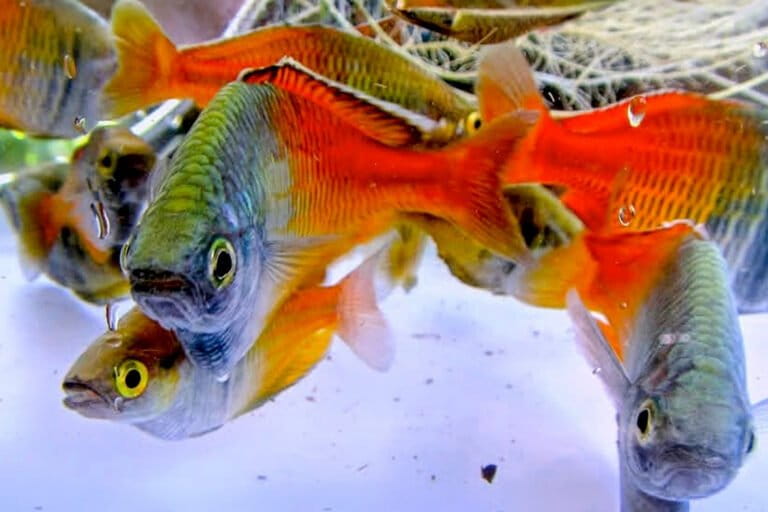
Because the fish is readily available in pet stores, the public perception is that the species is thriving. This false sense of security often masks the dire reality in its native Papua. The presence of millions of Boeseman’s rainbowfish in captive tanks worldwide does nothing to safeguard the genetic integrity or the ecological role of the original wild population in Indonesia. Conservationists argue that relying on captive populations as a proxy for the species’ survival is a dangerous fallacy that ignores the loss of biodiversity occurring in the karst lakes of Maybrat.
Indigenous Wisdom and the Sasi System
For the indigenous Maybrat people, the Ayamaru lakes are more than an economic resource; they are an integral part of their cultural identity and ancestral heritage. The recent research by Kambu et al. (2026) brings a critical perspective to the conservation debate by highlighting the practice of "sasi." Sasi is a traditional indigenous management system that imposes strict, time-bound prohibitions on the harvesting of natural resources.
By declaring specific areas as sacred or off-limits for a set duration, the Maybrat community allows ecosystems to regenerate without human interference. This indigenous approach offers a blueprint for sustainable management that transcends conventional government-led conservation. It acknowledges that the survival of the sekiak is not dependent solely on the artificial propagation of the species in distant laboratories, but on the restoration of the water quality, the protection of the surrounding forests, and the legal recognition of customary land and water rights.
Implications for Policy and Biodiversity
The plight of the Boeseman’s rainbowfish serves as a case study for the broader challenges facing endemic species in isolated ecosystems. The transition from a "resource to be extracted" to a "species to be preserved" requires a multi-layered policy response.
First, there is an urgent need for habitat restoration within the Maybrat Regency. Addressing sedimentation requires strict regulation of agricultural expansion and logging in the highland areas that feed the lake system. Second, the government must formalize the integration of traditional ecological knowledge with modern environmental science. The success of the sasi system demonstrates that the local community is the most effective guardian of the lake, provided they are supported by policy frameworks that respect their ancestral authority.
Finally, there is an ethical imperative for the global aquarium industry to contribute to in-situ conservation. While commercial breeding has saved the species from extinction in the literal sense, the industry profits from a creature that, in its wild state, is on the brink of collapse. Partnerships between international exporters and local Maybrat stakeholders could fund water monitoring and habitat rehabilitation projects, effectively "giving back" to the environment that provided the foundation for their trade.
Conclusion
The Boeseman’s rainbowfish is a masterpiece of evolution, a flicker of color in the remote karst lakes of Papua. Its journey from a local river fish to a global icon has been fraught with ecological cost. As we move further into the 21st century, the goal must shift from merely keeping the species alive in glass boxes to ensuring that it can once again swim in the clear, undisturbed waters of its home. The future of the sekiak is a test of whether humanity can move beyond the extraction of beauty and toward the protection of the complex, interconnected systems that give that beauty its meaning. Protecting the Ayamaru ecosystem is not just an act of environmental stewardship; it is a commitment to preserving the cultural and biological heritage of Southwest Papua for generations to come.

