
The Telecommunication and Information Accessibility Agency (BAKTI) under the Ministry of Communication and Digital Affairs (Komdigi) has initiated an urgent and comprehensive restoration effort for the damaged Melonguane–Morotai segment of the Palapa Ring Tengah submarine cable network. This vital infrastructure, crucial for digital connectivity across Indonesia’s remote eastern islands, sustained damage attributed to recent tectonic activity, specifically a magnitude 5.7 earthquake on May 26, 2026, and subsequent tremors. The government aims to restore full service by August 11, 2026, a timeline reflecting the complexity and critical nature of the deep-sea repair operations.
The Palapa Ring Network: Bridging Indonesia’s Digital Divide
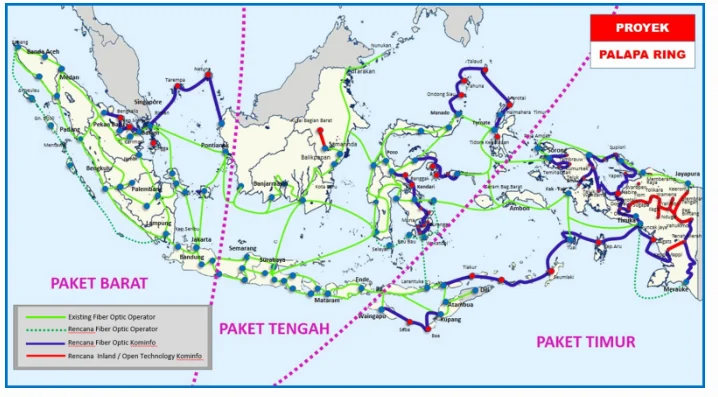
To fully appreciate the significance of this restoration, it is essential to understand the Palapa Ring project’s foundational role in Indonesia’s national digital infrastructure. Conceived as a strategic initiative to bridge the digital divide and ensure equitable internet access across the archipelago, the Palapa Ring is a sprawling national fiber optic backbone network. It comprises three main segments: Palapa Ring Barat (West), Palapa Ring Tengah (Central), and Palapa Ring Timur (East), collectively spanning over 36,000 kilometers of submarine and terrestrial fiber optic cables. The project was designed to connect 514 districts and cities throughout Indonesia, particularly focusing on underserved and remote regions, thereby fostering economic growth, improving public services, and enhancing social cohesion through digital inclusion.
The Palapa Ring Tengah segment, in particular, is pivotal for connectivity across the central and eastern parts of Indonesia, linking regions like Sulawesi, Maluku, and Papua. Its submarine cables traverse vast ocean stretches, providing high-speed, reliable internet access to island communities that would otherwise remain isolated from the global digital economy. The network’s completion marked a significant milestone in Indonesia’s ambition to become a fully digitally connected nation, laying the groundwork for advancements in e-governance, e-education, e-health, and various other digital services crucial for national development. Any disruption to such a critical artery has far-reaching implications, underscoring the urgency of BAKTI’s current restoration efforts.
Seismic Activity Triggers Cable Damage in Vital Melonguane-Morotai Segment
The damage to the Melonguane–Morotai segment of the Palapa Ring Tengah cable was not a catastrophic total severance but rather a partial break in some of its fiber optic strands. This anomaly was detected following a series of significant seismic events in the region. Plt Direktur Infrastruktur BAKTI Komdigi, Darien Aldiano, confirmed on July 23, 2026, that technical monitoring identified the anomaly after a magnitude 5.7 earthquake struck on May 26, 2026, accompanied by several other strong tremors felt in the vicinity of the Melonguane–Morotai segment. This geological context is particularly relevant given Indonesia’s location within the "Ring of Fire," a highly active seismic zone where tectonic plate movements are frequent and powerful. Submarine cables in such regions are inherently vulnerable to seismic shifts, underwater landslides, and turbidity currents triggered by earthquakes, which can exert immense stress on the cables, leading to damage.
The precise location of the damage has been pinpointed to an approximate depth of 3,400 meters, situated about 95 kilometers from the Terminal Station (TS) in Morotai. This depth presents considerable technical challenges for repair operations, requiring highly specialized equipment and expertise. While a partial fiber break might not result in a complete blackout of services, it significantly degrades network performance, leading to slower speeds, increased latency, and potential service interruptions, especially during peak usage times. This degradation can severely impact the quality of telecommunication services for the communities reliant on this segment, necessitating a swift and effective repair to prevent more extensive and prolonged service disruptions. The proactive repair strategy adopted by BAKTI is thus a preventive measure to mitigate a broader crisis, ensuring the integrity and reliability of the network before the partial damage escalates into a more severe outage.
Navigating the Depths: Complexities of Submarine Cable Repair
The restoration of a submarine cable at depths of 3,400 meters is an undertaking fraught with technical and logistical complexities. Unlike terrestrial cable repairs, which can be executed relatively quickly, deep-sea operations require highly specialized vessels, advanced robotics, and precise navigational and engineering capabilities. The "Melonguane–Morotai" repair necessitates a dedicated cable repair ship, equipped with state-of-the-art remotely operated vehicles (ROVs) capable of descending to extreme depths, locating the damaged segment, and performing intricate maneuvers to retrieve, splice, and re-lay the cable.
The process typically involves several critical stages. First, the cable repair vessel must accurately pinpoint the damage location using acoustic pinger signals emitted from the cable or through detailed bathymetric surveys. Once located, the ROV or specialized grapnel hooks are deployed to retrieve the damaged section from the seabed. The retrieved cable ends are then brought onto the deck of the repair vessel, where highly skilled technicians perform precision fiber optic splicing in a controlled, clean environment to ensure optimal signal transmission. After splicing, the repaired section is carefully re-laid onto the seabed. Weather conditions, strong underwater currents, and the sheer pressure at such depths are constant challenges that can delay operations and demand meticulous planning and execution. The collaboration among various stakeholders, including BAKTI, the Directorate General of Digital Infrastructure Komdigi, PT Len Telekomunikasi Indonesia (a state-owned enterprise with expertise in telecommunications infrastructure), PT Surveyor Indonesia (often involved in quality assurance and supervision), and local telecommunication operators, is paramount to navigate these complexities efficiently and ensure a successful restoration. This multi-agency effort underscores the national importance of the Palapa Ring and the collective commitment to its resilience.
Connectivity Crisis: Impact on North Sulawesi’s Island Communities
The partial damage to the Palapa Ring Tengah cable has had a tangible impact on telecommunication services in three key island regencies within North Sulawesi Province: Kabupaten Kepulauan Sangihe, Kabupaten Kepulauan Talaud, and Kabupaten Kepulauan Siau Tagulandang Biaro (Sitaro). These regions, characterized by their remote geographical locations and reliance on submarine cable connectivity for their digital lifeline, have experienced significant degradation in internet and communication services. For the residents of these island communities, consistent and high-quality internet access is not merely a convenience but a fundamental requirement for daily life, economic activity, and access to essential public services.

The disruption affects various critical sectors. In education, schools in these areas rely on the internet for e-learning platforms, administrative functions, and access to educational resources, all of which are hampered by slow or intermittent connectivity. Healthcare services, particularly in Puskesmas (community health centers) and hospitals, depend on stable internet for telemedicine, patient data management, and communication with referral centers. Government offices utilize the network for public services, data exchange, and administrative coordination, which become less efficient under impaired conditions. Furthermore, local businesses, from small enterprises to fisheries, depend on internet access for transactions, market information, and communication with suppliers and customers, experiencing direct economic consequences from the degradation. Social communication among families and friends, a vital aspect of island life, also suffers. Darien Aldiano expressed his sincere apologies to the affected communities, acknowledging the inconvenience and disruption caused by the incident. He reiterated BAKTI’s unwavering commitment to working diligently to restore this vital infrastructure, emphasizing the government’s dedication to ensuring quality connectivity across all corners of Indonesia.
Immediate Mitigation: SATRIA-1 Satellite Ramps Up Internet Access
Recognizing the immediate need to maintain essential digital services in the affected regions during the restoration period, BAKTI has implemented robust mitigation strategies. A key component of this plan involves optimizing 286 existing internet access points across the impacted areas by leveraging the SATRIA-1 satellite. SATRIA-1, Indonesia’s newest and most powerful communications satellite, was launched with the primary objective of providing high-speed internet access to underserved and remote regions, making it an invaluable asset in emergency situations like this.
The optimized access points are strategically located within critical public facilities to maximize their impact. These include 106 locations in Kabupaten Kepulauan Sangihe, 48 in Kabupaten Kepulauan Sitaro, and 132 in Kabupaten Kepulauan Talaud. The facilities encompass government offices, schools, community health centers (Puskesmas), hospitals, and even defense and security establishments, ensuring that core public services can continue to function. To address the increased demand and compensate for the submarine cable’s reduced capacity, BAKTI has significantly boosted the bandwidth at these satellite-powered locations. Depending on the specific needs of each site, bandwidth has been upgraded to speeds ranging from 50 Megabits per second (Mbps), 100 Mbps, up to 150 Mbps. This substantial increase in satellite capacity aims to provide a reliable interim solution, allowing essential digital communications and services to proceed with minimal disruption. BAKTI’s technical teams are also continuously monitoring the quality of these satellite-provided services, making real-time adjustments as needed to ensure that the community’s digital communication activities remain as uninterrupted as possible throughout the cable repair process. This dual-pronged approach – rapid repair of the primary infrastructure coupled with robust satellite backup – exemplifies a comprehensive disaster response strategy.
A Coordinated National Effort Towards Swift Recovery
The successful and timely restoration of the Palapa Ring Tengah segment is a testament to a highly coordinated national effort involving multiple government agencies, state-owned enterprises, and private sector partners. The detailed recovery plan was meticulously developed in collaboration with the Directorate General of Digital Infrastructure Komdigi, PT Len Telekomunikasi Indonesia, PT Surveyor Indonesia, various telecommunication operators, and other relevant stakeholders. This multi-stakeholder approach is crucial for managing the complex logistics, technical requirements, and administrative procedures associated with deep-sea cable repairs.
The critical phase of the repair operation is scheduled to commence with the departure of the specialized repair vessel from Bitung, North Sulawesi, heading towards Morotai, on July 28, 2026. This departure is contingent upon the completion of all necessary administrative documentation and securing the required sailing permits, a process that involves coordination with maritime authorities and other regulatory bodies. Once the vessel reaches the repair site, the technical process will involve a "critical service interruption period," estimated to last approximately 12 days. During this period, direct intervention on the cable will temporarily disconnect service to allow for the precision work of retrieval, splicing, and re-laying. While this temporary disruption is unavoidable, it is a necessary step towards full restoration. BAKTI has emphasized that if all phases of the operation proceed according to the meticulously laid-out plan, the Melonguane–Morotai segment of the Palapa Ring Tengah network is targeted to be fully operational and "ready for service" by August 11, 2026. This ambitious yet carefully planned timeline reflects the urgency placed on restoring full connectivity to the affected island communities.
Beyond the Repair: Strengthening Indonesia’s Digital Backbone
The incident with the Palapa Ring Tengah cable serves as a stark reminder of the inherent vulnerabilities of critical infrastructure, especially in a seismically active nation like Indonesia. While the immediate focus is on restoring the damaged segment, this event also provides valuable lessons for strengthening Indonesia’s broader digital backbone and enhancing its resilience against future natural disasters. The proactive measures taken, such as the rapid deployment and optimization of SATRIA-1 satellite services, highlight the importance of network redundancy and diverse connectivity solutions. Relying solely on a single type of infrastructure, whether submarine cables or terrestrial networks, carries significant risks, particularly in archipelagic states.
Looking ahead, the incident underscores the need for continuous investment in advanced monitoring systems for submarine cables, capable of detecting subtle anomalies before they escalate into major outages. Furthermore, exploring alternative routing options, investing in more robust cable technologies designed to withstand seismic stress, and potentially expanding satellite-based backup systems could be crucial strategies for future resilience. Indonesia’s ambitious vision for "Indonesia Emas 2045" (Golden Indonesia 2045), which heavily relies on a robust and inclusive digital economy, necessitates an infrastructure that is not only widespread but also highly resilient and adaptable to environmental challenges. The commitment demonstrated by BAKTI and its partners in this restoration effort reflects a national dedication to achieving ubiquitous and reliable connectivity, ensuring that no community, regardless of its remoteness, is left behind in the nation’s digital transformation journey. This ongoing effort to maintain and enhance the Palapa Ring network is fundamental to empowering Indonesian citizens with the tools and opportunities of the digital age.
Official Statements and Forward-Looking Commitments
In his official statement on July 23, 2026, Darien Aldiano, Acting Director of Infrastructure for BAKTI Komdigi, underscored the government’s unwavering commitment to resolving the issue swiftly. "We extend our sincerest apologies for the inconvenience experienced by the affected communities in the Sangihe, Talaud, and Sitaro Archipelagos," Aldiano stated. "We assure you that all teams are working at maximum capacity on the ground to accelerate the recovery of this vital infrastructure, striving for quality connectivity across all corners of Indonesia." This statement not only conveyed empathy but also reinforced the government’s dedication to its long-term vision of universal digital access.
The incident has also prompted discussions within Komdigi about reinforcing disaster preparedness protocols for digital infrastructure. While the Palapa Ring was designed with redundancies, the unique challenges of deep-sea repairs in active seismic zones necessitate continuous review and enhancement of response mechanisms. The collaboration between government bodies, state-owned enterprises, and private operators in this repair effort sets a precedent for how such national-scale challenges can be effectively addressed through unified action. As Indonesia continues its rapid digital transformation, the lessons learned from this event will undoubtedly contribute to building a more robust, resilient, and future-proof national telecommunications network, ensuring that the promise of digital inclusion reaches every citizen across the vast archipelago.

