
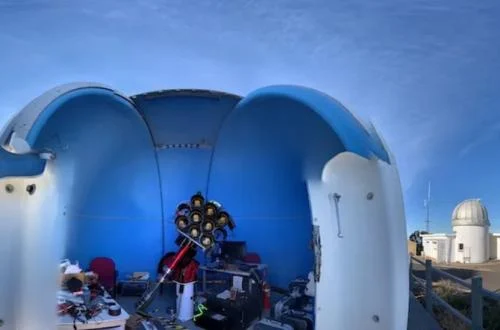
In a landmark development for the field of optical astronomy, researchers at Macquarie University in Australia have successfully pioneered a technique that allows for the precise measurement of stars, satellites, and other celestial targets during daylight hours. Utilizing the innovative Huntsman Telescope, a multi-lens array located at the Siding Spring Observatory, the team has demonstrated that the traditional limitations of ground-based astronomy—which typically restrict optical observations to the darkest hours of the night—can be overcome through sophisticated light-filtering technology and high-speed data processing. This breakthrough, recently detailed in the Publications of the Astronomical Society of Australia, opens new frontiers for continuous "24/7" monitoring of the sky, a capability that is becoming increasingly critical as the Earth’s orbit becomes more crowded with artificial satellites and debris.
The Huntsman Telescope was originally conceived and constructed to detect ultra-faint structures around distant galaxies, a task that requires extreme sensitivity to low-surface-brightness light. However, the unique architectural design of the telescope, which eschews the traditional single large mirror in favor of a "compound eye" approach, has proven unexpectedly versatile. By applying specialized broadband filters and leveraging the high-cadence imaging capabilities of its sensor array, the research team, led by Sarah Caddy, has turned the Huntsman into a tool capable of piercing through the overwhelming glare of the sun to identify stellar and man-made objects with remarkable accuracy.
The Evolution of the Huntsman Telescope and the Multi-Lens Concept
The Huntsman Telescope represents a significant departure from conventional astronomical engineering. Located at the Siding Spring Observatory near Coonabarabran, New South Wales—Australia’s premier site for optical and infrared astronomy—the facility is managed by Macquarie University’s School of Mathematical and Physical Sciences. The telescope’s design is inspired by the "Dragonfly Telephoto Array" developed in the United States, utilizing a cluster of high-quality commercial lenses rather than a single primary mirror.
Specifically, the Huntsman combines a suite of ten Canon 400mm f/2.8 L-series IS II lenses. These lenses are world-renowned for their exceptional anti-reflective coatings, which minimize "ghosting" and internal reflections—a critical requirement when attempting to observe faint objects near bright light sources. Each lens is paired with a high-performance CMOS (Complementary Metal-Oxide-Semiconductor) camera and precision astro-mechanical focusing equipment. By orienting these ten lenses to work in parallel, the Huntsman can capture a wide field of view while simultaneously gathering enough light to rival much larger, more expensive telescopes.
The transition to daytime observation was not a matter of chance but the result of rigorous testing on a "pathfinder" model—a single-lens version of the Huntsman. For several months, researchers utilized this pathfinder to calibrate exposure times and test the efficacy of various filters. The primary challenge of daytime astronomy is Rayleigh scattering, the phenomenon where sunlight is scattered by the Earth’s atmosphere, creating the bright blue sky that effectively masks the light from distant stars. To combat this, the team employed broadband filters designed to block the majority of the solar spectrum while allowing specific, high-contrast wavelengths from celestial bodies to reach the sensors.
Chronology of the Research and Key Milestones
The journey toward daytime observation capability followed a structured timeline of development and testing:
- Initial Design and Assembly (Pre-2019): Macquarie University engineers and astronomers, including Sarah Caddy, began the assembly of the Huntsman array, focusing on the integration of the Canon lens technology with astronomical-grade sensors.
- The Betelgeuse Catalyst (2019-2020): The "Great Dimming" of the red supergiant star Betelgeuse sparked a global interest in continuous stellar monitoring. Astronomers realized that gaps in data—often caused by the star being too close to the sun for nighttime observation—hindered their understanding of such volatile celestial events.
- Pathfinder Testing (2022-2023): The mini-Huntsman pathfinder was deployed to refine the daytime observation methodology. Researchers focused on managing atmospheric turbulence, which is significantly more pronounced during the day due to solar heating of the ground.
- Full Array Implementation (Late 2023): The techniques perfected on the pathfinder were applied to the full 10-lens Huntsman array. This allowed for the capture of thousands of short-exposure images per second, which are then stacked and processed to filter out noise and atmospheric distortion.
- Formal Publication (May 20, 2024): The findings were published in the Publications of the Astronomical Society of Australia, providing the scientific community with a proven framework for daytime optical astronomy.
Case Study: Monitoring the Supergiant Betelgeuse
One of the most significant applications of the Huntsman’s new capability is the monitoring of Betelgeuse, a red supergiant located approximately 650 light-years from Earth. In late 2019 and early 2020, Betelgeuse experienced a sudden and dramatic drop in brightness. While initial theories suggested the star might be on the verge of going supernova, subsequent analysis indicated that a massive ejection of surface material had formed a dust cloud, temporarily obscuring its light.
Because Betelgeuse is located near the ecliptic, there are periods each year when it is visible only during the day or when it is in close proximity to the sun from Earth’s perspective. Traditional telescopes lose sight of the star during these windows. The Huntsman’s ability to track Betelgeuse in broad daylight ensures a continuous stream of data, allowing astronomers to monitor its pulsations and brightness fluctuations without seasonal interruptions. This constant surveillance is vital for predicting the eventual supernova of such a nearby star, an event that would be visible even during the day and would provide unprecedented insights into stellar evolution.
Space Situational Awareness and Satellite Tracking
Beyond pure astrophysics, the Huntsman’s daytime capability addresses a pressing logistical challenge: Space Situational Awareness (SSA). Currently, there are approximately 10,000 active satellites in orbit around Earth. However, this number is projected to skyrocket. With the rise of "mega-constellations" like SpaceX’s Starlink and Amazon’s Project Kuiper, experts estimate that an additional 50,000 satellites could be launched into Low Earth Orbit (LEO) within the next decade.
The proliferation of satellites, combined with millions of pieces of space debris, has significantly increased the risk of orbital collisions. Such collisions can trigger the "Kessler Syndrome," a theoretical scenario where the density of objects in LEO is high enough that a single collision starts a cascade, creating more debris and rendering space activities and the use of satellites in certain orbital shells difficult for generations.
Sarah Caddy emphasized the necessity of the Huntsman’s role in this context: "With the planned launch of tens of thousands of satellites, there is a clear need for dedicated daytime and nighttime telescope networks to constantly detect and track these objects. Astronomy is no longer just about looking at distant galaxies; it is about managing the environment immediately surrounding our planet."
Daytime observation allows for the tracking of satellites during the hours when they are traditionally "invisible" to optical sensors. This provides orbital dynamics experts with more data points to refine the trajectories of satellites, thereby improving collision-avoidance maneuvers.
Technical Analysis and Future Implications
The success of the Huntsman Telescope is a testament to the power of "software-defined" astronomy. By using thousands of short exposures (often referred to as "lucky imaging" in a modified form), the system can select the frames least affected by atmospheric shimmer. When combined with the light-blocking filters, the signal from the star or satellite is isolated from the background noise of the sun-drenched sky.
This approach offers several advantages:
- Cost-Efficiency: Using mass-produced, high-end camera lenses is significantly cheaper than casting and polishing a single large mirror.
- Redundancy: In a multi-lens array, the failure of one sensor or lens does not render the entire system inoperable.
- Scalability: More lenses can be added to the array to increase light-gathering power without the exponential cost increases associated with traditional telescope scaling.
The implications for the global scientific community are profound. As Sarah Caddy noted, "Astronomy daytime is an exciting field. With advances in camera sensors, filters, and other technologies, we are seeing dramatic improvements in the sensitivity and precision achievable under clear sky conditions."
The work at Macquarie University suggests a future where a global network of multi-lens arrays could provide a seamless, 24-hour watch over the heavens. Such a network would not only advance our understanding of variable stars and transient astronomical events but would also serve as a critical defense against the growing hazards of space traffic.
Conclusion
The transformation of the Huntsman Telescope from a nighttime deep-space explorer to a versatile, around-the-clock observatory marks a pivotal moment in Australian astronomy. By bridging the gap between day and night, the researchers at Macquarie University have provided a solution to the "blind spots" that have long hampered the study of the stars and the monitoring of our own orbital backyard. As the research continues to evolve, the Huntsman stands as a model for the next generation of astronomical instruments—flexible, cost-effective, and capable of seeing what was once thought to be invisible.

