
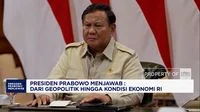
In a significant move to foster transparency and align national policy with public discourse, President Prabowo Subianto convened a high-level dialogue session in Jakarta on Thursday, September 17, 2026. This gathering, which brought together prominent figures from the Indonesian media landscape and the capital market sector, underscores a strategic shift toward an open-door policy regarding governance and economic strategy. The discussion, held at the Presidential Palace, served as a platform for candid exchanges concerning the nation’s current macroeconomic trajectory, regulatory climate, and the challenges of sustaining growth amidst global economic volatility.
The President’s guest list was meticulously curated to include influential voices capable of synthesizing complex policy decisions for the broader public. Among the attendees were Rivana Pratiwi, Deputy Editor-in-Chief of Metro TV; Andromeda Mercury, a veteran journalist from TV One; Ratna Susilowati, Director of News at Rakyat Merdeka; and Wahyu Daniel, Editor-in-Chief of CNBC Indonesia. Complementing the media contingent were figures bridging the gap between political analysis and market reality, namely veteran journalist and politician Akbar Faisal, and prominent capital market analyst Gema Goeyardi.
Contextualizing the Presidential Dialogue
The dialogue occurs at a pivotal juncture for the Indonesian administration. Since assuming office, President Prabowo has emphasized the necessity of a "collaborative presidency," where the executive branch seeks continuous feedback from various societal pillars. The inclusion of journalists and market analysts is not merely symbolic; it represents an effort to manage expectations in an era characterized by rapid digital transformation and shifting geopolitical alliances that directly impact Indonesia’s export-led economy.
For the media leaders present, the invitation provides a direct conduit to the head of state, allowing for a clearer understanding of the administration’s legislative priorities. For the capital market experts, the meeting offers a rare opportunity to discuss fiscal sustainability, foreign direct investment (FDI) trends, and the efficacy of current monetary policies.
Chronology of Consultative Governance
The current administration has established a pattern of recurring consultative sessions, a departure from the more centralized decision-making styles of previous regimes.
- Initial Transition Phase (Early 2025): The President began by prioritizing internal economic advisors, focusing on consolidating the state budget and managing post-pandemic recovery debt.
- Expansion of Dialogue (Late 2025): Recognizing the need for public buy-in on difficult fiscal reforms, the President initiated a series of "Industry Consultations," meeting with sector-specific trade associations.
- The Media and Market Nexus (2026): By September 2026, the strategy evolved into a dual-track engagement model. The current session with media and market experts represents the most recent installment of this series, aimed at ensuring that media narratives are grounded in data-driven reality while market players gain confidence in government stability.
Analytical Perspective: The Economic Landscape
To understand the weight of these discussions, one must look at the prevailing economic data. As of the third quarter of 2026, Indonesia faces a complex global environment. While inflation has remained within the central bank’s target range, the nation is grappling with the fluctuations of global commodity prices, particularly in the energy and nickel sectors—the latter being a cornerstone of Indonesia’s "downstreaming" (hilirisasi) strategy.
Market analysts, including experts such as Gema Goeyardi, have frequently pointed to the need for structural reforms that go beyond basic infrastructure development. The dialogue likely touched upon the following critical areas:
- Capital Market Depth: Increasing the number of retail investors and ensuring that the Indonesian Stock Exchange (IDX) remains attractive to international institutional investors despite regional competition.
- Fiscal Discipline: Maintaining a debt-to-GDP ratio that satisfies international credit rating agencies while continuing to fund ambitious social welfare programs.
- Regulatory Certainty: Investors have historically voiced concerns regarding the speed of legal processes and the clarity of land acquisition laws. These forums serve as a pressure valve where such concerns are voiced directly to the highest level of government.
The Role of Media in Policy Communication
The participation of seasoned journalists like Wahyu Daniel and Ratna Susilowati highlights the government’s acknowledgment of the media’s role as an intermediary between policy and public perception. In an era of rampant misinformation, the government is incentivized to provide top-tier journalists with direct access, ensuring that news reports are based on firsthand accounts rather than speculative leaks.
Journalists present at the session are expected to play a crucial role in framing the government’s narrative on topics like the transition to renewable energy and the expansion of digital infrastructure. By engaging with these media leaders, President Prabowo aims to cultivate a more nuanced public understanding of why certain reforms—some of which may be initially unpopular—are essential for long-term economic stability.
Implications for Investors and Stakeholders
The immediate implications of such meetings for the business community are significant. Investors generally favor predictability. When a head of state engages directly with market analysts, it signals that the government is listening to the "voice of the market." This can result in increased sentiment stability, which is crucial for maintaining the strength of the Indonesian Rupiah and preventing capital flight during periods of global turbulence.
Furthermore, the involvement of political commentators like Akbar Faisal suggests that the government is also focused on the political economy—the intersection where market performance meets public sentiment. Managing this balance is the primary challenge of the current administration. If the government can successfully demonstrate that its economic policies are not just for corporate benefit but are aligned with the broader prosperity of the Indonesian populace, it secures the necessary political capital to push through further reforms.
Official Responses and Expected Outcomes
While no official policy change was announced immediately following the meeting, the consensus among attendees—as inferred from prior sessions of this nature—is that the dialogue serves as a "feedback loop." The President takes note of the systemic risks identified by analysts and the public concerns raised by journalists.
Spokespersons for the administration have previously characterized these sessions as "informal but intense." By avoiding the rigid structure of formal press conferences, the President creates an environment where experts feel empowered to speak truth to power. For the media, this access provides a deeper background context that enriches their reporting, shifting the focus from mere event coverage to in-depth analytical journalism.
Broader Impact on Governance
The overarching strategy here is the institutionalization of dialogue. By hosting these sessions regularly, the President is setting a standard for his administration that prizes intelligence-gathering through direct, diverse, and expert-led interaction. This approach mitigates the risk of the "echo chamber" effect, where leaders are only exposed to the opinions of their immediate subordinates.
As Indonesia moves toward the final quarter of 2026, the success of this strategy will be measured by the administration’s ability to turn these suggestions into tangible policy outcomes. The integration of market analyst insights into the legislative agenda could, for instance, lead to more agile fiscal policies or improved transparency in the state-owned enterprise (SOE) sector.
Conclusion
The dialogue between President Prabowo Subianto and the assembly of media leaders and market analysts is a testament to the maturation of Indonesia’s political and economic governance. By bridging the divide between state leadership, the media, and the capital markets, the President is building a framework of resilience.
As the country continues to navigate the complexities of a changing global order, the reliance on informed, expert-driven counsel—and the transparent dissemination of these insights through a responsible media—will remain a cornerstone of Indonesia’s growth strategy. While the challenges ahead are formidable, the commitment to open communication suggests a government that is not only aware of the obstacles but is actively engaging the best minds in the country to overcome them. The future of the Indonesian economy, therefore, rests not just on the strength of its commodities or the size of its population, but on the effectiveness of these institutional dialogues in shaping a coherent, forward-looking national strategy.

